Research — Aug 28, 2026
Growth expectations soften but remain positive among US bankers: S&P survey
By Ayesha Shahbaz and Xylex Mangulabnan
A majority of US bankers expect deposits and loans to grow over the next 12 months, though optimism eased from the prior quarter amid economic uncertainty. The softer sentiment comes despite continued growth in both industrywide deposits and loans during the first quarter.

➤ A majority of bankers still expect deposits and loans to grow over the next 12 months, although growth expectations softened from the prior survey.
➤ Credit quality concerns remained concentrated in auto and credit card portfolios despite resilient industry performance.
➤ Banks remain more inclined to be acquirers than sellers as M&A execution improves and consolidation activity continues.
➤ AI and fintech partnerships continue to gain traction, while stablecoins and open banking remain lower-priority initiatives.

Deposit growth and funding
Expectations for deposit growth remained strong despite a modest sequential decline. In the first-quarter 2026 survey, 78.9% of respondents expect total deposits to increase over the next 12 months, down from 82.7% in the fourth-quarter 2025 survey.
The outlook comes as deposit balances increased across the banking industry during the first quarter.
Bankers appear less confident in the composition of future deposit growth. Although most respondents expect total deposits to increase, 22.2% foresee declines in consumer deposits over the next 12 months, up from 19.4% in the prior quarter. The same share expects lower wholesale or brokered deposits, highlighting continued competition for funding.
Loan growth and credit quality concerns
Loan growth expectations followed a similar pattern to deposits. The share of respondents anticipating higher loan balances over the next year fell to 78.5% from 84.9% in the prior survey. While recent industry trends point to strengthening loan growth, the decline in survey optimism suggests some bankers are becoming more cautious about how long that momentum can be sustained.
Personal automobile and credit card loans remained the primary areas of credit quality concern.
The share of respondents expecting deterioration in auto loans increased 4.5 percentage points from the prior survey, despite improving industrywide delinquency trends during the first quarter. Similarly, expectations for weaker credit card performance rose 4.6 percentage points even as industry metrics remained resilient.
M&A outlook
Bank M&A is becoming easier to execute under the second Trump administration, with the median deal closing time falling to 94 days for transactions announced in 2026. Against that backdrop, respondents were considerably more likely to view their organization as a potential acquirer than a seller over the next 12 months.
About 34.7% of bankers said their organization was either somewhat or very likely to pursue an acquisition, compared with 9.9% who indicated they were likely to consider a sale.
Deal activity has remained robust as well. Through mid-July, banks announced 89 transactions with an aggregate value of $19.83 billion, underscoring continued interest in consolidation and scale-driven growth.
Interest rate outlook
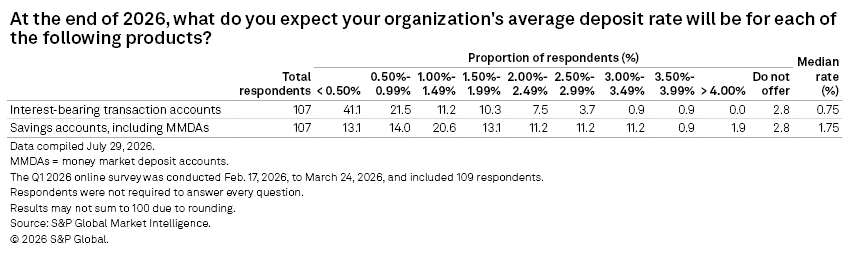
At the end of 2026, respondents expect median rates of 0.75% on interest-bearing transaction accounts and 1.75% on savings accounts, including money market deposit accounts.
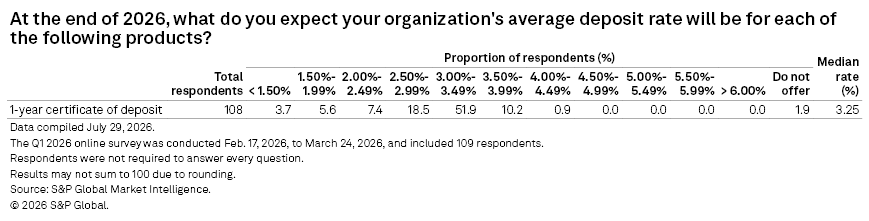
The median year-end 2026 rate forecast for one-year certificates of deposit is 3.25%.
Fintech adoption and partnerships
The survey highlighted a mixed approach to fintech adoption. AI and instant payments have gained considerably more traction than open banking, which remains a lower priority for many institutions.
Among the 102 respondents, 69.6% said their organization has either already adopted AI or plans to do so within the next 12 months.
As banks expand their use of emerging technologies, many are also looking outside their organizations for additional capabilities. More than half of respondents said their institution is likely to partner with a new fintech vendor over the next 12 months. Fraud detection and prevention emerged as the top area for prospective fintech partnerships, followed by lending technologies and services, and data platforms and analytics.
The appetite for fintech partnerships did not fully extend to digital assets. Stablecoin adoption remained limited, with 42% of respondents indicating their organization had not yet formed a clear view on the technology.
Meanwhile, 41% reported that their organization is monitoring regulatory developments and market activity related to stablecoins.
Economic outlook
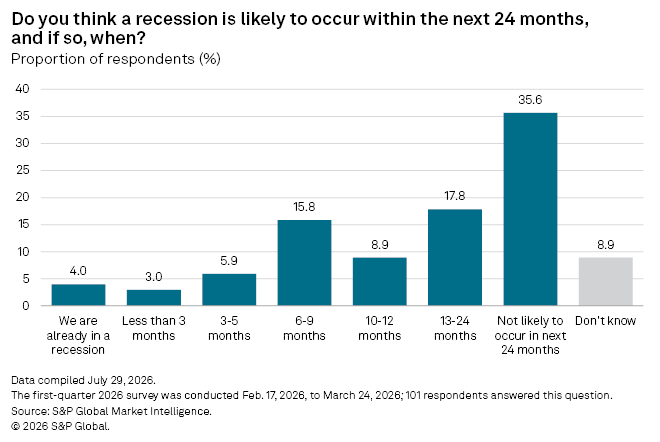
Despite expectations for continued growth in deposits and loans, recession concerns remain in the background. While 35.6% of respondents said a recession is unlikely over the next 24 months, a combined 33.6% still expect a downturn to materialize within the next year, highlighting a degree of caution beneath an otherwise constructive outlook.

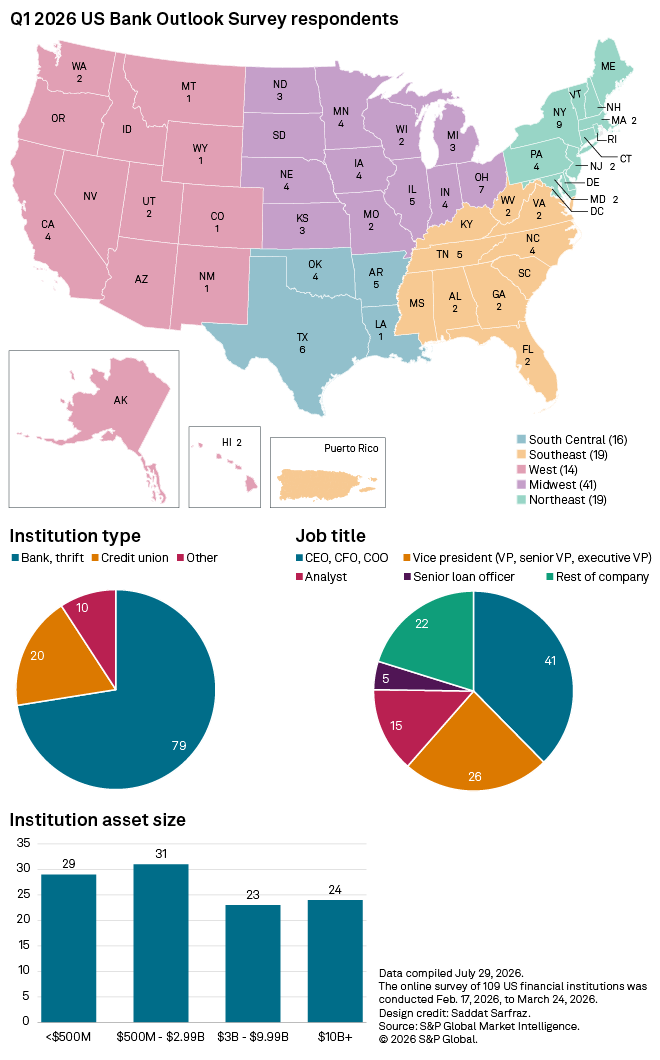
S&P Global Market Intelligence surveyed 109 US financial institution clients on various topics, including expected loan and deposit growth and credit quality trends. Of the 109 participants, 79 worked for commercial banks or thrifts, 20 for credit unions, two for investment banks, and eight for other US institutions.
The online survey was conducted between Feb. 17 and March 24, 2026.
The margin of error for topline statistics is +/- 9 points at the 95% confidence lrvey.
If you would like to participate in future US banking surveys, please contact xylex.mangulabnan@spglobal.com or ayesha.shahbaz@spglobal.com.
This article was published by S&P Global Market Intelligence and not by S&P Global Ratings, which is a separately managed division of S&P Global.
Content Type
Theme
Products & Offerings
Segment
Language