ECONOMICS COMMENTARY — 07 Aug, 2026
Global outlook marred by further slide in emerging market business confidence

As well as tracking current business metrics, PMI surveys monitor business sentiment via firms’ future output expectations. The data show that business confidence improved in July from May’s recent low, but remains worryingly subdued by historical standards.
Concerns over the Middle East conflict, US tariff policy and the war in Ukraine continue to weigh on sentiment. Confidence varies, however: while developed markets have seen a clearer revival in growth expectations from the lows seen earlier in the year, emerging market optimism has weakened sharply again in July, running at one of the lowest levels recorded by the surveys. Mainland China, Russia and Brazil report especially low confidence, while India’s improvement seen earlier in the year faded.
Tracking business sentiment as well as actual current conditions
The worldwide Purchasing Managers’ Index™ (PMI) surveys compiled by S&P Global Market Intelligence ask for factual information from companies relating to metrics such as output, prices, employment and inventories. However, the surveys also include a single sentiment-based question asking about companies’ expected output in the next 12 months. For this index, a level of 50 signals no expected change in output over the coming year. Readings above 50 signal an expectation of growth while readings below 50 indicate an expected contraction.
This subjective question adds much colour to the PMI surveys, providing companies with a means of expressing their confidence in their outlooks against actual current business conditions. The accompanying comments from survey participants add deeper insight into which factors are expected to drive growth, or dampen business conditions, in the coming months.
Confidence improves from recent lows
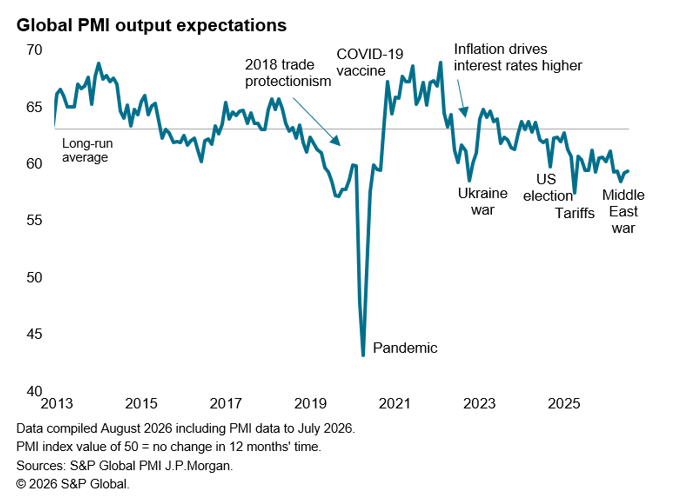
Globally, these future output expectations picked up further from a low seen back in May, when the conflict in the Middle East appears to have had its most damaging effect on the business mood. However, June and July have seen an easing of concerns over the impact of the war on prices and supply chains, notably in relation to energy, which has helped alleviate some of the business gloom.
Growth expectations nonetheless remain well below the survey’s long-run average, hinting at sub-par optimism. While in part reflecting a sustained widespread concern over the negative impact of the war in the Middle East, this low confidence also reflects other factors that have dampened sentiment in prior months, notably the uncertainty caused by US policy, especially in relation to tariffs, and the ongoing war in Ukraine. Since the outbreak of the Middle East war, global business confidence is clearly running not just below its long-run average, but close to all-time lows.
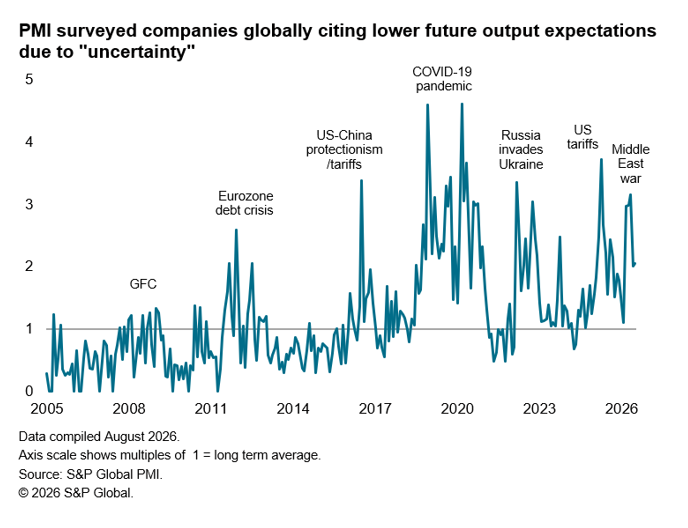
When we analyse the reasons for low growth expectations, a stand-out factor is widespread “uncertainty”, the tracking of the word having spiked higher early in the war in the Middle East and remaining very elevated into July.
Emerging market sentiment near all-time low
Most striking is the divergence between developed and emerging markets. Whereas confidence revived further in the developed economies on average during July, reaching its highest since the outbreak of the war in February, confidence slipped to its lowest on record in the emerging markets if the height of the pandemic is excluded.
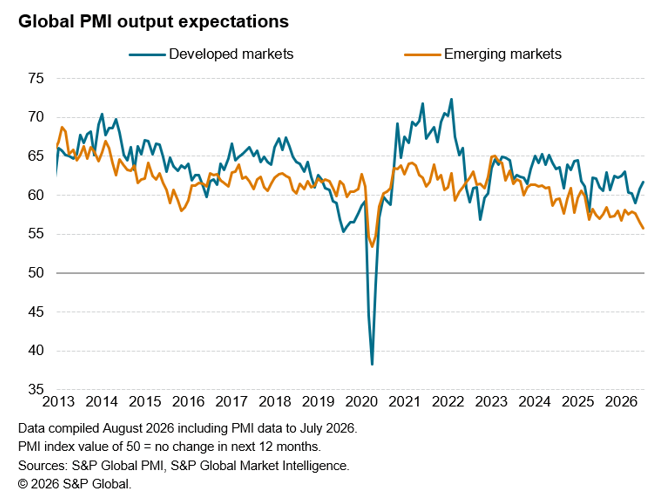
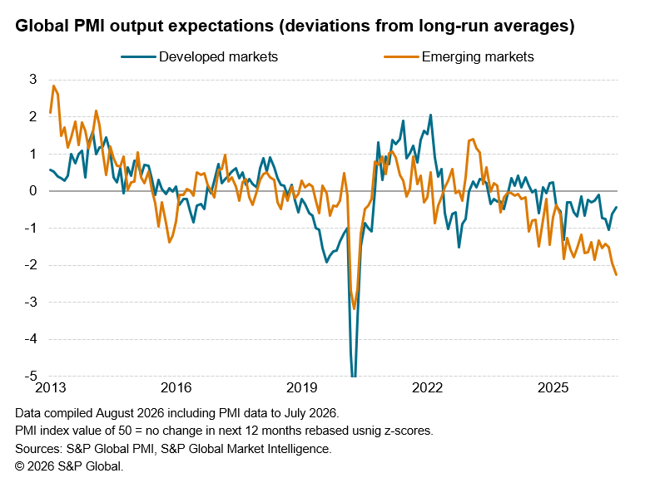
However, we can see that business confidence in the emerging markets typically runs below that of the developed markets. Hence it is useful to standardise the series by looking at how each tends to deviate from its long-run average. This analysis shows us that expectations in both developed and emerging markets are running below their long-run means, though clearly the emerging markets are seeing a far greater lack of optimism than their developed world counterparts.
Confidence lowest in mainland China
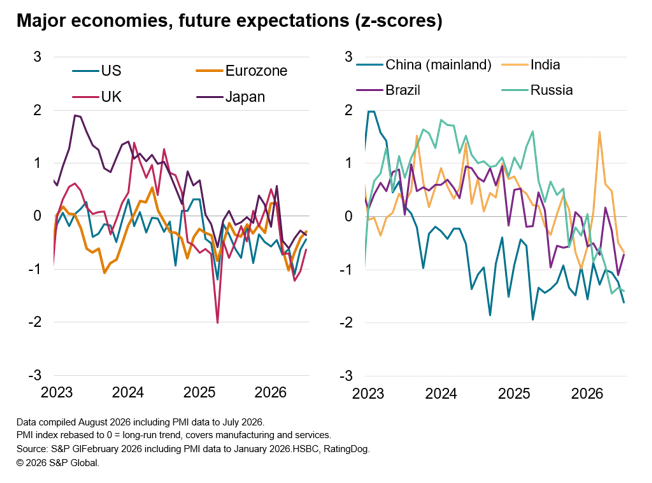
Looking deeper into sentiment among the major economies, we again use comparisons based on deviations from long-run averages to standardise the data to allow for cultural variations in sentiment.
We can see that business growth expectations have revived among all the major advanced economies from the lows seen following the outbreak of the war in the Middle East, though in all cases sentiment remains below long-run averages, highlighting lingering uncertainty and caution. UK sentiment remained the weakest relative to its long-run average, with changing domestic politics adding to business headwinds, followed by the US. By a small margin, eurozone optimism was the highest relative to its average.
Sentiment also remained below long-run averages across all the major emerging markets. India’s surge in confidence seen earlier in the year faded further in July, down to one of its lowest levels over the past four years. Mainland China sentiment also slipped, hitting a 15-month low and one of the lowest levels on record, with near-historical lows also seen in Russia in recent months. While sentiment improved in Brazil, it remains among the lowest seen for a decade, bar the pandemic.
Access the latest global PMI press release here.
© 2026, S&P Global. All rights reserved. Reproduction in whole or in part without permission is prohibited.
Purchasing Managers' Index™ (PMI®) data are compiled by S&P Global for more than 40 economies worldwide. The monthly data are derived from surveys of senior executives at private sector companies, and are available only via subscription. The PMI dataset features a headline number, which indicates the overall health of an economy, and sub-indices, which provide insights into other key economic drivers such as GDP, inflation, exports, capacity utilization, employment and inventories. The PMI data are used by financial and corporate professionals to better understand where economies and markets are headed, and to uncover opportunities.
Read our latest PMI commentary here.
This article was published by S&P Global Market Intelligence and not by S&P Global Ratings, which is a separately managed division of S&P Global.
Theme
Location
Products & Offerings