ECONOMICS COMMENTARY — 06 Aug, 2026
Global economic upturn led by advanced economies as emerging market expansion fades

PMI survey data from S&P Global showed worldwide economic growth strengthening in July, but the improvement was driven chiefly by advanced economies as emerging market momentum faded. Developed markets reported one of the fastest expansions recorded over the past two years, seeing a broad-based upturn amid stronger services activity and firmer technology and machinery output. By contrast, emerging markets recorded broad-based weakness, led by slower growth in India and mainland China alongside contractions in Brazil and Russia, linked widely to the rising cost of living.
Advanced economies outpace emerging markets
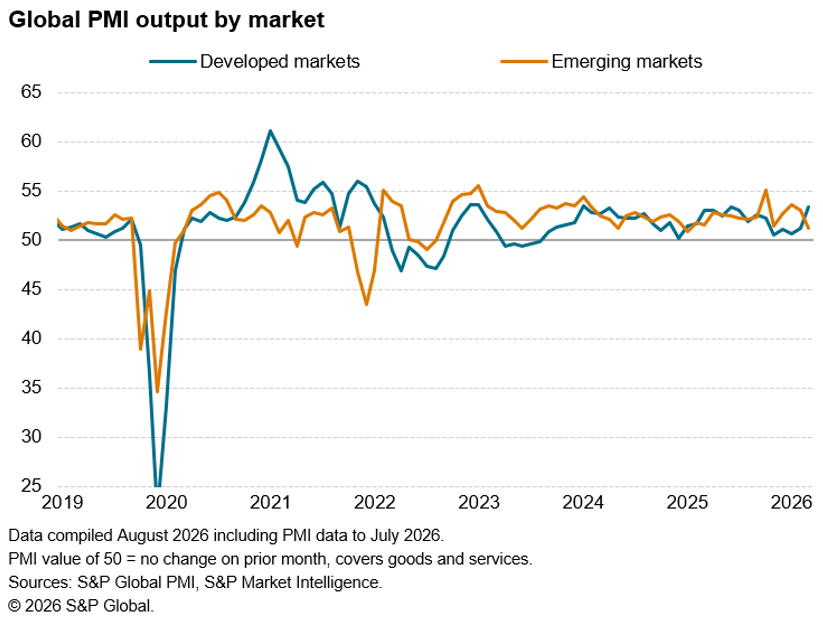
While the J.P. Morgan Global Composite PMI Output Index ticked higher for a fourth successive month in July, up from 52.0 in June to 52.6, the improvement masked a variation in trends between advanced and emerging markets.
Whereas emerging markets had fared better than advanced economies in prior months, the situation reversed in July.
Output growth across the advanced economies accelerated in July to the joint-fastest in over two years. Emerging markets meanwhile saw growth slip to a 14-month low, underperforming the advanced economies for the first time in six months and in marked contrast to the near-three-year high seen back in February.
Diverging trends fuelled by services and equipment spending
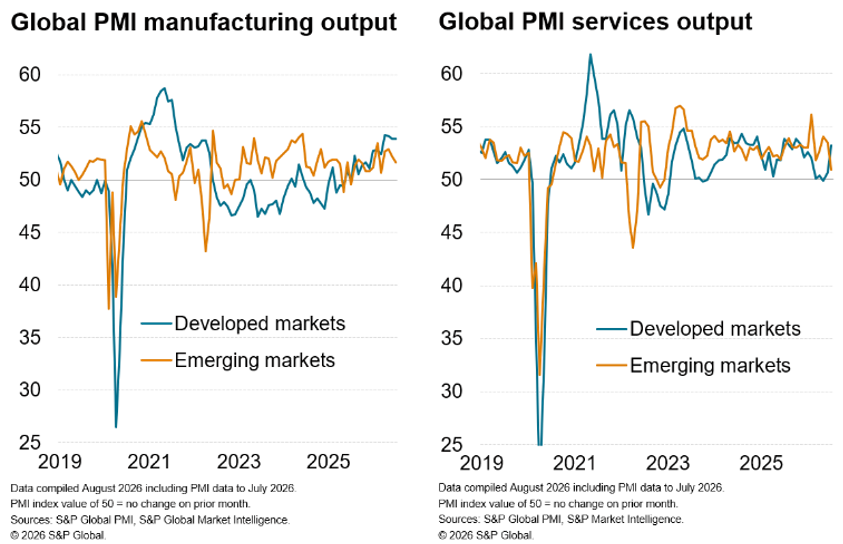
Developed economies suffered disproportionately from reduced consumer spending on services amid the escalating conflict in the Middle East, which hit travel, tourism and recreational spending. However an easing of geopolitical tensions in the Gulf in June and through much of July’s survey data collection period saw a return to growth for services in advanced economies, while the output trend slowed sharply in emerging markets.
Whereas services activity in advanced economies grew at a rate not beaten for eight months in July, services activity in emerging markets grew at the slowest rate since December 2022, often linked to high prices for fuel, energy and food squeezing discretionary spending power.
A caveat here is that, in some developed economies – notably the US, which hosted the FIFA World Cup and US250 celebrations – July also saw service spending buoyed by temporary factors and sunnier-than-usual weather in many economies. Some of this spending may therefore moderate in the coming months.
While both advanced and emerging economies saw manufacturing growth moderate in July on the back of reduced precautionary inventory building, some additional support came to developed markets from greater defense spending by governments, notably in the US and Europe, as well as higher AI-related investment spending. Technology and machinery & equipment manufacturing were two of the three fastest-growing sectors globally in July [link].
US leads advanced economies
The upturn in developed world growth reflected a largely broad-based improvement.
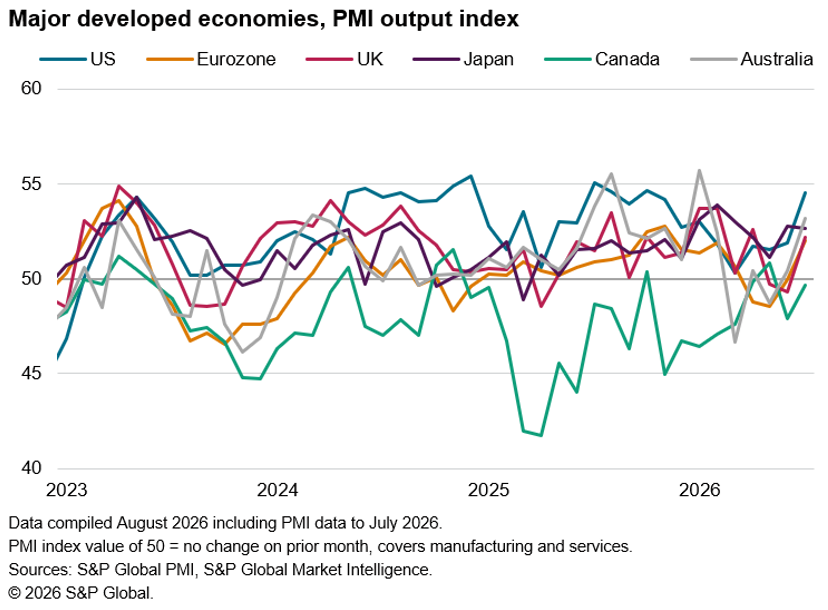
A surge in service sector growth offset a cooling manufacturing sector to push the US expansion to its sharpest since last October, outpacing all other major advanced economies.
However, notable growth was also seen in Australia, the UK and the eurozone. Australia's expansion was the strongest since January, with manufacturing output broadly stabilising after five months of decline alongside improved services growth. The UK meanwhile returned to growth after two months of decline in a broad-based upturn. The eurozone’s upturn also represented a return to growth for the first time in four months, and was the best performance since last November as a revival of services growth was accompanied by a jump in factory output.
While Japan’s upturn lost fractional momentum, its rate of growth remained elevated by recent standards (it had led the advanced economies in June), as a booming manufacturing sector offset a weakening of growth in the service sector.
That left Canada as the only major advanced economy reporting a decline (barring France, which reported a small contraction within the eurozone). However, Canada’s contraction eased to only a very modest pace.
Emerging markets show across-the-board weakness
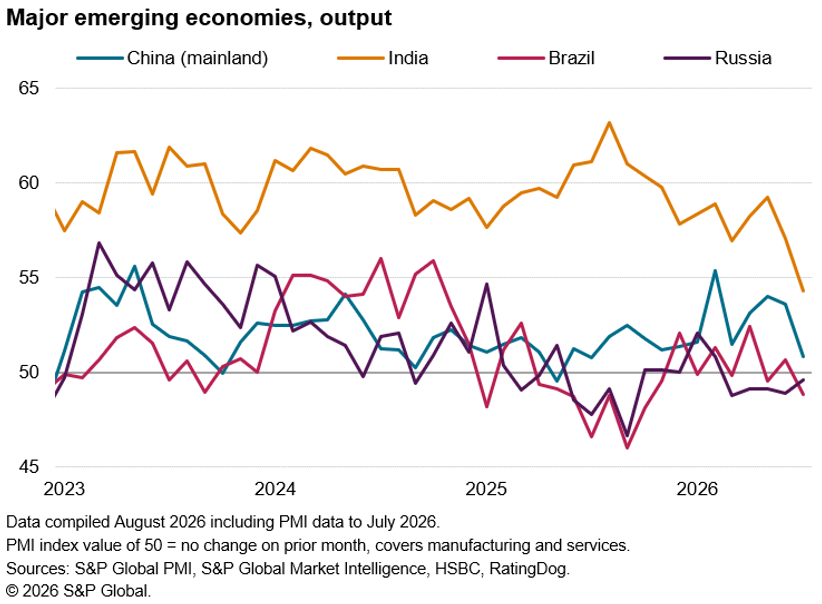
Just as July’s improvement in performance among advanced economies was broad-based, weakness in emerging markets was seen in all major markets.
While India remained the best performer among the four largest emerging economies, its growth rate sank to the weakest since March 2022. Service sector growth slowed especially sharply, though manufacturing also lost momentum compared with earlier in the year.
Growth likewise deteriorated in mainland China, slipping to a one-year low. Manufacturing growth hit a four-month low while the service sector came close to stalling, reporting its worst performance since September 2024 to strike a marked contrast to the robust expansions seen throughout the second quarter.
Brazil meanwhile fell into contraction, reporting its steepest downturn since last October. An especially sharp drop in factory output was accompanied by the first decline in services activity in nine months.
Russian output fell for a fifth successive month, albeit with the decline easing thanks to a small upturn in factory output and a reduced rate of service sector contraction.
© 2026, S&P Global. All rights reserved. Reproduction in whole or in part without permission is prohibited.
Purchasing Managers' Index™ (PMI®) data are compiled by S&P Global for more than 40 economies worldwide. The monthly data are derived from surveys of senior executives at private sector companies, and are available only via subscription. The PMI dataset features a headline number, which indicates the overall health of an economy, and sub-indices, which provide insights into other key economic drivers such as GDP, inflation, exports, capacity utilization, employment and inventories. The PMI data are used by financial and corporate professionals to better understand where economies and markets are headed, and to uncover opportunities.
Read our latest PMI commentary here.
This article was published by S&P Global Market Intelligence and not by S&P Global Ratings, which is a separately managed division of S&P Global.
Theme
Location
Products & Offerings