ECONOMICS COMMENTARY — 18 Aug, 2026
Czech manufacturing sector reports surge in exports, but cost considerations cause employment to fall

By Sian Jones
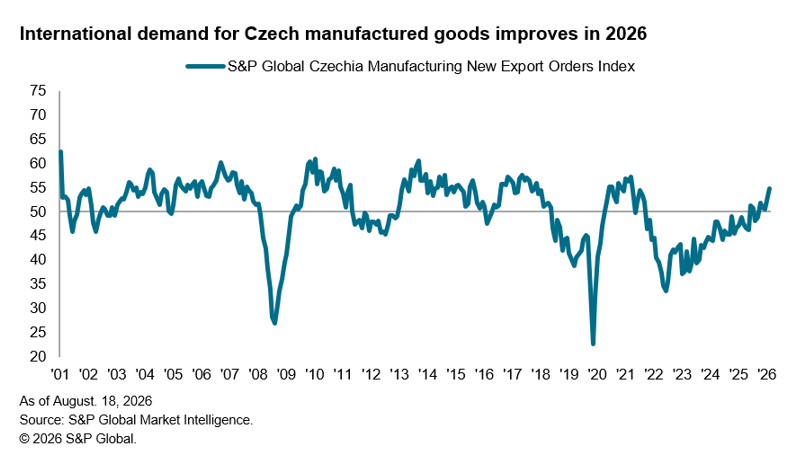
July PMI data signalled further growth in the Czech manufacturing sector. Although rates of expansion in output and new sales eased, there were positives to be taken from the strongest rise in new export orders since August 2021.
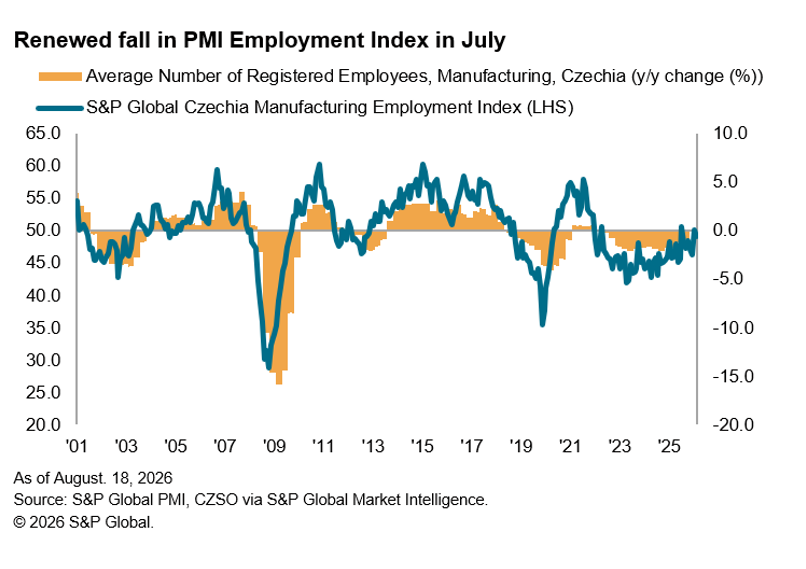
Underlying data, however, indicated that still elevated increases in input prices and squeezed margins pushed firms further towards retrenchment mode and raising productivity. Manufacturers hence resumed job shedding after a brief pause in June, despite the sustained expansion of production and orders.
Softer rise in costs, but firms hesitant to hire in July
The Czech manufacturing sector has enjoyed its best growth spell for four years so far in 2026, linked to export demand reaching its highest since 2021, but factories have also seen a substantial rise in input prices in recent months, according to PMI survey data from S&P Global.
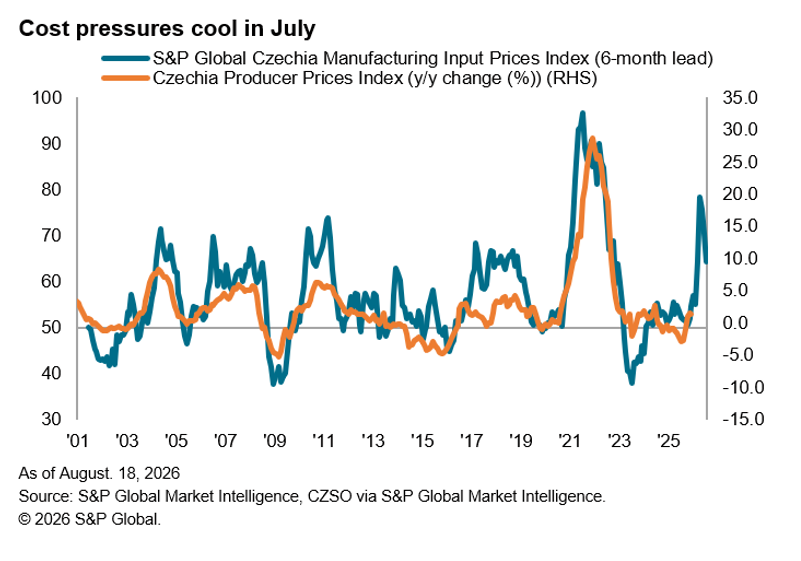
The rate of inflation in operating expenses in the goods-producing economy reached a recent peak in April 2026, attributed by producers to the war in the Middle East and subsequent spikes in fuel, energy and raw material costs, but has cooled consistently since. The latest (July) rise in cost burdens was the softest since March. Nonetheless, the rate of input price inflation is still well above the long-run series average, causing firms to grapple with squeezed margins and strained balance sheets.
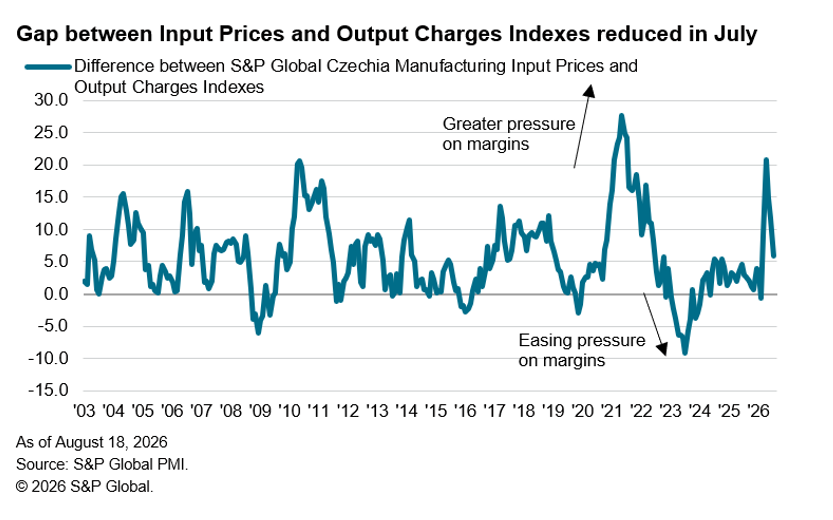
In fact, with the exception of the period March-July 2021 when companies were dealing with significant supply shortages and marked demand for items following the COVID-19 lockdowns, the gap between the PMI’s seasonally adjusted Input Prices and Output Charges Index was the largest on record in April. The gap has been closing in the months since, but this sustained strain on margins has bled into company decisions on spending. Although input buying continued to expand, purchasing activity grew at the slowest pace in five months in July, and only marginally as firms pulled back on a recent surge in precautionary stock building due to cost considerations.
Meanwhile, cost-cutting initiatives and efforts to optimise production processes were listed by panellists as key factors driving a fresh decline in workforce numbers at the start of the third quarter. The latest instance of job shedding resumed the trend of lower staffing levels seen throughout the majority of the last three years. In fact, in the recently published S&P Global Czechia Outlook report, companies in the manufacturing sector signalled more downbeat expectations regarding hiring in the coming 12 months, as shortages of skilled staff and hikes in wage bills dampened employment intentions.
Headwinds to the outlook remain, as business confidence ticked lower in July
Despite more positive demand conditions in recent months, there remain significant headwinds to the progress of the Czech manufacturing sector through the rest of 2026. Although rates of inflation have cooled from the highs seen at the start of the war in the Middle East, paces of increase are still well above their respective averages.
For manufacturing sectors which have a large reliance on energy, heavy machinery and commodities, such as that in Czechia, heightened cost pressures are unlikely to dissipate fully given the current geopolitical landscape. According to July PMI data, suppliers’ delivery times also remain more elevated than seen historically, as shortages continue to be noted for items including metals, chemicals and plastics.
Subsequently, Czech goods producers were less confident in the outlook for output in the coming 12 months during July. Although above the series average, the Future Output Index – the only sentiment-based indicator covered by PMI data – dipped for the second month running. Concerns raised by companies largely revolved around customer hesitancy as the war in the Middle East continues and high costs, with many foreseeing these headwinds persisting or even worsening as the year progresses.
© 2026, S&P Global. All rights reserved. Reproduction in whole or in part without permission is prohibited.
Purchasing Managers' Index™ (PMI®) data are compiled by S&P Global for more than 40 economies worldwide. The monthly data are derived from surveys of senior executives at private sector companies, and are available only via subscription. The PMI dataset features a headline number, which indicates the overall health of an economy, and sub-indices, which provide insights into other key economic drivers such as GDP, inflation, exports, capacity utilization, employment and inventories. The PMI data are used by financial and corporate professionals to better understand where economies and markets are headed, and to uncover opportunities.
Read our latest PMI commentary here.
This article was published by S&P Global Market Intelligence and not by S&P Global Ratings, which is a separately managed division of S&P Global.
Theme
Location
Products & Offerings