Research — Aug 20, 2026
Consensus price forecasts – Economics, fundamentals lift metals in July

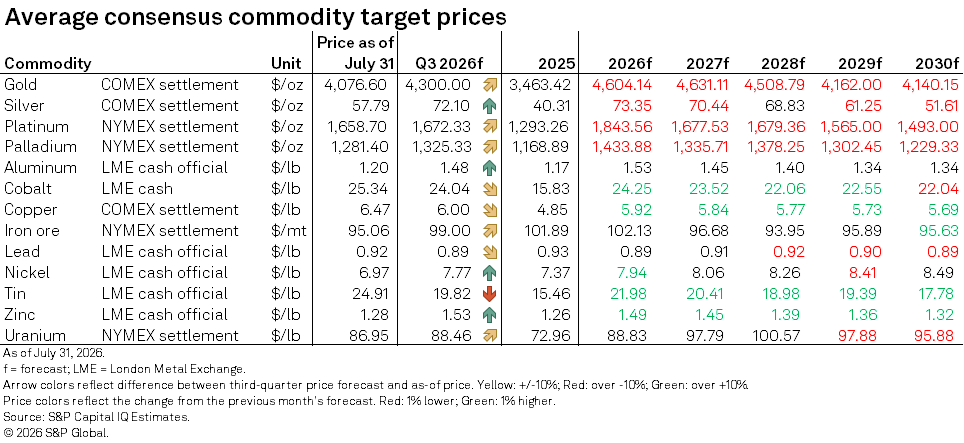
S&P Global Energy discusses consensus price forecasts for industrial and precious metals, including platinum group metals, amid broader market trends. The consensus target prices represent the average of broker estimates for each commodity for a given period, as compiled by S&P Capital IQ.
Access the databook.
See S&P Global Energy's most recent market outlooks for aluminum, copper, gold, iron ore, lithium and cobalt, nickel and zinc.

July's metals outlook reflects a fragile macroeconomic backdrop, with the US-Israel war with Iran still at the fore and risks of inflation ever-present, even though major central banks held rates steady at their latest policy meetings during the month. Fundamentals were broadly supportive but uneven across our metals market coverage: Notably, tight supply and firm demand provided support to copper and zinc, while higher-for-longer rate expectations have displaced safe-haven demand for gold.

Oil was flowing through the Strait of Hormuz into July following a ceasefire between the US and Iran, but as the truce quickly unraveled, the effects of renewed disruptions once again spilled over into energy, inflation and financial markets. The conflict remained a key driver of investor sentiment, fueling concerns over both supply disruptions and slowing demand across many commodities and driving rallies whenever prospects for a pause in hostilities improved.
The energy shock continued to complicate the inflation outlook in many major economies. Nevertheless, three major institutions — the US Federal Reserve, the Bank of England and the European Central Bank — kept their benchmark interest rates intact at their July meetings. In Japan, authorities addressed renewed yen weakness against the US dollar through official intervention in currency markets late in the month but also maintained interest rates at current levels.
Metals markets generally rebounded in July, with most ending the month higher than they began. The drivers were diverse, though many still hinged on the ripple effects of the war: Aluminum and zinc were supported by rising energy prices that threatened supply by elevating production costs; gold ceased to benefit from safe-haven demand and became hampered by the opportunity cost of being a non-yielding asset. Overall, demand for base and industrial metals remained surprisingly steady, supported by mostly expanding manufacturing activity in July.
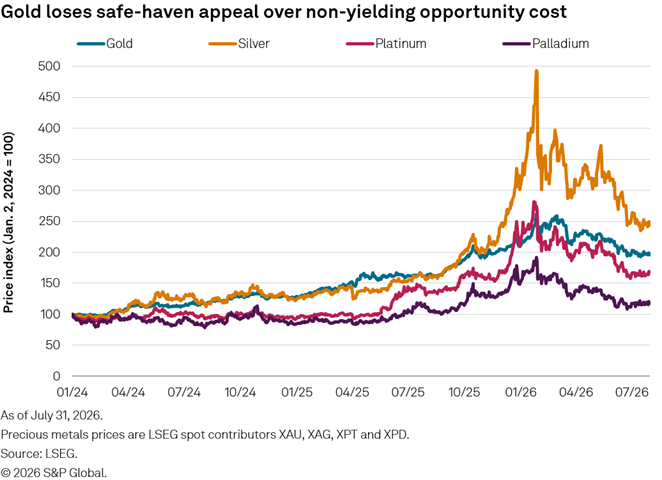
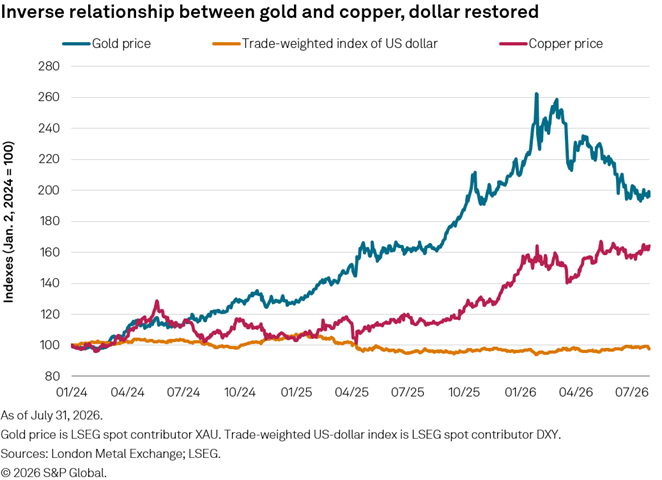
Gold traded largely sideways in July, with the COMEX price averaging $4,071 per ounce in the month, even as it briefly sank below the $4,000/oz threshold on July 16. This eight-month low reflects waning safe-haven demand amid the US-Israel war with Iran, with gold responding instead to the strengthening US dollar and rising Treasury yields in line with its typical inverse relationship. Prices found support when inflation data cooled and rate-hike expectations eased but came under pressure as labor-market data reinforced the likelihood of higher-for-longer interest rates. As prospects of another bull run fade, consensus price forecasts have been revised down by 3.1% annually through 2030, although $4,000/oz remains the floor.
Silver prices remained within a band of less than $10/oz in July, as investors balanced persistent physical-market deficits and safe-haven demand against higher-for-longer US interest rates and softer activity in some industrial sectors. The traditional distinction between silver's investment and industrial roles is becoming increasingly blurred, with the two narratives working to reinforce each other. Many investors now view silver not as a choice between growth and safe-haven exposure, but as one of the few assets that offer both simultaneously. Structural demand from AI infrastructure, electronics and electrification is poised to grow amid yet another year of physical silver deficit. Although consensus price targets have been revised downward for each year of the forecast horizon, the price is expected to remain well above the 2025 average of $40.31/oz.
The platinum and palladium markets experienced significant volatility in July, although prices were rangebound overall. Fundamentals favored platinum as the demand narrative for the two metals further diverged. Robust and diversifying industrial demand — especially in green hydrogen chemistry and advanced manufacturing — supported platinum. Despite ongoing mine constraints, palladium remained weighed down by declining production of internal combustion engine cars and rising recycling of existing vehicular catalytic converters. While consensus price forecasts were lowered for both metals across the forecast horizon, the differing market sentiment was evident: an annual average downgrade of 4.5% for platinum versus 6.6% for palladium.
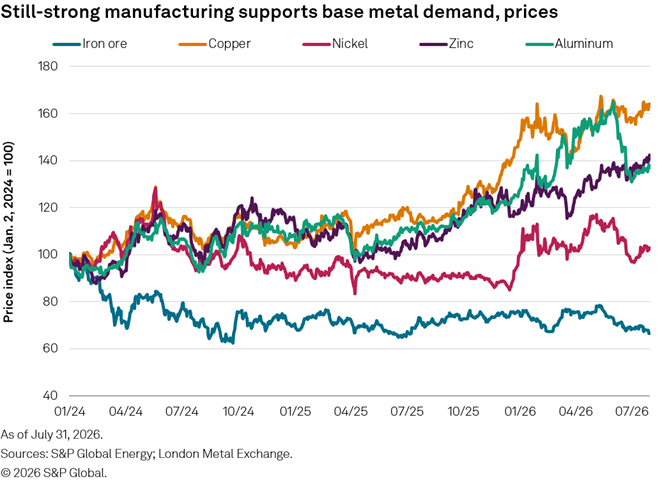
On July 2, the London Metal Exchange (LME) aluminum price touched a low of $3,061.50/metric ton, a level unseen since the onset of the war in the Middle East, and a sharp pullback from the peak one month prior. While the price recovered slightly to close the month near $3,200/mt, supply relief from a faster-than-expected ramp-up at Emirates Global Aluminium PJSC's damaged Al Taweelah smelter in the United Arab Emirates helped ease concerns over further disruptions, despite a return to hostilities. Further supply growth will come from China, Indonesia and Venezuela, where the aluminum industry is reviving. While demand has held steady in Japan and the US, concerns are emerging about the impact of the US' 50% import tariff policy. With expectations of a record deficit this year, the consensus price is forecast to peak in 2026 at $3,364.45/mt before retreating as the supply deficit withers over the next few years.
The LME copper price also rebounded from a recent low to reach $13,895/mt on July 22, driven by doubly positive fundamentals — robust demand, especially from China, and tight supply, including scrap. Prices were further supported by the expected status quo on interest rate hikes in the US. Inventories ticked up in July on the COMEX to a record 700,953 mt, while falling on the Shanghai Futures Exchange and LME, nevertheless maintaining a positive arbitrage window that has been supporting cathode imports into China. The concentrate market is tightening as solvent extraction-electrowinning operations reduce utilization rates due to war-induced shortages of sulfuric acid. This has also made for record-low spot treatment charges (TCs) and is expected to drive smelter cutbacks in the second half. Driven by strong demand from the energy and AI sectors, consensus price forecasts have been increased by an average of 2.8% annually through 2030 — the largest upward revision among the metals covered in this month's report.
The LME nickel price went through the same roller coaster in July, dipping to a six-month low of $16,070/mt on July 2 before rebounding to close the month at $17,100/mt. Prices were initially pressured by rumors that Indonesia would loosen its nickel ore mining quotas, but were later supported as those rumors were disproven by the Ministry of Energy and Mineral Resources. While the quotas have been maintained, risks remain to overall output because of constrained sulfur availability. This will continue to provide some support to prices, which are still capped by the ongoing market surplus. However, the tide is expected to turn, with the market shifting into deficit in 2028. While consensus forecasts still point to rising prices through 2030, price targets for 2027 onward have been downgraded.
The rally that drove the LME zinc price to a four-year high of $3,710.50/mt on the last trading day of July was driven by threats to sulfur availability following a fire at the sulfuric acid plant of Young Poong Corp.'s zinc smelter in South Korea, multiyear low inventories and negative TCs. Mine suspensions in China are contributing to the raw material shortage pressuring TCs and refined production growth this year, making for a positive price outlook supported by a projected short-term refined market deficit. Accordingly, consensus forecasts have been upgraded across the entire horizon by an annual average of 2.5%.
The price expectations for cobalt were similarly lifted through 2029, rounding up the three highest target upgrades, although prices are still expected to decline from their 2026 average. Throughout July, sluggish demand from the battery sector — where other chemistries are being favored and recycling activity continues to intensify — failed to counter supply concerns from Democratic Republic of Congo, where unused export quotas are revoked and reassigned to the strategic quota pool. Further, the restart of Ambatovy in Madagascar will add to available raw material supply. This has pressured the European cobalt price, which had edged down to $26.30 per pound by the last trading day of July. Consensus expectations are for an annual average of $24.25/lb in 2026.
Iron ore prices also fell in July, with the Platts-assessed 61% Fe iron ore (IODEX) benchmark settling below $100/dry metric ton during the month. Platts is part of S&P Global Energy. This was largely a response to a tepid steel market that is curbing demand for iron ore, while seaborne trade recovered from weather-related and operational disruptions. With the steel market further entering a seasonal slowdown in July and August alongside planned mill maintenance, demand for iron ore will remain flat — and so should the price. Consensus expectations have been almost constant month over month, with target prices adjusted by less than 1%, in either direction, through 2029.
For questions or more information, please contact:
Aude Marjolin, Principal Analyst, Metals and Mining Research, aude.marjolin@spglobal.com.
S&P Global Energy produces content for distribution on S&P Capital IQ Pro.
This article was published by S&P Global Market Intelligence and not by S&P Global Ratings, which is a separately managed division of S&P Global.