Research — Aug 20, 2026
Asia’s digital economy benefits from the continued shift to online buying

By Keith Nissen
Survey results show the shift toward more online buying continued over the past year in China, South Korea and India. China has the most online-centric buyers, while the majority of consumers in India still prefer shopping at retail stores.

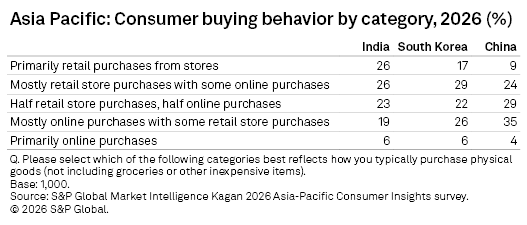
➤ In China, 39% buy mostly or primarily from online sources, while 52% of consumers in India said they shop predominantly at retail stores.
➤ Approximately half of consumers in India and China indicated they are making more online purchases this year than in 2025. The shift to online buying is more moderate in South Korea.
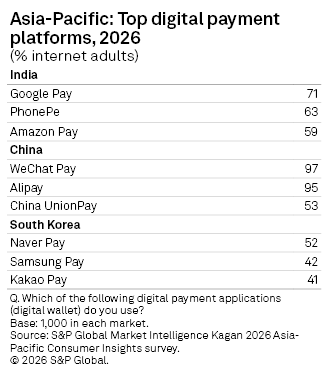
➤ WeChat Pay and Alipay are the top two digital payment services in China. GooglePay is tops in India, with the majority of South Koreans using Naver Pay.
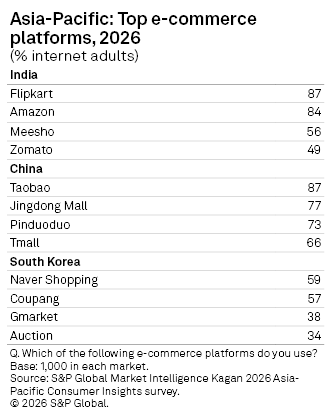
➤ Flipkart and Amazon are the most popular e-commerce platforms in India. Taobao and Naver Shopping are most popular in China and South Korea, respectively.

Results from the S&P Global Market Intelligence Kagan 2026 Asia-Pacific Consumer Insights survey show that the buying behavior of internet adults in India, South Korea and China varies greatly. For instance, over half (52%) of surveyed adults in India said they buy primarily or mostly from retail stores, with some online purchases. In contrast, only one-third (33%) of consumers in China buy primarily or mostly from retail stores. China has substantially more (39%) consumers who buy mostly or primarily from online sources than India (25%).
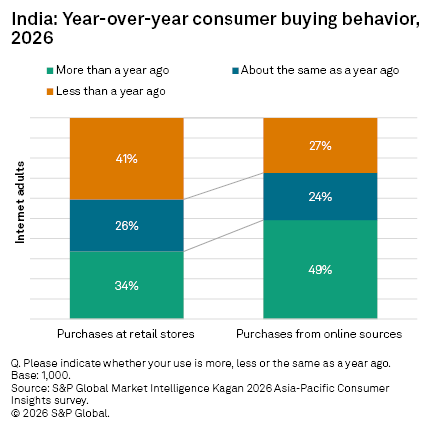
A shift toward greater online purchases can be seen in all three markets surveyed. In India, 41% of respondents reported that they are making fewer purchases at retail stores than one year ago and about half (49%) said they are making more online purchases this year, compared to last year. However, only a portion of consumers are shifting to more online shopping. One-third of internet adults in India said they are making more retail purchases than a year ago, while 27% indicated they have cut back their online buying. Overall, 20% of internet adults are doing well enough that they have increased both their retail and online purchases from a year ago and 13% have cut back on their total purchases from all sources.
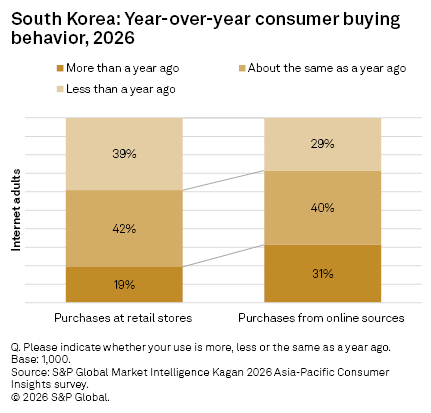
In South Korea, the survey data shows a buying trend similar to India, with 39% of internet adults reporting they are making fewer retail store purchases this year compared to 2025 and 31% increasing their online purchases. Conversely, 19% said they are buying more at retail stores, and 29% have cut back on their online purchases compared to a year ago. Only 10% of survey respondents indicated they have increased their purchases from both retail stores and online sources over the past year, while 18% have cut back on both retail and online purchases.
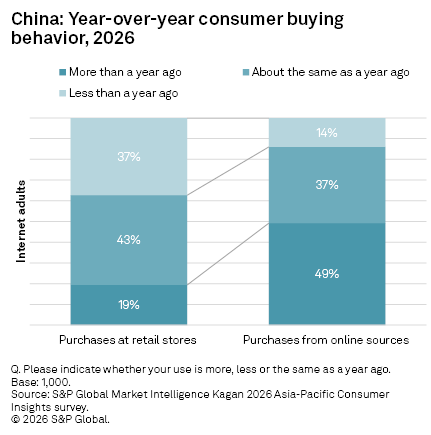
The survey data suggests a strong shift from retail to online buying in China. Over one-third (37%) of surveyed adults said they are making fewer purchases at retail stores this year compared to 2025, and approximately half (49%) reported higher online purchases in 2026. The data also shows that 19% have increased their purchases at retail stores this year, and only 14% are placing fewer online orders than last year. What is most telling is that 28% of respondents said they made fewer retail store purchases while buying more online in 2026. Only 11% reported more purchases from both retail stores and online sources, and a mere 5% said they have cut back on both retail store and online purchases this year.
The vast majority of surveyed adults in all three markets cited using digital payment services. In India, 97% said they use a digital payment service, with nearly three-quarters (71%) of respondents using Google Pay. Nearly two-thirds (63%) said they use PhonePe, a leading digital payments platform that supports mobile peer-to-peer and bank transfers, as well as bill payment and investment services. The majority (59%) of survey respondents in India also said they use Amazon Pay.
Survey results in China also show very high use (99%) of digital payment services, with nearly all (97%) using WeChat Pay. Its main competitor is AliPay, used by 95% of surveyed adults and operated by Alibaba. Just over half (53%) said they use the China UnionPay service, a Chinese state-owned financial services company that issues debit and credit cards.
Nine out of 10 (89%) surveyed adults in South Korea cited using a digital payment service in 2026. Just over half (52%) of internet adults said they used Naver Pay, a financial services app, operated by Naver, home of South Korea’s most popular web portal. Other popular mobile payment apps include Samsung Pay (42%) and Kakao Pay, which is integrated into the KakaoTalk social media app.
The dominant e-commerce platforms in India include Flipkart and Amazon, both boasting usage of over 80%. Flipkart is the most popular domestic e-commerce site, owned by Walmart. About half of internet adults said they also use Meesho, an Indian e-commerce platform specializing in fashion, home and daily use products. Another popular e-commerce site is Zomato, a leading food ordering and delivery service, used by 49% of surveyed adults.
Taobao, used by 87% of surveyed adults in China, is one of the top consumer-to-consumer retail platforms in the market, owned and operated by Alibaba. Jingdong Mall is the e-commerce platform operated by China’s largest retailer, JD.com. Tmall, used by 66% of surveyed internet adults, is the sister of Taobao, specializing in business-to-consumer e-commerce. Pinduoduo (73%) uses WeChat to allow consumers to share product links with family and friends for shopping discounts.
The top two e-commerce platforms in South Korea are Naver Shopping (59%) and Coupang (57%). Coupang is the largest online retailer in South Korea, offering a wide range of products, fast delivery services, as well as digital entertainment content. Gmarket, owned by eBay and used by 38% of internet adults, is a leading online retailer of fashion, beauty and electronics products. Auction, also owned by eBay and used by 34% of respondents, operates an online merchandise auction platform.
The Kagan 2026 Asia-Pacific Consumer Insights survey was conducted in June of this year, consisting of 1,000 internet adults in China, South Korea and India. The margin of error is +/-3.0 ppts at the 95% confidence level. Survey data should only be used to identify general market characteristics and directional trends.
Consumer Insights is a regular feature from S&P Global Market Intelligence Kagan
This article was published by S&P Global Market Intelligence and not by S&P Global Ratings, which is a separately managed division of S&P Global.
Content Type
Theme
Segment
Language