ECONOMICS COMMENTARY — 30 Jul, 2026
US flash PMI shows faster growth, but price pressures and supply delays intensify

US businesses reported a good start to the third quarter, the latest ‘flash’ PMI showed. The month saw an encouraging return to hiring by companies, with employment rising for the first time in three months.
However, the improvement was confined to services, as manufacturing growth slowed sharply. Supplier delays meanwhile worsened to the greatest extent in nearly four years amid the ongoing conflict in the Middle East. Price pressures also intensified, with input cost inflation reaching a more than one-year high and selling price inflation accelerating close to a four-year high.
Faster GDP growth signaled
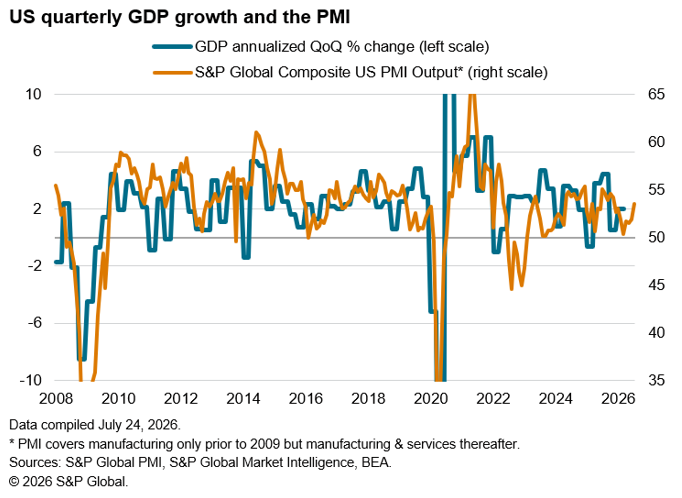
US business activity growth accelerated at the start of the third quarter, according to provisional PMI survey data. The headline flash S&P Global US PMI Composite Output Index rose from 51.9 in June to 53.6 in July, signaling the fastest growth since last November and a further improvement from the near stagnation seen in March.
The upturn in the PMI means the latest survey data are broadly consistent with GDP growing at an annualized 2.0% rate in July against a 1.2% pace signaled for the second quarter.
Manufacturing outperformance fades
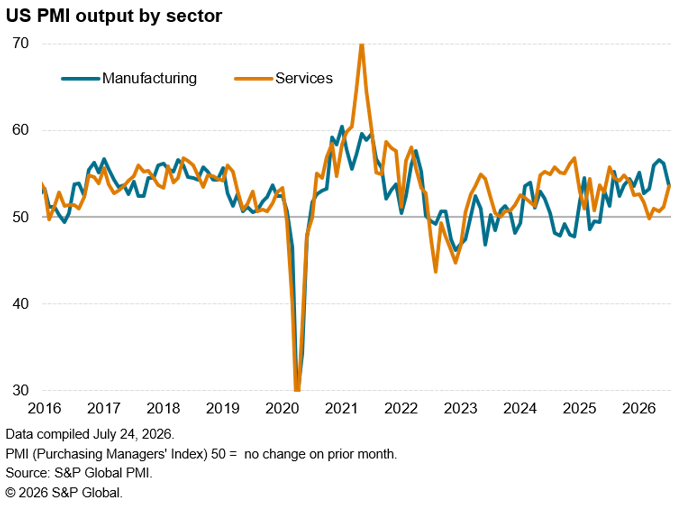
July’s faster expansion was led by services, where business activity hit an eight-month high amid stronger new work inflows. Manufacturing output continued to rise, but factories reported the weakest gains in output and order books since March. These diverging growth trajectories mean rates of expansion have equalized after nine months of outperformance by the goods-producing sector.
Domestic demand drove growth across both services and manufacturing, as exports of goods and services continued to fall in July. Firms cited a lift from FIFA World Cup-related spending, stronger-than-usual July 4th activity and increased investment in sales, marketing and product development. Manufacturers again reported precautionary stock building amid concerns over prices and supply availability linked to the war in the Middle East, though fewer such reports helped explain the slowdown in manufacturing growth.
Brighter future sentiment drives hesitant return of job creation
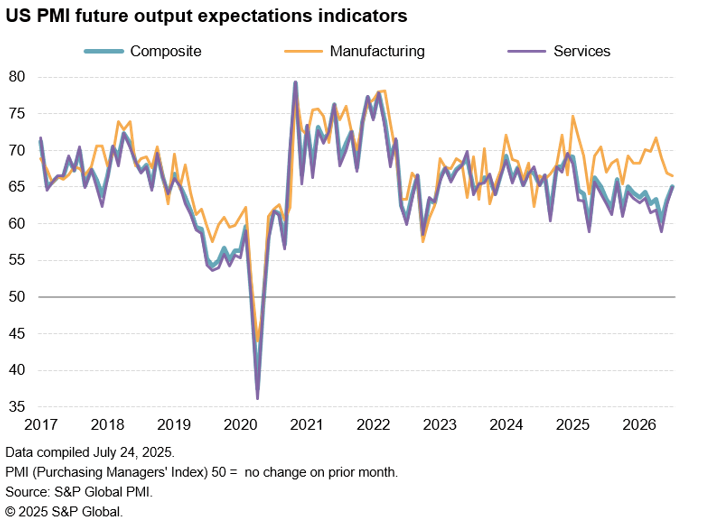
Business output expectations improved in July to an eight-month high, but prospects again diverged by sector. Services firms reported the strongest 12-month outlook since last September, helped in part by lower energy prices, which had previously squeezed customer spending power and lifted interest rate expectations. Manufacturing optimism slipped to its lowest since last October, reflecting weaker demand growth, global trade worries, geopolitical uncertainty, tariffs and high costs.
Employment rose only marginally in July after two months of decline, with modest gains in both services and manufacturing. High costs and an uncertain trading environment restrained hiring and often led firms to not replace leavers, though some companies continued to report difficulties finding staff.
Supply chains lengthen and prices rise
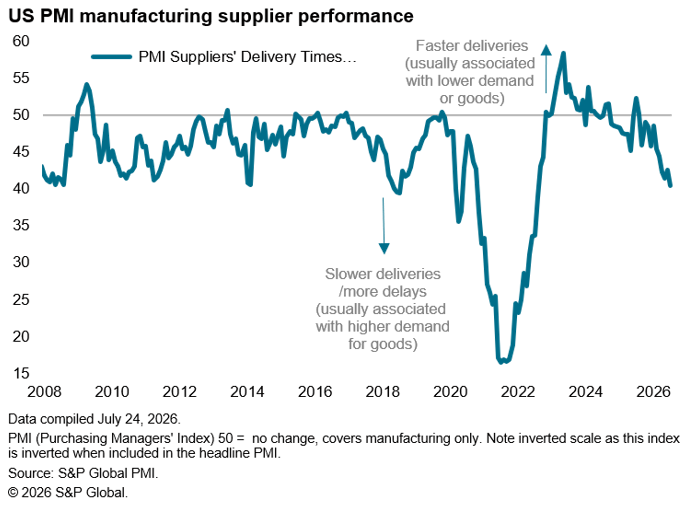
War-related disruptions meanwhile further intensified existing supply problems. Manufacturers reported the sharpest lengthening of supplier delivery times since August 2022, with lead times now worsening for 11 straight months as shipping disruption around the Strait of Hormuz and demand for safety stocks compounded tariff-related availability issues.
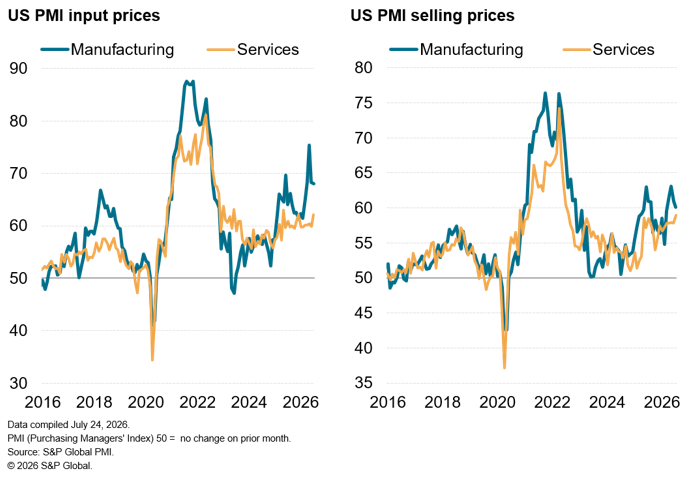
Input cost inflation rose to its highest since May 2025, as cooler manufacturing cost growth was more than offset by a 14-month high in services. Manufacturers nevertheless continued to report the steeper overall increase. Companies attributed higher costs to elevated energy and shipping prices, tariffs and broad-based supplier price rises.
Selling price inflation also accelerated as firms passed higher costs on to customers, with the overall rise in charges the steepest since July 2022. Factory gate inflation remained sharp, albeit reduced, while services charge inflation climbed to the highest in just under four years.
Downside risk to outlook
Looking ahead, some of the improvements reported in July may prove short-lived. Not only did July see hospitality spend being boosted by special events, but it was also worrying – though not unexpected given warnings from prior months – to see manufacturing growth weaken as some of the stock building activities evident since the start of the war showed signs of fading. Instead, July saw a concerning intensification of supply chain delays and accompanying renewed upturn in price pressures, constraining growth and subduing demand.
Events over recent days in the Middle East will have only further exacerbated these supply chain and price worries and raise downside risks to the near-term outlook for the economy, hinting that July’s upturn may not be the start of an improving trend.
Access the latest PMI press release here.
© 2026, S&P Global. All rights reserved. Reproduction in whole or in part without permission is prohibited.
Purchasing Managers' Index™ (PMI®) data are compiled by S&P Global for more than 40 economies worldwide. The monthly data are derived from surveys of senior executives at private sector companies, and are available only via subscription. The PMI dataset features a headline number, which indicates the overall health of an economy, and sub-indices, which provide insights into other key economic drivers such as GDP, inflation, exports, capacity utilization, employment and inventories. The PMI data are used by financial and corporate professionals to better understand where economies and markets are headed, and to uncover opportunities.
Read our latest PMI commentary here.
This article was published by S&P Global Market Intelligence and not by S&P Global Ratings, which is a separately managed division of S&P Global.
Theme
Location
Products & Offerings