Research — July 23, 2026
Public Staff supports less than half of rate hike by Duke Energy Progress in NC

By Dan Lowrey
The North Carolina Utilities Commission Public Staff is recommending the North Carolina Utilities Commission authorize a multiyear rate increase for Duke Energy Corp. unit Duke Energy Progress LLC of $382.3 million in 2027 and 2028. This compares to the company's request for a cumulative increase of $947.2 million.
The commission is expected to issue an order in the case by Sept. 20. Duke has requested that new rates become effective Jan. 1, 2027.

➤ The staff's recommendation is about 40% of that sought by Duke Energy Progress (DEP), signaling meaningful regulatory scrutiny of the utility's multiyear rate plan (MYRP). The gap is driven in part by the staff's lower recommended return on equity (ROE) of 9.50% versus DEP's requested 10.95%, as well as proposed disallowances tied to decommissioning costs, breaker replacement investments and certain large-load customer (LLC) facilities.
➤ Affordability, customer benefits and cost allocation appear to be central issues in the case. The staff raised concerns that DEP's proposed performance-based regulation framework would not provide sufficient ratepayer benefits, while also emphasizing customer affordability pressures. The staff also recommended a dedicated tariff for LLCs, such as data centers, reflecting concern that costs associated with serving concentrated demand should be more directly assigned to those customers rather than broadly socialized across the rate base.
➤ Regulatory Research Associates considers the utility regulatory framework in North Carolina to be relatively constructive from an investor viewpoint. In almost all of the major rate cases decided during the last several years, the commission (NCUC) adopted settlements. In cases that specified an ROE, the authorized return was typically slightly above the nationwide average for energy utilities at the time established. For additional details, refer to the North Carolina commission profile.

On July 9, 2026, the staff filed testimony supporting a $213.9 million increase in base rates for DEP in 2027, exclusive of the impact of riders, together with an incremental $78.6 million increase in 2027 associated with the MYRP and another $90.7 million increase in 2028 associated with the MYRP. Including the impact of the various riders, the net increase in base net revenues would be $236.1 million over the multiyear plan term under the staff's proposal.
The staff's recommended increase is premised upon a 9.50% return on equity (51.00% of capital) and a 6.92% overall return. The recommendation did not specify a rate base amount for the duration of the MYRP.
The recommended 9.50% ROE is below national averages. According to data gathered by RRA, the average ROE authorized by electric utilities in cases, including limited-issue riders, decided during the first quarter of 2026 was 9.71%. This is below the 9.84% average for cases decided during the full year 2025. There were 11 electric ROE authorizations in the first quarter of 2026, compared with 86 in the full year 2025.
With respect to non-nuclear decommissioning costs, the staff recommends the commission not allow DEP to add any contingency percentage to its decommissioning costs because of their uncertainty. The staff also recommends the commission not allow DEP to collect decommissioning costs for the retired Sutton plant or the cooling pond closure costs of the retired Weatherspoon plant. In total, the disallowance of these costs would remove $91.4 million from costs estimated in the decommissioning study.
Additionally, the staff recommended removal of several projects from the MYRP due to delays in project completion or cancelations. Also, the staff recommended disallowance of about $60.4 million associated with DEP's breaker replacement program, arguing the costs should be removed from the MYRP unless DEP is able to quantify and reflect the benefits customers would receive through this program and offset the estimated costs accordingly.
The staff also rejected the company's proposal to establish a storm reserve with $30 million in annual funding. The reserve would be used for future incremental storm restoration costs, helping to mitigate volatility in customer rates resulting from storm activity. "First, as evidenced by the voluminous record in this case of public witness hearings and consumer statements, customers are already struggling to pay their electric bills," the staff testified. "This is not an ideal time to ask them to pay more and pay in advance for potential future storms."
Concerns over performance-based regulation
Similar to its testimony in Duke Energy Carolinas LLC's (DEC) pending rate proceeding, the staff expressed significant concerns regarding DEP's performance-based regulation (PBR) application, which accompanies the MYRP request. The staff concluded that PBR, as implemented by the company, will not benefit ratepayers. On June 19, DEC filed rebuttal testimony in its proceeding reducing its rate request to reflect "a significant, voluntary reduction to its request in response to customer concerns about affordability."
With respect to the DEP case, the staff testified July 9 that DEP customers had expressed concerns about affordability "in staggering amounts. North Carolina ratepayers are grappling with the affordability of utility bills. Throughout the public witness hearings in this proceeding, we heard compelling testimony from witnesses regarding the difficult choices people are currently facing between paying an electric bill, putting food on the table, or accessing healthcare."
PBR is an alternative rate-making framework that includes revenue decoupling, one or more performance incentive mechanisms, an MYRP, and certain mechanisms for sharing excessive earnings. Under Duke's proposed PBR, if adjusted annual earnings exceed the authorized ROE plus 50 basis points, the excess earnings will be distributed to customers through a rider. If adjusted annual earnings fall below the authorized ROE, the utility may file a rate case.
New data center tariff proposed
Also, as it did in DEC's rate case, the staff argues that DEP's existing tariffs are insufficient to address the unique challenges and risks associated with serving LLCs such as data centers. Staff defines a large load as a substantial, concentrated electrical demand of 25 megawatts or greater, originating from a single user or facility, and notes that such loads are not exclusive to one business sector. The staff recommends creation of a large load tariff for DEP. Moreover, the staff recommends removal of $85.9 million in costs related specifically to dedicated facilities such as a substation, which solely serve LLCs.
Rate case background
DEP on Nov. 20, 2025, filed its second multiyear rate request with the commission seeking increases in electric rates through 2028, as well as extending residential decoupling, performance incentive mechanisms and an earnings sharing mechanism. The company said rate increases are needed to make investments to improve service reliability, upgrade power plants and support economic development.
DEP requests in Docket No. E-2, Sub 1380 a cumulative rate increase of $947.2 million over the term of the MYRP. Beginning Jan. 1, 2027, DEP is requesting a $619.5 million increase in its traditional revenue requirement, partially offset by proposed retail rider modifications of about $200 million, resulting in a net increase of $401 million. In the MYRP, each rate year's revenue requirement builds on the traditional revenue requirement and adds incremental investments for that year. The incremental revenue requirements for DEP projects in Rate Year 1, beginning Jan. 1, 2027, are projected to be $127.4 million. For Rate Year 2, beginning Jan. 1, 2028, they are projected to be $200.3 million. So, beginning Jan. 1, 2027, rates, excluding rider offsets, would rise $746.9 million ($619.5 million + $127.4 million) and incrementally $200.3 million higher to a cumulative increase of $947.2 million beginning Jan. 1, 2028.
DEP is requesting a 7.79% return on rate base valued at $20.38 billion for year one, and $23.34 billion by year two of its MYRP ending Dec. 31, 2028.
The two-year rate request is premised upon a 10.95% return on equity (53% of capital structure) for DEP.
Significant historical plant investments and changes, including changes in depreciation rates, account for 40% of DEP's revenue request. MYRP projected investments account for 45%, changes to ROE for 19% and coal ash compliance costs for 8%.
Major capital investments include $826 million in energy storage, solar and solar paired with storage assets included in the rate plan consistent with the Carolinas Resource Plan. Transmission and distribution investments, including grid planning and integration of about $2.4 billion, are also proposed in the plan.
DEP also noted investments in its existing nuclear plants to enhance safety, maintain performance and reliability of the plants throughout their extended life operations, and ensure compliance with regulatory requirements. It has also consistently invested in maintaining its coal units and enhancing its generation fleet, including hydroelectric assets and the new Warsaw Battery Energy Storage System, to ensure resource adequacy and reliable generation capacity during peak load periods and extreme weather events.
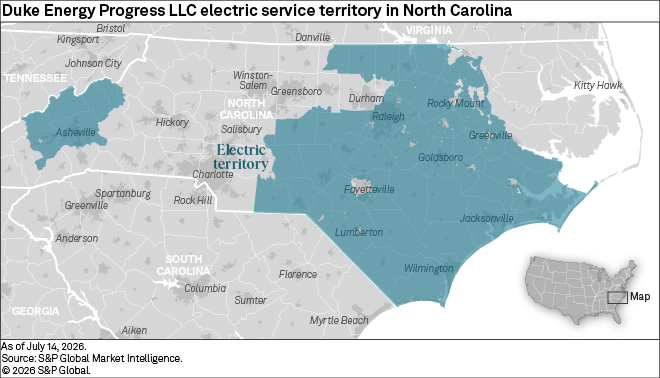
On Aug. 14, 2025, Duke announced it had formally filed an application with federal and state regulators to merge DEC and DEP in the Carolinas. The company expects the merger to result in over $1 billion in savings for retail customers between the Jan. 1, 2027, proposed effective date and 2038. The NCUC and Public Service Commission of South Carolina have approved the merger.
NC regulatory environment
RRA accords North Carolina energy regulation an Above Average/3 ranking, indicating that North Carolina regulation remains relatively constructive from an investor viewpoint. In almost all of the major rate cases decided during the last several years, the NCUC adopted settlements. In cases that specified a return on equity, the authorized return was typically slightly above the nationwide average for energy utilities at the time established.
State law requires the NCUC to utilize a historical year and a year-end rate base valuation in general rate cases but permits adjustments for "known and measurable" changes and allows the commission to include construction work in progress in rate base for a cash return. There is little in place in the way of alternative or performance-based ratemaking. The NCUC permits timely recovery of electric fuel costs, purchased power expenditures and the costs of certain materials used in reducing or treating emissions. State law enacted in 2019 allows utilities to securitize storm damage costs, providing for cost recovery outside of a general rate case.
On Oct. 13, 2021, RRA raised its ranking of North Carolina to Above Average/3 from Average/1 following the signing into law of comprehensive energy legislation that provides utilities the ability to file MYRPs with the commission and develop performance-based incentives, with the ability to pursue regulatory approval for increases of up to 4% over three years rather than initiating a new rate case each year. The bill (House Bill 951) also effectively solidifies North Carolina's regulated energy monopoly system, maintaining the vertically integrated public utility model and commission regulatory authority. In doing so, it shuts down, at least for now, any hopes that the state might move to an unregulated/competitive power market structure. The bill also provides securitization as an option to recover costs associated with retiring coal plants.
Regulatory Research Associates is a group within S&P Global Energy.
S&P Global Commodity Insights produces content for distribution on S&P Capital IQ Pro.
For a complete, searchable listing of RRA's in-depth research and analysis, please go to the S&P Capital IQ Pro Energy Research Library.
For a full listing of past and pending rate cases, rate case statistics and upcoming events, visit the S&P Capital IQ Pro Energy Research Home Page.
This article was published by S&P Global Market Intelligence and not by S&P Global Ratings, which is a separately managed division of S&P Global.