Research — July 28, 2026
IBM postQ: Guidance cut as demand slows; AI momentum holds
By Soumya Khandelwal and Sunny Rupani
International Business Machines Corp. (NYSE: IBM) reported a weaker-than-expected second quarter when it released earnings on July 22, with revenue missing Visible Alpha consensus expectations after a handful of large enterprise transactions slipped out of the quarter. Profitability remained resilient, and management maintained its free cash flow outlook.
The results followed IBM CEO Arvind Krishna’s July 14 investor letter, which disclosed a preliminary revenue shortfall and attributed the weakness to customers prioritizing AI-related infrastructure investments, causing several large enterprise deals to shift into later periods. Management reiterated that much of the delayed demand remains in the pipeline, with about one-third of delayed deals already closing early in the third quarter.
Looking at earnings summaries compiled by S&P Global Pronto NLP, along with Visible Alpha pre-quarter consensus expectations and revised outlook, here are some key takeaways.
Key takeaways
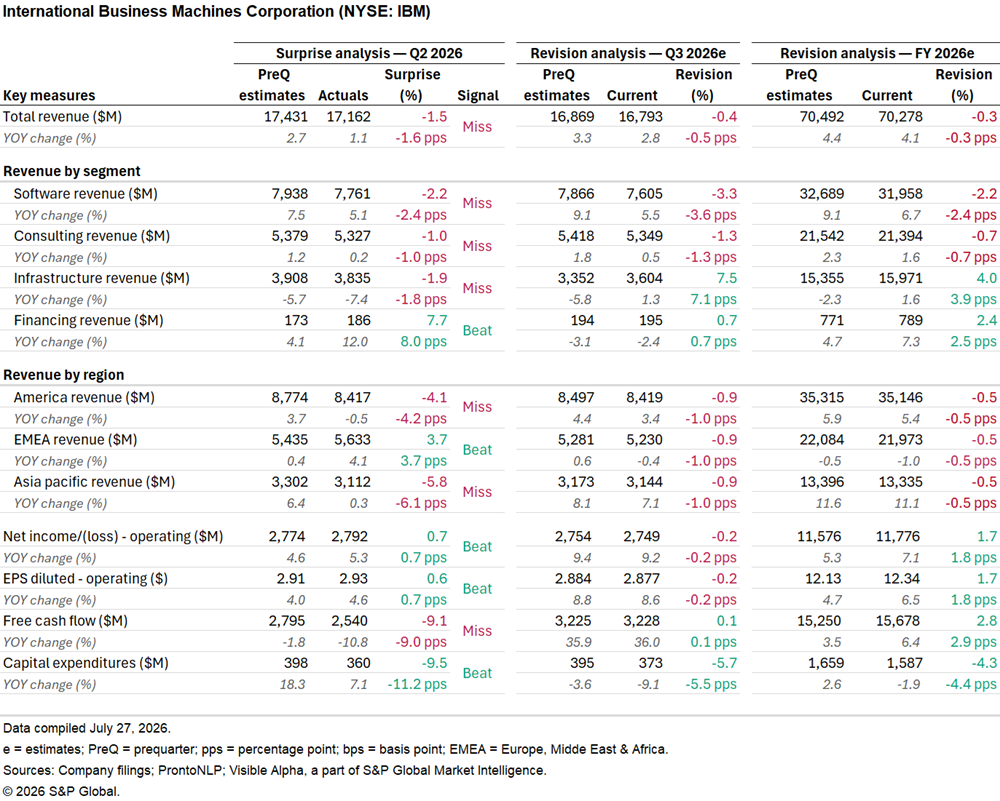
IBM’s Q2 revenue rose 1.1% year-over-year to $17.2 billion, missing Visible Alpha consensus expectations by 1.5%, as weaker Infrastructure and Consulting results offset continued growth in Software. Software revenue increased 5.1% year-over-year to $7.76 billion; however, fell short of consensus analyst expectations by 2.2%. Consulting revenue was broadly flat at $5.33 billion, and Infrastructure revenue declined 7.4% year-over-year to $3.84 billion, both missing expectations.
Regional performance was mixed. EMEA was the strongest-performing region, exceeding consensus expectations. Americas revenue, while Asia Pacific revenue increased but missed expectations.
Profitability remained relatively stable despite weaker revenue. Non-GAAP net income increased 5.3% year-over-year to $2.79 billion, slightly exceeding consensus expectations, while adjusted diluted EPS of $2.93 was 0.6% above consensus expectations. Free cash flow was the key area of weakness, declining 10.8% year-over-year to $2.54 billion and missing consensus by 9.1%.
Guidance
Management lowered its FY2026 constant-currency revenue growth outlook to 4%–5%, from its previous expectation of above 5%, reflecting the slower conversion of enterprise deals and near-term pressure from shifting technology budgets toward AI infrastructure.
Despite the revenue reset, IBM maintained its expectation for approximately $1 billion of year-over-year free cash flow growth in FY2026 and expects operating pre-tax margin expansion of about 100 basis points, supported by productivity initiatives, AI-enabled efficiencies, and cost discipline.
Consensus revisions
Following the earnings release, analysts modestly reduced revenue expectations, reflecting IBM’s lower full-year growth outlook and softer near-term demand assumptions.
Visible Alpha consensus estimates now point to Q3 revenue of $16.8 billion, 0.4% down from preQ expectations, while FY2026 revenue expectations have been reduced by 0.3% to $70.3 billion.
Segment revisions are mixed. Software and Consulting estimates have been lowered as analysts adjusted expectations following the weaker quarter, while Infrastructure estimates have been increased, reflecting confidence in a recovery from the delayed z17 mainframe cycle and continued strength in distributed infrastructure.
Profitability expectations remained constructive. FY2026 adjusted diluted EPS expectations are up 1.7% to $12.34, while full year free cash flow expectations are up 2.8% to $15.7 billion.
Analysts Q&A highlights
Management said Q2 weakness was primarily driven by delays in a limited number of large enterprise capital expenditure deals as customers redirected spending toward AI infrastructure. Approximately one-third of delayed deals closed early in Q3.
Management expects revenue growth to improve in the second half, supported by a strong pipeline, improved software bookings, and recovery in infrastructure demand.
IBM reiterated its ambition for double-digit software growth over time, driven by recurring revenue, AI-related offerings, and acquisitions including Red Hat LLC, HashiCorp Inc., and Confluent Inc.
Management said the z17 mainframe cycle remains healthy despite the sharp quarterly decline, with customer demand delayed rather than lost.
IBM highlighted AI-enabled security and automation opportunities as potential long-term growth areas, including its open-source security platform initiatives.
Share price reaction
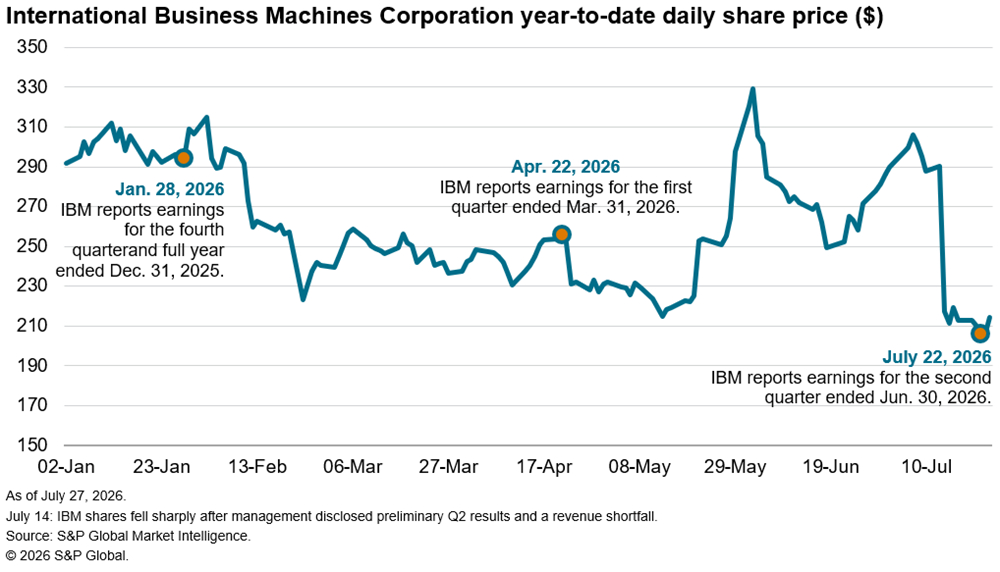
The company faced a historic single-day stock decline following CEO Arvind Krishna’s investor letter on July 14, to pre-announce disappointing preliminary second-quarter results. The letter functioned as a surprise profit warning, triggering immediate panic when the market opened.
Shares edged higher following the official earnings release as investors looked beyond the weaker revenue outlook and focused on management’s explanation that delayed deals reflected timing issues rather than lost demand.
This article was published by Visible Alpha, part of S&P Global Market Intelligence and not by S&P Global Ratings, which is a separately managed division of S&P Global.
Content Type
Theme
Products & Offerings