Research — July 02, 2026
Fox looks to Roku to grow reach, revenue
Fox Corp.'s planned $22 billion purchase of Roku Inc. would pair Fox's live sports, news and entertainment content with Roku's reach across smart TVs and streaming devices. In a consolidating media industry, a combined entity could be better positioned to battle for advertising dollars, especially on the streaming side.

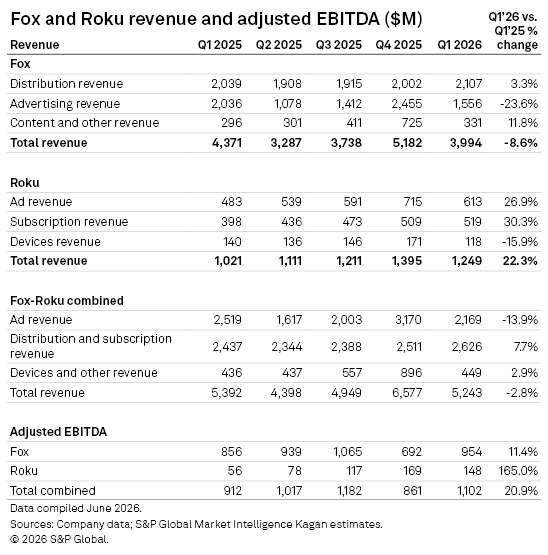
➤ Fox and Roku generated a combined $21.32 billion in revenue in calendar year 2025, including $9.31 billion in advertising revenue. Growth in ad revenue could accelerate as Fox leverages Roku's existing advertiser relationships and first-party data to boost monetization of ad inventory across both linear and streaming platforms.
➤ Fox's streaming subscription services FOX Nation and FOX One would likely benefit from prominent placement across Roku's more than 100 million global streaming homes. Roku owns a pair of subscription video services itself — Howdy and FrndlyTV — that could get a boost from the addition of Fox content.
➤ The combined entity would also control two of the most popular free, ad-supported TV (FAST) platforms in Tubi and The Roku Channel. S&P Global Market Intelligence Kagan estimates that the US FAST sector generated $3.9 billion in ad revenue in 2025, with Tubi and The Roku Channel accounting for nearly two-thirds of that total between them.
➤ On the devices front, Fox is buying the most widely used streaming operating system in the US and the most lucrative platform for smart TVs and streaming devices.

While Fox has invested in streaming in recent years, primarily via Tubi and FOX One, its traditional linear business still represents the majority of revenue. A focus on live sports and news has insulated it from some of the impacts of cord cutting, and its adjusted EBITDA has remained healthy, with $954 million in adjusted EBITDA in the first calendar quarter of 2026 growing by 11.4% versus the prior year quarter.
Roku may be known for its devices and smart TVs, but devices and other revenue accounted for just 9.4% of revenue in the first quarter, with advertising and subscription fees generating 49.1% and 41.5% of revenue in the quarter, respectively. Overall profitability has improved steadily for Roku, and its $148 million in adjusted EBITDA in the first quarter jumped by 165% from $56 million in the first quarter of 2025. Combined together, Fox-Roku produced $3.97 billion in adjusted EBITDA in calendar year 2025 and $1.1 billion in the first quarter of 2026.
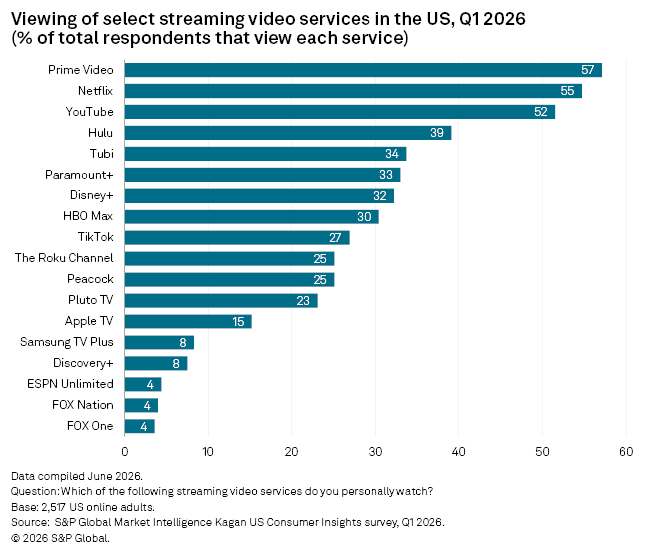
Fox launched its specialty subscription video-on-demand service FOX Nation in 2018 but avoided entering the general entertainment SVOD fray until its 2025 launch of FOX One. Kagan's US Consumer Insights survey fielded in the first quarter of 2026 showed 4% of US online adults reporting that they used each service, versus much higher uptake for Fox's free service Tubi (34%) and Roku's The Roku Channel (25%).
Greater exposure across Roku streaming households could increase uptake for FOX Nation and FOX One, although some nuance could be necessary to avoid disrupting Roku's existing service partners and relationships — not to mention the risk of alienating some consumers who may have preferred using an agnostic platform not owned by a major media firm.
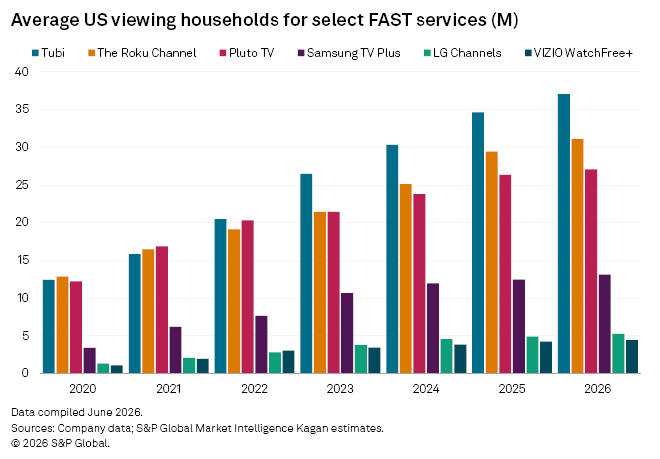
Linear ad revenue still comprises the bulk of Fox's ad revenue, but streaming video ad revenue from Tubi has been steadily growing and generated an estimated $343.9 million in revenue in the first quarter, or roughly 22% of Fox's total ad revenue in the quarter. Tubi and The Roku Channel have seen their US viewing households swell significantly to cement their No. 1 and No. 2 positions in the US FAST arena. Pluto TV has also built a sizable audience, while Samsung TV Plus, LG Channels and VIZIO WatchFree+ reach smaller audiences.
Given the reach and scale of Tubi and The Roku Channel, Fox is likely to keep both services active should it successfully acquire Roku. Fox's catalog content of films and TV series could be more widely available via on-demand viewing at The Roku Channel, while Roku's Sports Zone hub, a central destination on Roku devices that highlights live sports availability and other sports content, could see more sports programming from Fox flow through it.
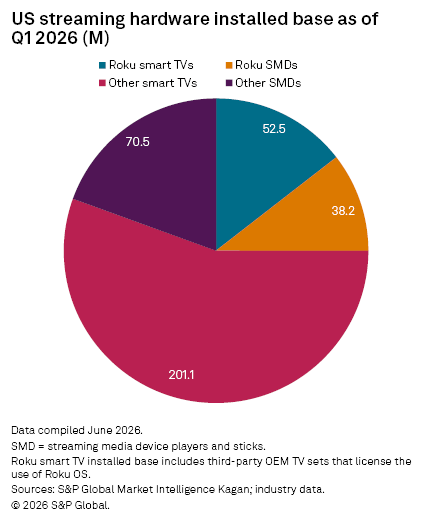
On the device side, we estimate Roku OS runs on no less than 25% of the streaming media devices (SMDs) and smart TVs in the US, with a combined installed base of 90.7 million units as of the first quarter. Roku was an early mover in the streaming space, affording it a long tail of sales and a deep well of brand equity with consumers.
Smart TVs compose the bulk of Roku's US installed base at 52.5 million units. Roku built its TV business footprint by partnering with the likes of TCL, Hisense and Walmart. However, Roku's position in the TV OEM market has been eroded by Alphabet's Android TV, Amazon's Fire TV and, more recently, Walmart's SmartCast.
Roku started selling its own smart TVs in 2023 in a bid to offset that trend, but the segment has been relatively tough to scale in a competitive and increasingly supply-constrained market. Furthermore, there are inherent inefficiencies in directly competing against its own TV vendor partners, especially those operating in the same price bands.
The combination with Fox, with its breadth of content that includes live sports programming and its deep relationships with advertisers, may offer a more compelling sales pitch to potential OEM partners, which is the definitive growth vector for a streaming operating system in 2026. This may also reinvigorate their relationship with existing partners that have gravitated toward Android TV and Fire TV in recent years.
Roku has an additional 38.2 million streaming players and sticks installed in the US. Roku built this business by itself by offering consumers an array of affordable hardware options often at low or no margins. The goal was to subsidize hardware to collect a large streaming customer base capable of producing revenue for years on end, and it worked given its current market-leading platform revenue.
However, the SMD segment has matured and the total installed base, both globally and for the US, has started to contract as consumers have moved definitively toward smart TVs for their primary streaming needs and made SMDs redundant.
Roku has a presence in overseas markets, claiming Roku OS device availability in over 15 countries worldwide, but it has not been able to scale to a truly global market in the way that Android TV has. There may be potential for Fox to push Roku as a global brand, although the revenue opportunity in streaming is still largely centered on the US.
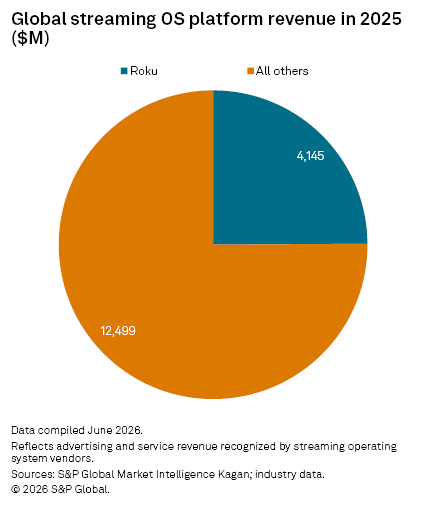
In 2025, Roku drove $4.14 billion in revenue through subscriptions and advertising, the largest top line in the industry. We estimate the total addressable market for streaming operating systems was $16.64 billion in 2025, with the potential to grow to $24.41 billion by 2029.
Fox could offer Roku streaming players to its direct-to-consumer SVOD customers in an effort to grow its user base, but we expect it would quickly come to the same conclusion that Roku already has, which is that the future is in smart TVs.
Economics of Streaming Media is a regular feature from S&P Global Market Intelligence.
This article was published by S&P Global Market Intelligence and not by S&P Global Ratings, which is a separately managed division of S&P Global.Consumer Insights is a regular feature from S&P Global Market Intelligence Kagan.
This article was published by S&P Global Market Intelligence and not by S&P Global Ratings, which is a separately managed division of S&P Global.
Content Type
Theme
Segment
Language