Research — June 18, 2026
Regulatory risk levels warrant monitoring in 8 jurisdictions

A confluence of factors including, but not limited to, increasing affordability concerns, resource adequacy challenges, energy transition issues and increasing politicization due to the upcoming midterm elections have created an increasingly adverse environment for utilities across the US. Even so, there is significant variation in the level of regulatory risk faced by the utilities operating in different jurisdictions.

➤ Following a comprehensive periodic review of comparative regulatory risk across the US conducted in May, Regulatory Research Associates identified eight jurisdictions where current trends could lead to significant shifts in the near future; RRA refers to these jurisdictions as "states to watch." RRA also highlighted two states where there have been marked shifts in regulatory risk levels in recent months.
➤ Several of the states on the "watch list" have ongoing generic proceedings on affordability that could give rise to changes in the regulatory framework, and in certain pending rate cases, affordability concerns are leading to challenges to the commission's long-held policies. Commissioner turnover and election-year politics are significant factors in certain states, as well, while one of the states is grappling with issues related to one of the largest utility mergers in recent history.
➤ RRA monitors and evaluates regulatory and public policy developments in the 53 state-level jurisdictions under coverage on an ongoing basis. The analysis is intended to provide an assessment of the comparative risk level for investors in owning the securities issued by utilities within each state regulatory jurisdiction.

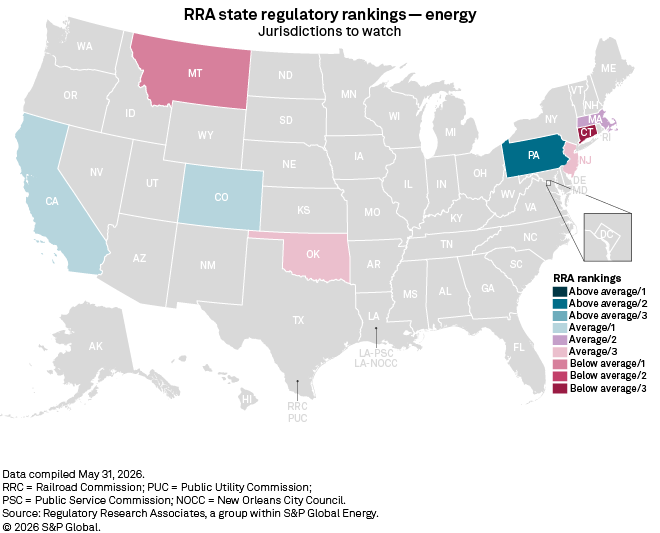
California
California remains a state to watch after the administrator of the state's wildfire fund delivered a report April 7, exploring new approaches to paying for wildfires and other catastrophes by replacing or augmenting the fund, which was bolstered by legislation enacted in late 2025. The state's "inverse condemnation" legal standard for wildfire events involving utility equipment has been a challenge for the utilities in recent years, but the report recommends three pathways for the governor and legislature to consider to improve catastrophe resiliency, particularly wildfires, in the state. One of the recommendations is to eliminate the inverse condemnation standard and transition to a negligence-based liability framework. However, RRA considers that option unlikely given that it would require a constitutional amendment approved by the voters who are largely at odds with utilities over high energy bills.
Under the inverse condemnation principle, if a utility's equipment is found to have been a substantial cause of the damage in an event such as a wildfire, the utility may be liable for damage, even if it has followed established inspection and safety rules. RRA will continue to monitor the state's progress toward turning the recommendations made in the April 7 report into law.
Other recommendations included implementing plans to reduce community wildfire risk, increasing the size of the wildfire fund, creating a state-administered insurance program and eliminating the insurance subrogation system, which could lower wildfire settlement costs for utilities.
Affordability has also become a more intense focus in general, as evidenced by the California Public Utilities Commission's March 17, 2026 ruling that reduced the authorized return on equity (ROE) for Algonquin Power & Utilities Corp. subsidiary Liberty Utilities (CalPeco Electric) LLC by 25 basis points to 9.75% after it had been stable at 10.00% since 2016. This follows a December 2025 commission decision that reduced the authorized ROEs of all major electric and gas utilities. ROEs for California utilities still remain above national averages tracked by RRA. A pending rate case for American States Water Co. subsidiary Bear Valley Electric Service Inc. may become another instance in which the PUC lowers a utility's authorized ROE, and RRA is monitoring this.
Colorado
RRA continues to view the Colorado regulatory climate as somewhat more constructive than average from an investor viewpoint, but finds that investors should continue to monitor the jurisdiction given developments in recent rate cases for the state's gas utilities. In Xcel Energy Inc. subsidiary Public Service Co. of Colorado's pending gas base rate case, the company is seeking changes to how it recovers fixed costs to offset the impacts of conservation, full or partial electrification, and other net reductions to customer counts and gas usage that decrease sales volumes and cost recovery. In a recent decision for Black Hills Corp. subsidiary Black Hills Colorado Gas Inc., the commission voted to place limits on the use of demand-side management funding and expand electrification in the utility's clean heat plan to reduce overall emissions.
Connecticut
Connecticut's regulatory framework is viewed by RRA as among the most restrictive from an investor perspective, with heightened regulatory uncertainty observed in recent years. Following the departure of former Chair Marissa Gillett in fall 2025, the composition of the Connecticut Public Utilities Regulatory Authority has changed, with four new members appointed. These new individuals may provide a moderating influence, as early signals from the new leadership point to a more measured and less adversarial regulatory posture, although it remains too early to determine. Eversource Energy subsidiary The Connecticut Light and Power Co. filed a rate case in late May, seeking a $503 million electric distribution rate increase, along with a multiyear performance-based regulation proposal; this case will likely provide initial insights into the new commissioners' philosophies.
Massachusetts
Massachusetts bears watching as utility bills and energy affordability have become central policy issues because 2026 is an election year for Gov. Maura Healey (D). At the governor's urging, the Massachusetts Department of Public Utilities opened an investigation in December 2025 to evaluate gas and electric delivery charges and redesign billing practices. This proceeding is to include a comprehensive review of all delivery charges and rate structures, including consideration of a monthly cap on bill increases and the role of reconciliation mechanisms, followed by a focus on bill design and billing practices.
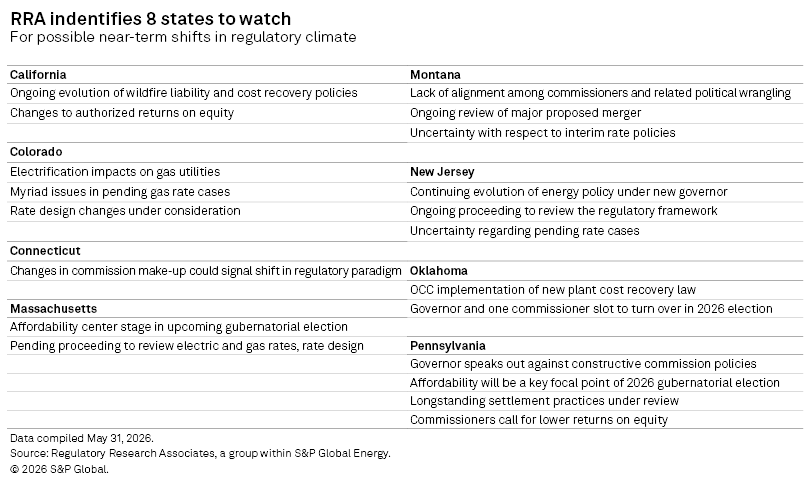
Montana
The regulatory climate in Montana has been somewhat restrictive from an investor perspective in recent years and thus warrants continued attention from investors, particularly the Montana Public Service Commission's review of the NorthWestern Energy Group Inc.'s proposed merger with Black Hills Corp. The transaction was recently approved by the Federal Energy Regulatory Commission.
Political wrangling among the commissioners has further exacerbated regulatory risk in the jurisdiction in recent months, even though all five commissioners are of the same political party. In October 2025, following reported internal disputes, the commissioners voted to demote Brad Molnar, who was the PSC president at the time, after previously amending the PSC's internal policy guidelines. In the past, the president was elected by the serving commissioners and would serve a two-year term as president. Commissioner Jeff Wellborn was subsequently elected to serve as PSC president. On May 6, 2026, the PSC adopted a "Response Team Report in the Matter of the Misconduct of Commissioner Brad Molnar," and authorized implementation of recommendations following an independent investigation that substantiated consequential violations of internal policies and Montana state law. Notably, the report states that the matter "is a human resources issue and is not in any way related to past or potential outcomes in regulatory decision(s) of the Public Service Commission."
Approval of interim rate increases during rate cases is an issue on which the commissioners have disagreed. In December 2025, the commission rejected MDU Resources Group Inc. subsidiary Montana-Dakota Utilities Co.'s request for an interim rate increase, and did so again in February 2026. The utility sought reconsideration of the initial order rejecting the interim increase, and the Montana PSC staff issued memos in January and February recommending that the PSC approve an interim increase, stating that MDU has demonstrated its existing electric utility rates do not allow for the full recovery of the cost of providing service to its Montana customers. The PSC eventually approved the temporary rate hike March 3.
New Jersey
As the new governor's tenure begins, energy affordability and load growth challenges continue to loom large in New Jersey. Immediately upon taking office, Gov. Mikie Sherrill issued Executive Order 1, which calls for the New Jersey Board of Public Utilities (BPU) to more closely scrutinize utility rate cases and to discourage rate increases "to the extent allowed by law." It is unclear how these mandates will impact base rate cases for Consolidated Edison Inc. subsidiary Rockland Electric Co. and privately held South Jersey Gas Co. that were pending when the order was issued and a more recently filed rate case for New Jersey Resources Corp. subsidiary New Jersey Natural Gas Co., as well as other pending proceedings where the utilities are permitted to adjust rates outside of a base rate case for certain investments and future rate cases that might otherwise have been in the planning stages. In connection with the order, the BPU has initiated a stakeholder process to explore possible modifications to the existing regulatory frameworks for electric and gas utilities, with an emphasis on performance-based ratemaking. The first of multiple planned workshops was held May 7. The parties filed written comments May 29.
In addition, affordability is a focus during the current legislative session, with bills being considered that would change the allocation of policy and ratemaking processes between the administration and the board; limit the amount a utility could increase rates each year; limit authorized ROEs; and incentivize investment in new generation within the state.
Oklahoma
Although the increased attention Oklahoma had faced prior to 2025 due to one longtime Oklahoma Corporation Commission (OCC) member's adversarial stance toward the utilities in several proceedings has since abated, industry stakeholders should pay attention to recent developments regarding the state's treatment of the costs incurred to construct new gas-fired plants.
Senate Bill 998, enacted in 2025, allows for the use of a cost recovery mechanism to facilitate the recovery of the related costs during construction. On March 5, 2026, the OCC rejected a request filed by OGE Energy Corp. subsidiary Oklahoma Gas and Electric Co. to utilize such a mechanism for two new gas-fired units it intends to build. The company subsequently appealed the matter to the state's supreme court and contends the OCC erred on procedural grounds.
Stakeholders should also be aware that Gov. Kevin Stitt (R) and Commissioner Todd Hiett (R), whose terms are expiring, are not permitted to seek reelection in November due to term limits, raising concerns that the state's regulatory climate could become more politicized throughout 2026, as elections for replacements gear up.
Pennsylvania
While RRA continues to view Pennsylvania's regulatory climate as constructive from an investor viewpoint, recent developments may signal a tightening in the jurisdiction. While virtually all cases since the 1990s have been resolved by black-box settlements, in recent years, there has been growing pushback against this practice.
In his 2026 budget address, Gov. Josh Shapiro called for greater transparency in the rate case process, particularly regarding authorized ROEs. Requiring more details to be included in settlements may have limited direct impact but could make settlements modestly harder to achieve, as ROE is typically a central point of contention.
Even before the governor's address, some PUC members had challenged the ROE recommended by the administrative law judge in a recent fully litigated case. Although the majority upheld the recommendation, this split could indicate a shifting stance.
Even so, it is noteworthy that PPL Corp. subsidiary PPL Electric Utilities Corp. was able to reach a settlement in its recently completed electric distribution base rate case that was silent on the underlying ROE. Consistent with recent comments by the PUC chairman, however, the settlement provides more specific information than in past cases, including average total bill impacts by customer class, precise percentage increases and detailed settlement rate impacts.
While the vote was unanimous, Vice Chairman Kimberly Barrow dissented in part. Barrow, who has been a critic of black box settlements in recent cases, said she was "dismayed" that the settlement did not specify the capital structure or ROE used to determine the stipulated rate increase. "I believe that we are at an inflection point where the litigants should see no reason to cloak the ROE or capital structure from public view. I eagerly look forward to the time when both are expressly stated in settlements — our current economic environment and utility customers both command it," said Barrow in her statement.
In the budget speech, Shapiro also described Pennsylvania as a state where utilities can earn "among the highest returns in the nation." In RRA's view, these comments placed pressure on the PUC to lower authorized ROEs, even though most utilities appear to earn below prevailing averages, based on the commission's quarterly earnings reports.
In an unprecedented move, Shapiro sent a general letter to utility executives on April 29, informing them that the administration will "vocally and forcefully oppose rate case requests from utilities that fail to adhere to ... three commonsense practices" that the governor says will serve as benchmarks to evaluate rate case proposals. On the heels of these pronouncements, legislation, House Bill 2224, was introduced to impose a cap on authorized ROEs at the current (at the time of the decision) yield on 10-year US Treasury bonds, plus 2%. At the close of business on June 8, the yield on these bonds was reported as 4.568%.
The letter was issued as the Pennsylvania Public Utility Commission was getting ready to rule on a request by Exelon Corp. subsidiary PECO Energy Co. to withdraw, without prejudice, petitions for electric and gas rate increases totaling $510 million that the company had filed for on March 30. PECO had cited pressure from Shapiro's office and the public as reasons for withdrawing the request.
Shapiro faces reelection in November 2026, and with elections for 25 of 50 state Senate seats and all 203 House seats to be held as well. Energy and affordability issues are likely to feature prominently and political pressure could influence the PUC's stance in pending cases.
Please note: The rankings reflect information available as of May 31; consequently, that is the effective date of any ranking changes, even though the report is published with a later date.
Rankings overview
RRA ranks the regulatory climate for electric and gas utilities in a total of 53 state-level jurisdictions.
RRA maintains three principal ranking categories — Above Average, Average and Below Average. Above Average indicates a relatively more constructive, lower-risk regulatory environment from an investor viewpoint, and Below Average indicates a less constructive, higher-risk regulatory climate.
The numbers 1, 2 and 3 within each principal ranking category indicate relative position. The designation 1 indicates a stronger or more constructive ranking from an investor viewpoint; 2, a midrange rating; and 3, a less constructive rating.
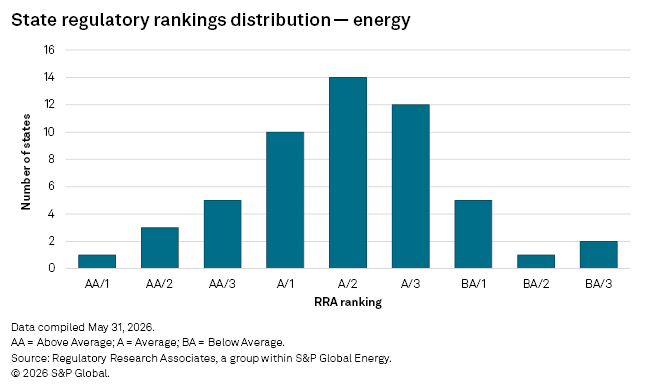
RRA endeavors to maintain an approximately normal distribution, with most rankings in the three average categories and the remainder split almost evenly between the Above Average and Below Average categories.
Regulatory Research Associates is a group within S&P Global Energy.
S&P Global Energy produces content for distribution on S&P Capital IQ Pro.
For a complete, searchable listing of RRA's in-depth research and analysis, please go to the S&P Capital IQ Pro Energy Research Library.
Joe Felizadio contributed to this article.
This article was published by S&P Global Market Intelligence and not by S&P Global Ratings, which is a separately managed division of S&P Global.