Research — May 7, 2026
Running on empty – Philippines' nickel sector and the fuel crisis
By Princess Rochelle Gan and Jason Holden
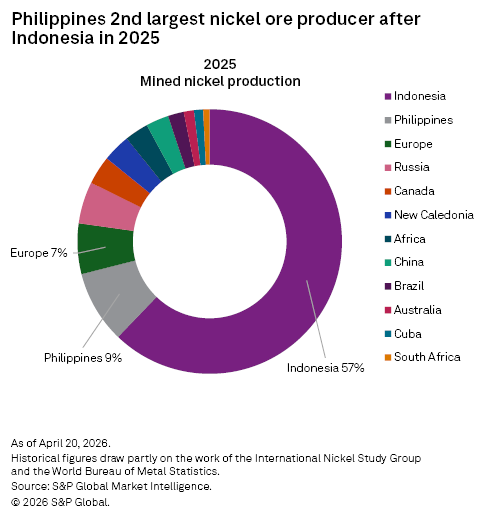
Shipping disruptions in the Strait of Hormuz have hit the Philippines harder than anywhere else in Asia, as the country imports 98% of its oil from the Middle East. Fuel reserves of 55-57 days at the outset of the US-Israel war with Iran fell to as low as 45 days on March 20 and were only 50 days as of mid-April. As a result, diesel prices surged 111% and gasoline 71.6%, marking one of the highest fuel price increases globally. Philippine President Ferdinand Marcos Jr. declared a national energy emergency on March 24, releasing 20 billion pesos ($326 million) in emergency funds and working to secure alternative supply from Malaysia, Russia and beyond. Ordinary Filipinos are clearly feeling the impact, with long queues at fuel stations, rising public transport fares and soaring food prices. However, the country also faces a less visible consequence in terms of global reach, as it is the world's second-largest nickel ore producer, and its mines are running out of diesel.
Nickel Asia Corp., the country's largest nickel producer, has just 30 days of fuel supply remaining, while DMCI Mining Corp. reports some operators have as little as 15 days of fuel supply left. Most companies have no contingency plan beyond that window. Fuel costs have risen to 128 Philippine pesos per liter from about 50 pesos pre-war, going up to 170 pesos at one point. Under our updated forecast, this adds $2-$3 per wet metric ton to total cash costs — manageable against export prices of $30-$40/wmt for now, but a second price increase would push high-cost mines into losses. With no assurance that fuel prices will drop soon, miners will bear this additional cost for the foreseeable future.
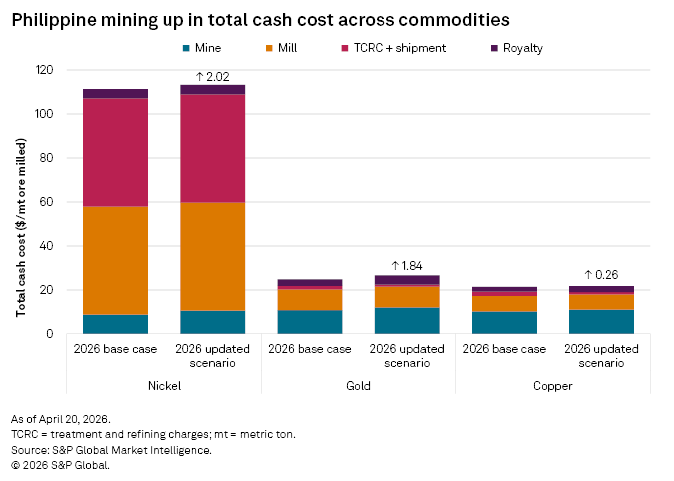
Gold and copper mining projects have also seen an increase in total cash cost, but milder than that of nickel. Philippines' nickel mining is almost entirely open-cast laterite — remote, island-based operations with no grid power and no alternative to the diesel used for haul trucks, drill rigs, barges and camp generators. Shipping 60 million metric tons of ore annually requires about 120 million liters of fuel for logistics alone, before minesite operations are included. An increase in fuel surcharges for flights taken by fly-in fly-out workers, higher remote-area food premiums and elevated LPG costs for camp cooking are among the daily expenses that will continue to accumulate, impacting overall operational costs.
Bad timing
Nickel mining in the Philippines is highly susceptible to weather, with peak monsoon season typically running from October to March. With heavy rains halting open-cast laterite operations and strong sea waves limiting tank and barge operations that transport direct-shipping ore from island ports to mother vessels, most of the nickel ore is shipped out between April to October. The diesel price hikes, which began in March, coincided with the end of the monsoon season, increasing operational costs throughout the most active and fuel-intensive period.
The sector was positioned to capitalize on a market opportunity when the war with Iran started. Indonesia has been cutting its domestic nickel ore production — some producers receiving only 30% of their proposed output approvals — creating a gap that the Philippines exporters were set to fill. Shipments to Indonesia's smelters from the Philippines had already surged from near-zero to 10.4 million mt in 2024, with projections pointing to 30 million mt by 2026. That opportunity is now at serious risk. Historically, over 87% of the Philippines' nickel ore flowed to China, representing over 90% of China's total nickel ore imports. This is now pivoting, with most of the ore mined in the Philippines being shipped to Indonesia. A sustained disruption simultaneously tightens the feedstock for refiners in China and smelters in Indonesia, compressing the supply chain base and ultimately impacting electric vehicle battery manufacturers across Asia. The Philippines is, in effect, a fuel-vulnerable link in the battery materials chain on which the energy transition depends.
The near-term question is whether the Philippine government classifies mining as a priority sector for fuel allocation. The industry is concerned that food, transport and power infrastructure will take precedence, with mining given a lower priority. The country has bought some time with an emergency 329,000-barrel diesel shipment from Malaysia after Iran agreed in April to allow safe passage to the Philippine-flagged vessels through the Strait of Hormuz. But the Philippines' energy secretary has acknowledged that prices will not return to pre-war levels quickly, regardless of when the Strait reopens.
For questions or more information, please contact:
Princess Rochelle Gan, Principal Analyst, Metals and Mining Research, p.gan@spglobal.com
Jason Holden, Senior Principal Analyst, Metals and Mining Research, j.holden@spglobal.com
This article was published by S&P Global Market Intelligence and not by S&P Global Ratings, which is a separately managed division of S&P Global.