Research — April 2, 2026
Mobile World Congress 2026: Can the industry sell network experiences?

As carriers flip the switch on 5G standalone (SA) networks, the question becomes how to monetize this new network capability.
During Mobile World Congress earlier this month, the message was consistent: Sell experiences or guarantee performance rather than just providing data access.

➤ 5G SA enables new capabilities, but near-term gains are mostly efficiency, not revenue.
➤ Carriers are testing performance-based pricing, but results are still limited.
➤ For now, network slicing is the main revenue model tied to 5G SA.

Wireless executives have repeatedly said that the real commercial value of 5G appears once an SA core is deployed. SA removes dependency on LTE and unlocks capabilities such as network slicing, automation and guaranteed quality of service (QoS). However, they also recognize that SA will deliver net benefits, but primarily through network efficiency over time, not new revenue. In the meantime, they will continue to search for the revenue cases.
SA-based networks are just now seeing acceleration. S&P Global Market Intelligence Kagan's recent tally of SA 5G networks globally stood at 85 networks at the end of 2025, representing an acceleration from 71 in the first half of 2025.
At its stand and in discussions, Ericsson framed monetization as selling differentiated connectivity using services to guarantee performance around actions such as video calling, stadium experiences and enterprise connectivity.
Ericsson said users will pay, citing its own consumer survey in which the vendor asked users if they could envision moments in time when they would be willing to pay more for the network performance. Ericsson said 40% could identify opportunities when guaranteed performance is needed. Half of those said they’d be willing to pay for it. It’s up to carriers to educate users about it.
In the US, AT&T Inc. has been offering "AT&T Turbo" since 2024. At the time of its launch, AT&T called this product the first step in modernizing and preparing its network for innovative use cases. The $7 per month add-on service gives customers higher priority network access, especially during congestion, to improve applications such as gaming, video calls and live streaming.
AT&T has not given any metrics on the service, nor has it indicated that the add-on has contributed significantly to revenue. But it recently expanded the offering with a completely different model. In February, the carrier launched "Turbo Live," which allows both AT&T customers and customers on other networks to purchase high-priority data access at stadiums, concert venues and other large events.
The service is available at just a handful of venues across the country and prices vary, likely depending on demand. It’s not clear how AT&T offers this to non-AT&T users, but the fine print says the service may require an unlocked device and an open eSIM profile on the device. A user scans a QR code to purchase Turbo Live and installs a temporary eSIM profile.
While this service is not based on 5G SA, it could be the bridge between API-driven network access, dynamic slicing and per-session charging — all capabilities enabled by SA.
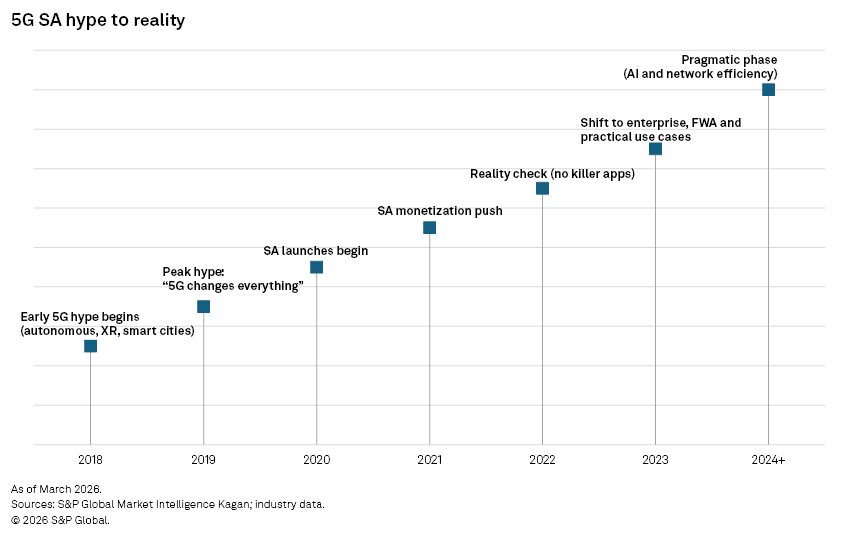
For now, network slicing is the flagship revenue model for 5G SA. While carriers are testing out slices for dedicated gaming services, it primarily lives in the enterprise market, according to examples discussed at MWC. Network slicing involves a 5G network being divided into multiple virtual networks optimized for different customers or applications. Examples include offering services such as ultra-reliable slices for industrial automation, a secure slice for public safety, and high-bandwidth slices for live video production.
While fixed wireless access (FWA) has become a primary application for 5G, SA takes it a step further by allowing carriers to offer service level agreements (SLAs) to enterprise customers. Most businesses have used FWA as a backup solution but not as their primary connectivity solution.
"Network slicing makes the role for fixed wireless much different if you’re an enterprise, even a small business, than it might have been a year or two ago," noted William Johnson, a senior vice president with Verizon Communications Inc., during an MWC session.
Johnson offered an example of an unnamed fast-growing restaurant chain that faced delays in obtaining fixed broadband access, such as fiber. Verizon was able to offer up FWA with an SLA and turn on service much quicker than fixed alternatives.
The concept of monetizing via network APIs with app developers has gained traction since 2023, when the GSM Association introduced the Open Gateway — a framework of APIs designed to give developers universal access to mobile networks. The idea is to allow third-party developers to use network elements to create mobile apps using the same APIs globally.
The GSMA reports that 85 operator groups have committed globally to the Open Gateway. This represents some 300 networks and about 80% of global mobile connections.
The key APIs today are number verification, fraud detection and silent authentications, but attendees noted that the real monetization opportunity comes from SA in terms of developers accessing Quality-on-Demand (QoD), network slicing and latency control APIs. While these APIs can be used on non-SA networks, they are far more viable with SA.
Related articles:
Mobile World Congress 2026: Operators talk up AI as a revenue generator
Mobile Investor is a regular feature from S&P Global Market Intelligence Kagan.
This article was published by S&P Global Market Intelligence and not by S&P Global Ratings, which is a separately managed division of S&P Global.
Content Type
Segment
Language