Research — April 23, 2026
Broadcast political ad revenue set to exceed $4 billion in 2026

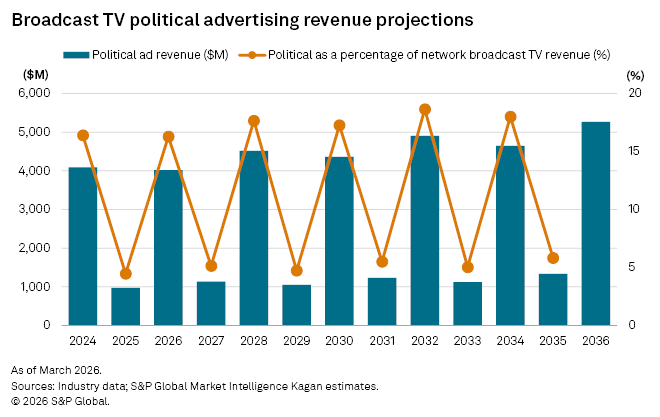
Our projections have local TV political ad revenue reaching $4.02 billion in 2026 and growing to nearly $5.27 billion in presidential election year 2036. Political ad revenue is expected to boost local TV stations in 2026, given the current political environment nationally and the many races and issues at the state and local levels.
Our broadcast television political projections for 2026 represent an increase of 15.0% from the total political ad revenue reached in the last non-presidential election year of 2022. Our projections depict political ad revenue to be 16.3% of net total broadcast revenue in 2026, a record for a non-presidential election year.

➤ The largest growth segment within political advertising in 2026 is the growth of political advertising on connected TV (CTV). CTV subscriber numbers are increasing, and advanced targeting ability is a draw for political campaigns and their PACs. However, broadcast TV groups have digital initiatives of their own and linear TV still commands close to half of all political advertising dollars.
➤ The political climate is very hot with economic and social issues blanketing the national and local news. This makes for a heightened importance placed on control of Congress that trickles down to the local level.
➤ With 36 of 50 governorships up for re-election, 15 of which are term-limited and two where the governor has opted to retire, open seats are abundant and will draw advertising from the many candidates in those regions.
➤ Political ad campaigns continue to start earlier in the political season, fundraising continues to become more efficient, and the pool of advertising continues to grow, leading to records for political campaign ad spending across multiple segments.

The even-year political ad revenue stream continues to benefit broadcast TV, especially as trends of earlier spending by candidates in the political cycle and increased usage of digital technology to target voters have helped increase the overall political total and volume. While CTV is experiencing fast growth in political ad revenue, broadcasters, who have traditionally seen around 50% of the total political ad spend in election years, have digital assets of their own to help capitalize on the surge of ad campaigns looking to promote candidates and propositions.
Access our political ad revenue projections in Excel format.
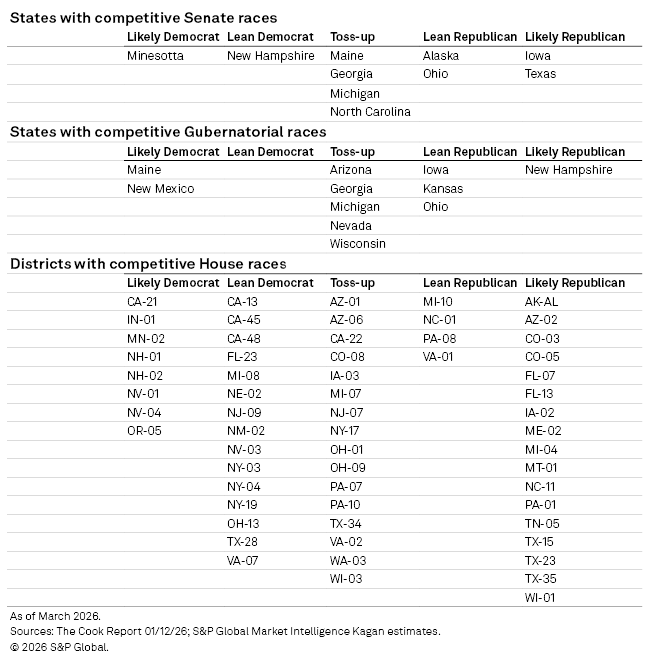
Just four of the 35 Senate seats (including special elections in Florida and Ohio) up for election in 2026 are in toss-up states, according to The Cook Political Report. Just one race is leaning Democrat, while two are competitive races leaning Republican.
Currently, 36 of the total 50 governorships are up for election in 2026. Gubernatorial toss-up races include Arizona, Georgia, Michigan, Nevada and Wisconsin. There are zero leaning Democrat gubernatorial races; however, three open races are leaning republican in Iowa, Kansas and Ohio.
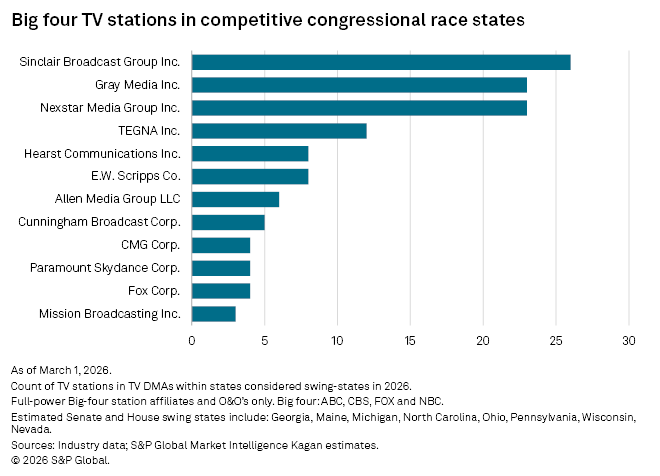
Of the TV station groups with the largest number of stations in states considered toss-up, Sinclair Broadcast Group LLC ranks first with 26 stations, and both Nexstar Media Group Inc. and Gray Media Inc. are close behind with 23 stations. However, as of the March 19 closing of Nexstar's purchase of TEGNA Inc., Nexstar will have the most full-power TV stations in competitive swing states.
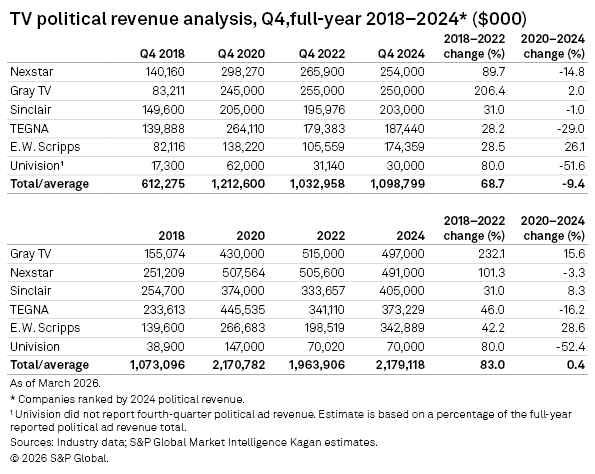
Looking at full-year political ad revenue, the 2024 political cycle represented an average 11.0% increase from the election year 2022 for the six broadcasters in our analysis. In 2024, Gray Media led all broadcasters with $497.0 million in total political ad revenue, up 15.6% from the last non-presidential election year of 2020.
For Gray, the 2026 political cycle has started off strong. On Gray's fourth quarter 2025 earnings call on Feb. 26, 2026, Gray President and Co-CEO Donald Patrick LaPlatney said, "Our guide for the fourth quarter of '25 was $7 million to $8 million, and our actual results came in at $12 million. Once again, we saw some revenue from issue advertisers supporting the President's legislative priorities. We also saw good results in Virginia from the 2025 state governor and attorney general races."
LaPlatney said on the call that first quarter 2026 political ad revenue guidance is between $25.0 million to $30.0 million and that Gray has a favorable TV station footprint with 10 competitive Senate races, 13 competitive gubernatorial races and countless others in markets with their local news stations.
In 2024, Nexstar was just below Gray in full-year political ad revenue with $491.0 million, a small decrease of 2.9% from presidential election year 2022. Nexstar reported fourth-quarter 2025 political ad revenue of $21.0 million due to Virginia's general elections, California's redistricting ballot proposition, and early governor's race spending.
On the Nexstar fourth-quarter earnings call, Nexstar EVP and CFO Lee Ann Gliha talked about some of the Synergies around the TEGNA deal and political revenue. "We have a presence in Georgia, but we didn't have a presence in Atlanta. They've (TEGNA) got some great stations in Maine that is a contested election market. They've got a station in Toledo, Ohio, which could also be a good political market for us. So -- and Phoenix, Arizona, is the other one where they have a larger market or a larger station than we do there," said Gliha.
Sinclair grew its full-year 2024 political ad revenue by 21.4% from nearly $333.7 million in 2022 to $405.0 million. At a March 9 company conference, Sinclair EVP and CFO Narinder Sahai talked about his expectations that 2026 will be a political ad revenue record for Sinclair. "Our guide for 2026 is to be at least comparable to 2022, which is about $333 million. It's too early in the year for us to come off of that or give you a different number. So we are watching it closely, and then we'll continue to refine that as we go forward," said Sahai at the conference.
TEGNA reported $373.2 million in full-year 2024 political ad revenue and increase of 9.4% from $341.1 million in 2022. TEGNA did not offer guidance for political ad revenue prior to the start of its purchase by Nexstar. It has 12 full-power TV stations in competitive congressional race states in 2026.
Competitive races to watch
Control of state legislatures and governor's offices can oftentimes determine who controls congress making local campaigns an important component to national campaigns. In 2026, there are 19 states with incumbent governors running for reelection, 15 states where the current governor is term-limited, and two states where the incumbent governor is eligible for reelection but has opted to retire instead. With so many open seats, we will likely see more competitive races given that there will be a lot of new governors in office next year. Open governor races in Minnesota, Wisconsin, and Michigan are a few we believe will draw ad dollars to local TV with competitive primaries through Election Day.
In Wisconsin, Gov. Tim Walz announced he will not seek reelection, leaving an open seat in the state. The primary is until Aug. 11, 2026, just three months before the Nov. 3 general election. While the front-runner is US Sen. Amy Klobuchar, we expect a heavy dose of political advertising in the state.
The California governor's race is also a hot spot for advertising, with billionaire Tom Steyer running for the open seat. He started the spending early in the political season with ad buys, and as of Feb. 28, 2026, he has spent $66.7 million on his campaign, vastly outspending the other candidates, which includes Trump-backed Steve Hilton. As of March 6, 2026, there are 10 candidates running for governor in California, and neither major parties has yet a front-runner. The spending that must accompany TV ads in California's TV markets commands a high premium, and that could elevate political totals in the state.
One of the most funded Senate races is taking place in Texas, where Republican Sen. John Cornyn and current state attorney general Ken Paxton are competing in the primary runoff election. Democratic nominee James Talarico raised $14.3 million in the first two months of 2026, according to the democratic online fundraising platform ActBlue, more than any other candidate on the platform. The Texas Senate races have become closer over the last few elections despite the Republican victories.
In Maine, the primary race between democrats Gov. Janet Mills and Graham Platner has led to a surge of political ads in the state. The competitive primary will lead the democratic candidate to a campaign against republican Sen. Susan Collins in the state that President Trump lost in 2024. In addition to what each candidate has spent on advertising in the state, independent conservative PAC groups have spent over $13.0 million on ads supporting Collins and PAC groups opposed to Collins have spent more than $2.0 million, according to an April 9, 2026, news report of AdImpact political numbers.
In North Carolina, Sen. Thom Tillis is retiring, and the race here is expected to be one of the most expensive Senate contests. Former governor, democrat Roy Cooper, is running against former Republican National Committee Chairman Michael Whatley, two well-known politicians. The state has been Republican leaning with Trump winning the presidential bid there three times, but Cooper's popularity could give him the advantage.
Both Georgia and Michigan have competitive Gubernatorial and Senate races this year, making them a hotbed for political ad spending. In Georgia, Democrat Jon Ossoff is running for reelection and has been raising millions in fundraising to defend his seat. Just in the fourth quarter of 2025, he raised nearly $10,0 million and started 2026 with $25.0 million of cash on hand. But the opposition is facing a very competitive primary in May to decide the Republican front-runner. US representatives Mike Collins and Buddy Carter are battling for the bid, while ex-Tennessee football coach Derek Dooley is also in the mix.
In Michigan, Democratic Sen. Gary Peters is retiring, leaving an open seat. Republican representative Mike Rogers is the party candidate here; however, the Democratic primary is a three-way race between Representative Haley Stevens, State Sen. Mallory McMorrow, and Abdul El-Sayed. With the Republican nominee undecided until an August primary, there will likely to be months of political posturing, with TV as the ad medium.
Broadcast Investor is a regular feature from S&P Global Market Intelligence Kagan.
Content Type
Segment
Language