Research — March 13, 2026
Speed wins: Gigabit users are the most satisfied broadband subs

By Brian Bacon
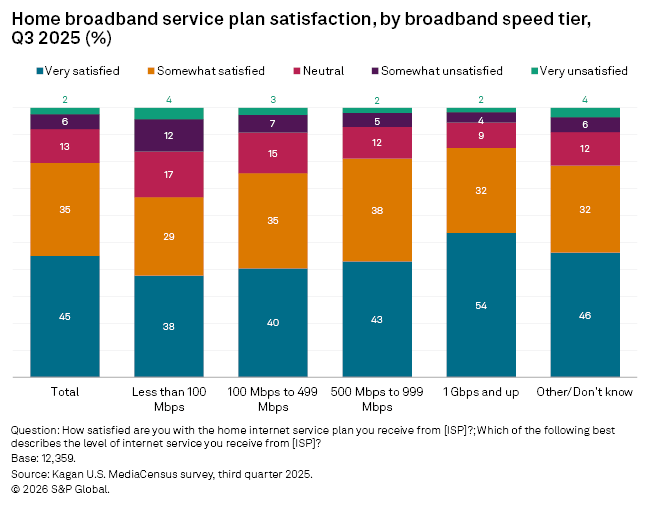
Examining broadband satisfaction by speed tier shows that subscribers to higher tiers were more likely to be satisfied. According to results from S&P Global Market Intelligence Kagan's US MediaCensus online consumer survey, this was especially true among those receiving gigabit speeds, among whom 54% were very satisfied and 85% were very/somewhat satisfied. Among subscribers receiving less than 100 Mbps, only 67% were very/somewhat satisfied.

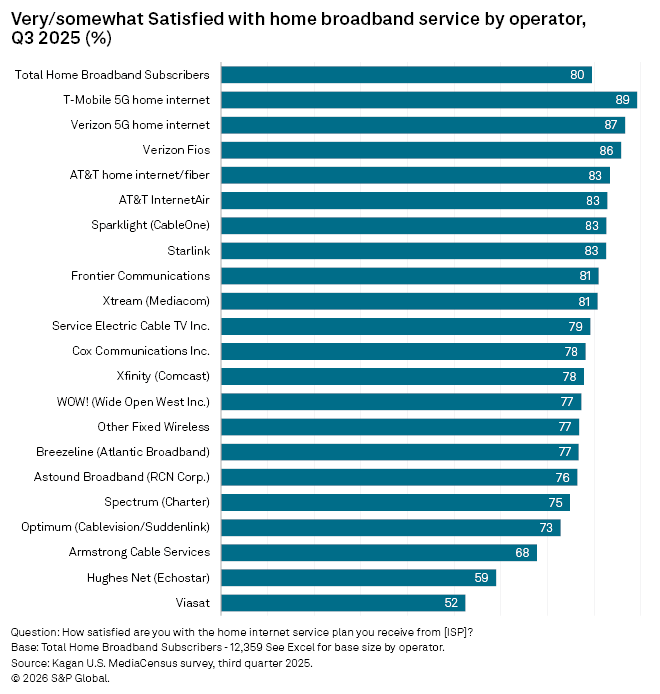
➤ Legacy satellite broadband operators Hughes Net (Echostar) and Viasat offered the only services with less than 60% of very/somewhat satisfied subs.
➤ Satisfaction was tied to broadband speed, with subscribers to faster speeds more likely to be satisfied.
➤ Gen Z respondents were less likely to be satisfied with their broadband services compared to older subscribers.

Access full tables in Excel format, including additional data, here.
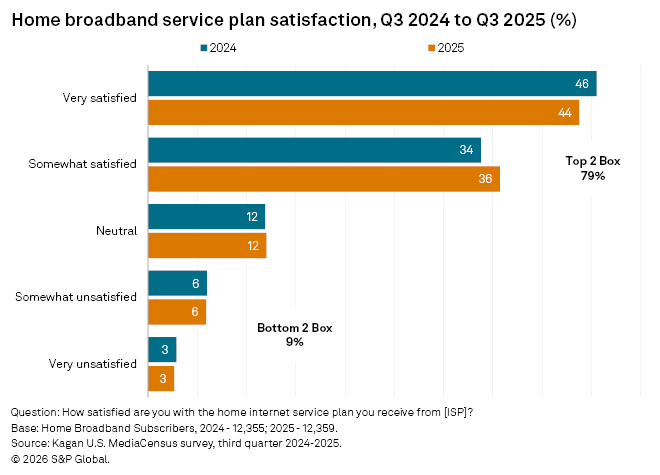
Overall, broadband satisfaction is high, with 79% indicating they were very/somewhat satisfied with the services they received in Q3 2025 – the same as in 2024. Although overall satisfaction remains high, there was a slight shift from very to somewhat satisfied.
Similar to results from prior surveys, subscribers to fixed wireless access (FWA) services were the most likely to indicate they were very or somewhat satisfied with their home internet services. T-Mobile US Inc.'s 5G home internet and Verizon Communications Inc.'s 5G home internet had the largest shares of subscribers indicating they were very/somewhat satisfied, at 89% and 87%, respectively. T-Mobile also had the largest share among operators surveyed of very satisfied subs at 62%.
AT&T Inc.'s InternetAir lagged behind the other FWA services with 83% very/somewhat satisfied, the same as the company's wired offering. However, its very satisfied FWA subs represented a larger share at 51% than the 49% of wired subs who were very happy with their services. Overall, broadband service satisfaction remains high across operators, although satellite broadband operators Hughes Net (EchoStar Corp.) and Viasat Inc. struggle as the only operators at less than 60% of subs very/somewhat satisfied. By comparison, relative newcomer SpaceX's Starlink boasts 83% satisfied subs, which the newly launched Amazon.com Inc. Leo service will surely hope to match.
See attached Excel for a full service satisfaction breakdown by package for: AT&T, Altice (Optimum), Charter (Spectrum), Comcast (Xfinity), Cox Communications, Mediacom Communications, Verizon Fios and Frontier Communications.
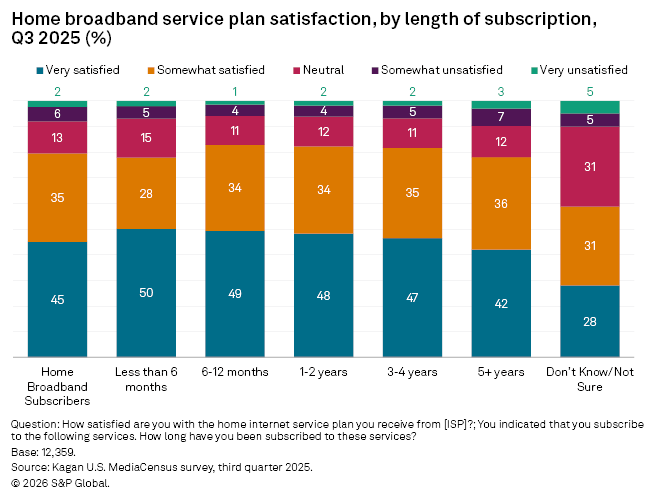
Satisfaction appears to drop over time, with very satisfied subs decreasing from 50% among those subscribed for less than six months, to 42% for those who have been subscribed for five years or more. However, the shift is mainly from very to only somewhat satisfied, with overall satisfaction highest among those subscribed six months to a year at 83%, slightly higher than 78% among those subscribed five years or more.
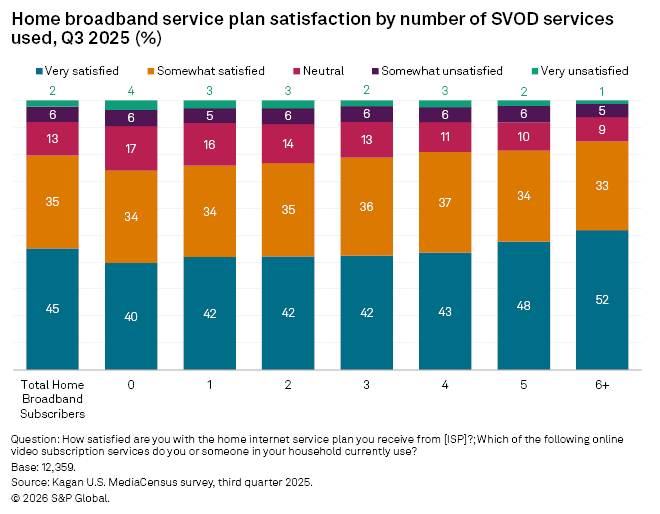
The more subscription video on-demand (SVOD) services a respondent used, the more likely they were to indicate they were very satisfied with their broadband service. Over half (52%) of those using six or more SVOD services indicated they were very satisfied, compared to only 40% of those not using any.
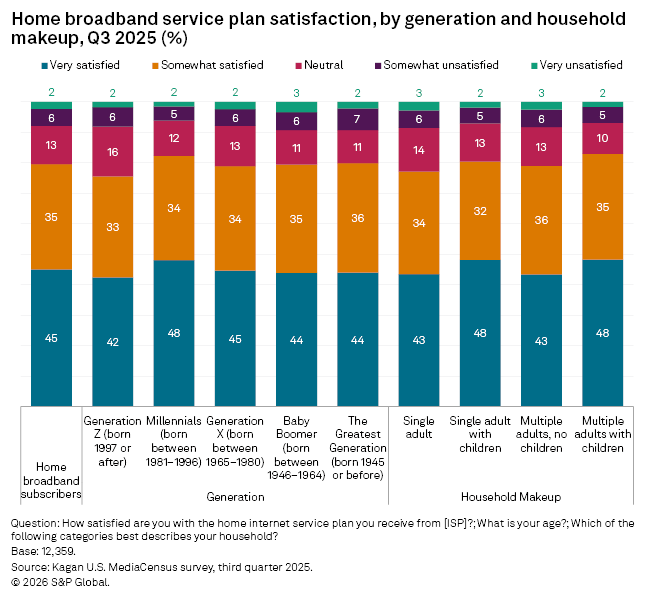
Gen Z respondents were the least impressed with their broadband services, with the smallest share indicating they were very/somewhat satisfied at 76%, while millennials had the largest share at 82%. Households with children were more likely to indicate they were satisfied with their broadband services, with the largest share among households of multiple adults with children at 83%.
Data presented in this article is from the MediaCensus survey conducted in the third quarters of 2024 and 2025. The sample included 13,299 (2024) and 13,500 (2025) US internet adults matched by age and gender to the US Census. The survey results have a margin of error of +/-0.98 ppts at the 95% confidence level. Survey data should only be used to identify general market characteristics and directional trends.
For more information about the terms of access to the raw data underlying this survey, please contact support.mi@spglobal.com.
Consumer Insights is a regular feature from S&P Market Intelligence Kagan.
This article was published by S&P Global Market Intelligence and not by S&P Global Ratings, which is a separately managed division of S&P Global.
Content Type
Segment
Language