


Research — March 31, 2026
Return of NCAA March Madness tips off year 2 of current media deals

By Michael Johnson
March ushers in an electrifying season for college basketball, highlighted this year by dominant teams and elite-level talent. For the National Collegiate Athletics Association (NCAA), March Madness remains a significant commercial opportunity, generating roughly $1 billion annually from media rights, licensing, ticket sales, and corporate sponsorships and advertising. The men's tournament, celebrated for its tradition and dramatic upsets, consistently attracts millions of viewers, while the women's tournament aims to sustain its rising popularity, fueled by the emergence of standout players in recent years.

➤ March Madness has entered year two of the current men's media rights agreement, valued at almost $9 billion in total.
➤ The 2025 men's title game averaged over 18 million viewers for the first time since the pandemic, and women's March Madness viewership is likely to continue the growth trend despite a dip in 2025.
➤ The 2025–26 regular season college basketball viewership is up big across networks.
➤ Expected betting totals could reach $4.5 billion, with the inclusion of prediction markets.

Men's March Madness media deals locked in through 2032
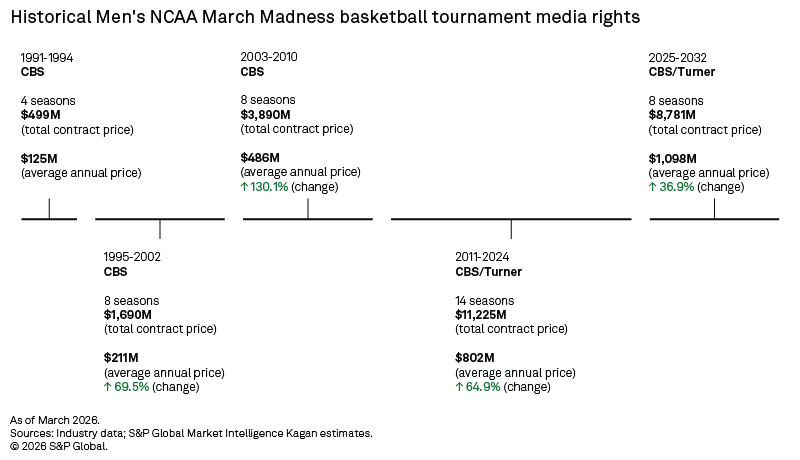
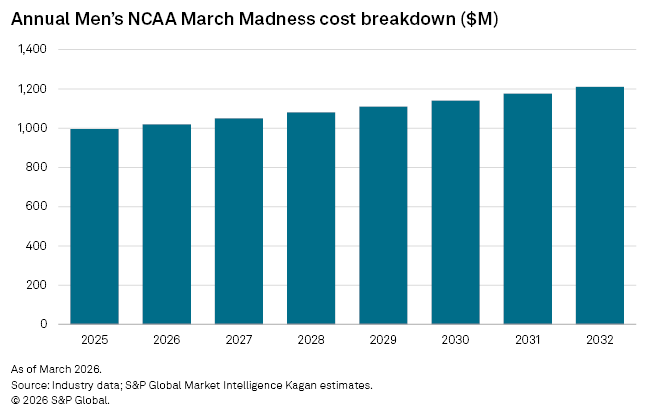
The NCAA entered the billion-dollar media rights era in 1994, signing an eight-year, $1.69 billion deal with CBS (US), which has broadcast the men's tournament since 1982. The momentum continued in 2010 with a groundbreaking 14-year partnership between CBS and Turner, valued at more than $11 billion. Originally scheduled to end in 2024, this agreement was extended in 2016, adding eight years and $8.8 billion, and securing coverage through 2032. Under the extension, Paramount Skydance Corp. and Warner Bros. Discovery Inc. are reportedly set to pay $1.02 billion to air this year's tournament, with annual escalators increasing the fee.
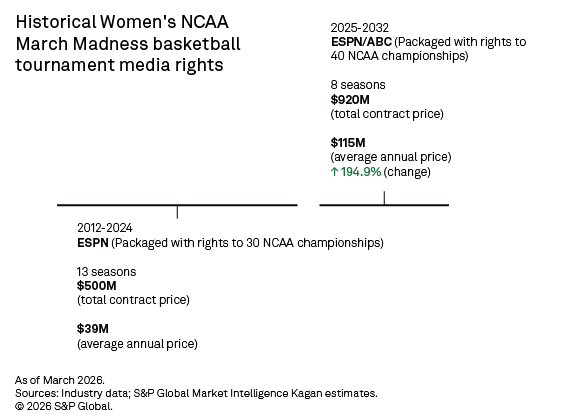
After facing criticism in 2021 for unequal treatment between men's and women's NCAA events, the association took steps to elevate the women's tournament. Enhancements included the introduction of the First Four, adoption of March Madness branding, and increased funding and staffing. These changes, coupled with a commitment to develop a media rights strategy that better captured the tournament's true value, paid off as viewership surged.
Building on this momentum, the NCAA negotiated a landmark media contract in 2023, securing $920 million over eight years for 40 championships, excluding the men's tournament and College Football Playoff. The new deal now values the women's basketball tournament at $65 million annually, doubling its previous valuation. Prior to 2025, ESPN (US) had paid about $40 million each year for these rights, including coverage of the women's March Madness tournament.
The men's Final Four returns to Indianapolis for the ninth time, while the women travel to Phoenix
The 2026 men's tournament will be broadcast across four national networks: TBS (US), CBS, TNT (US) and truTV (US). All 67 games will also be available for streaming on NCAA March Madness Live. Additionally, games shown on TBS, TNT and truTV can be streamed on HBO Max, while those airing on CBS will be accessible through Paramount+.
Throughout the tournament, TBS will televise 21 games, including major rounds such as the National Championship, Final Four Semifinals, Elite Eight, Sweet 16 and the early rounds. CBS will also broadcast 21 games, covering the Elite Eight, Sweet 16, and the First and Second rounds. truTV will air or simulcast 24 games, starting with the First Four, while TNT will air or simulcast 15 games throughout the tournament.
On the women's side, Walt Disney Co. will provide live coverage of all 67 games across ESPN's networks and the ESPN app, beginning with Selection Sunday on March 15.
Men aim to capitalize on rise in viewership, while women seek to sustain recent momentum
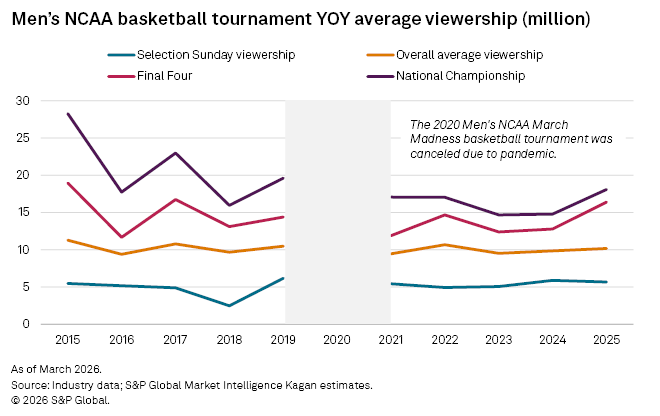
The 2025 men's National Championship was the most watched final since the pandemic, with overall viewership up compared to the previous two tournaments. Over the past five years, the tournament has averaged 10 million viewers overall, with the Final Four averaging over 13.5 million viewers. The five national championship games since 2020 have averaged 16.3 million viewers, almost 5 million fewer on average than the five championship games prior to the pandemic. The NCAA aims to return to 2015 levels, which marked the most-watched tournament since the mid-1990s.
The men's tournament has consistently boosted prime-time viewership for CBS, TNT, TBS and truTV in March. The April 2025 championship game was held on CBS and was the most-watched broadcast of the month with an average audience of over 18 million viewers.
This season, FOX set a new record for men's college basketball with over 1.2 million viewers, up 38% from last year, while FS1 had a 25% increase. CBS had its best season in seven years, averaging more than 1.4 million viewers, with standout games like Michigan-Michigan State drawing almost 3 million and Duke-Arkansas attracting 6.8 million, the highest regular-season game viewership in over 30 years. For women's basketball, FOX averaged 700,000 viewers (up 4%), and FS1 reached a record 148,000 viewers, up 22%.
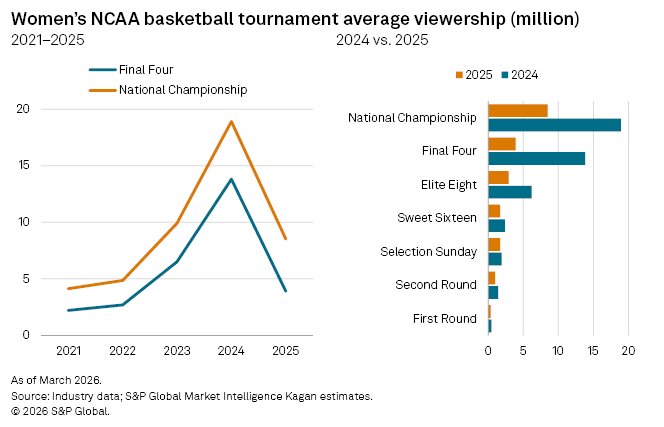
The women's NCAA tournament has risen in popularity in recent years, largely driven by the emergence of star players. Although viewership dipped heavily in 2025, as expected, the tournament still reflected the broader growth of women's basketball. The Final Four was the third most-watched women's national semifinals since 1995, with the South Carolina versus Texas matchup drawing 3.6 million viewers and UConn versus UCLA attracting 4.1 million. The championship game between UConn and South Carolina averaged 8.5 million viewers, ranking as the third most-watched women's NCAA national championship game on record.
Ahead of 2025's title game, coaches Geno Auriemma and Dawn Staley advocated for a new March Madness media deal. Both coaches, who led their teams to the 2025 championship, have supported a separate media rights agreement for women's basketball, distinct from the current package that includes 39 other collegiate championships.
Who is watching March Madness?
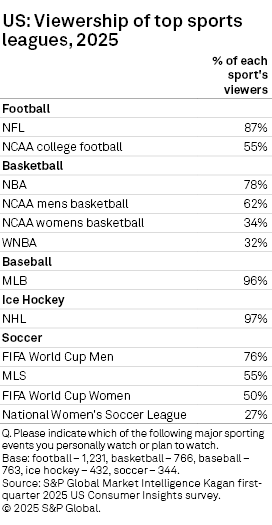
The S&P Global Market Intelligence Kagan US Consumer Insights survey for the first quarter of 2025 revealed that 31% of surveyed adults are basketball viewers. Among these basketball fans, 62% tune into NCAA men's basketball, while 34% follow NCAA women's basketball.
Prior survey data from S&P Global Market Intelligence Kagan shows NCAA men's basketball viewership among internet adults increased from 17% in fall 2023 to 20% ahead of March Madness 2024. Women's college basketball viewership rose from 7% to 9% during the same period. Most women's NCAA basketball viewers (78%) also watch men's games, while 36% of men's basketball viewers watch women’s games. About 20% of viewers for both men's and women's NCAA basketball are under 35, one-third are aged 35-54, and 45% are over 55. Men comprise 70% of the NCAA men's basketball audience and 62% of the women's basketball audience.
Over $4 billion expected to be wagered during March Madness
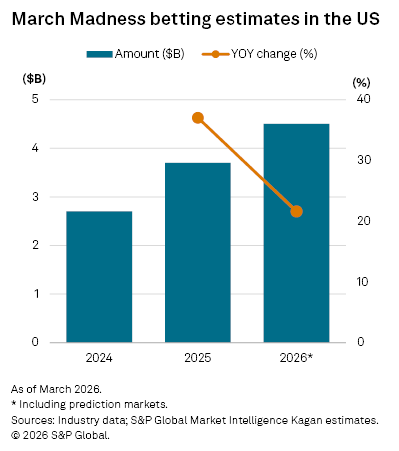
While the Super Bowl remains the most popular single game for wagers, March Madness stands out as the most bet-on event in the US sports calendar. US sportsbooks are expected to handle around $4 billion in bets on the 2026 NCAA college basketball tournaments. If prediction markets are included, the total amount wagered during March Madness could approach $4.5 billion. In comparison, legal betting on Super Bowl LX was estimated at $1.76 billion.
Much more likely to be hit by lightning or attacked by a shark than achieve a perfect bracket
Each year, around 100 million brackets are filled out for March Madness, equating to one bracket for about 30% of the US population. Of all the possible outcomes, the odds of picking a perfect NCAA tournament bracket by simply guessing or flipping a coin are one in 9.2 quintillion, according to the NCAA. The chances improve slightly to an estimated one in 120 billion using strategic logic of selecting favorites and underdogs.
Economics of Networks is a regular feature from S&P Global Market Intelligence Kagan.
This article was published by S&P Global Market Intelligence and not by S&P Global Ratings, which is a separately managed division of S&P Global.
Content Type
Segment
Language