Research — March 13, 2026
Data center power: Combined-cycle plant outperforms solar plus battery

Data centers are among the most power-intensive building types on the grid. A growing trend among hyperscale operators is to locate generation behind the meter (BTM) — that is, to build dedicated power assets on the same site as the load, rather than relying solely on grid interconnection and the wholesale electricity market. BTM generation can reduce exposure to volatile energy prices, provide greater control over supply timing and, when paired with storage and related forms of backup generation, can improve resilience against grid disturbances. The trade-off, however, is that the data center operator must shoulder the capital, operating and reliability risk of the power plant itself.
This analysis evaluates two contrasting BTM strategies for a hypothetical West Texas data center that requires 627 megawatts of electricity. The first option is a dedicated combined-cycle natural gas plant; the second is a solar plus battery system. The data center is assumed to be 627 MW, matching the capacity of a combined-cycle single-shaft gas plant in the US Energy Information Administration Annual Energy Outlook for 2025. Given the time required to build a power plant, this hypothetical facility is assumed to be available and online in 2028, with all costs presented in 2028 dollars.
Capital costs in dollars per kilowatt of capacity are highest for the combined-cycle plant at $2,293/kW and lowest for the single-axis tracking solar project at $1,118/kW. A 10-hour lithium-ion battery has a capital cost of $2,103/kW. Assuming a 28.4% capacity factor for the solar project and that all solar generation passes through an 80% efficient battery, the required solar project capacity is 2,705 MW, or 4.3 times the data center's peak load. To meet power needs on the lowest average solar production day, the 10-hour battery is sized at 903 MW, which is 44% higher than the data center's peak load. Capital costs are sourced from the S&P Global Energy Levelized Cost of Energy dashboard.
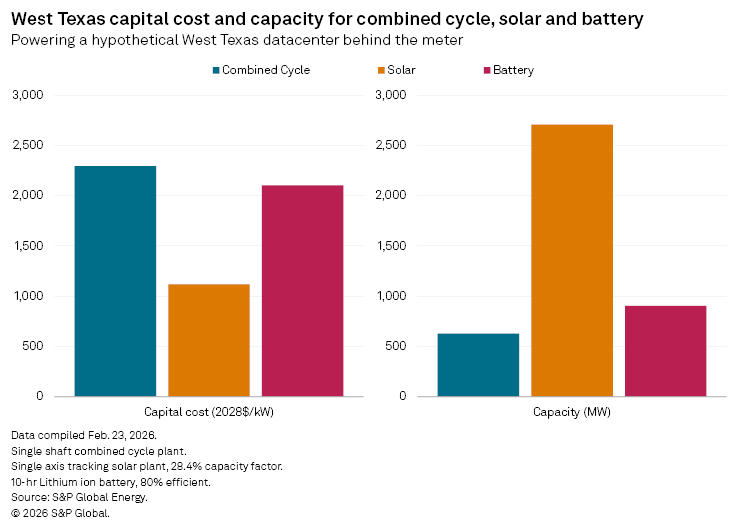
Operating costs for the combined-cycle plant include fixed and variable operations and maintenance (O&M) and fuel costs for sourcing natural gas in West Texas, based on the Q4 2025 Market Indicative forecast. The relatively small emissions costs in Texas are not included in this estimate. The battery and solar project have fixed O&M costs, and the battery is assumed to be 80% efficient over a 20-year lifetime.
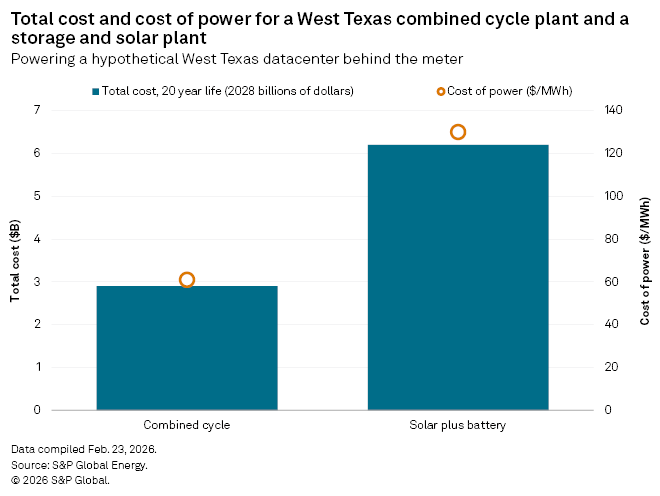
From a pure cost perspective, the combined-cycle option is the lower-cost pathway on a 20-year basis, delivering firm capacity at a cost of $2.9 billion. This economically advantageous option leverages mature generation technology and abundant natural gas supply. By contrast, the renewable carbon-free alternative of solar plus storage costs $6.2 billion, more than twice as expensive. This figure does not include potentially available production tax or investment tax credits. The estimated levelized cost of power based on these capital expenditures is $61/megawatt-hour for the combined-cycle plant and $130/MWh for the solar plus battery system, indicating a clean firm premium of $69/MWh based on technology available today. Hyperscale datacenters have shown willingness to pay premiums for firm baseload power.
Assuming the combined-cycle plant is the sole source of electricity for the data center, its availability directly determines the facility's uptime. Common maintenance estimates are unscheduled outages 2% of the time and scheduled maintenance downtime 7%. In absolute terms, 2% downtime corresponds to roughly 175 hours per year (about 7.3 days), while 9% translates to 788 hours per year (approximately 32.8 days). The unserved energy associated with those outages is substantial, ranging from 110 gigawatt-hours/year to 494 GWh/year. The solar and battery sizing is based on average values and will not fully power the data center during several-day stretches of low insolation or snow that persists on the solar panels.
Even though the pure cost comparison favors natural gas, the ultimate choice for a hyperscale data center may hinge on a broader set of strategic factors. First, corporate sustainability commitments are increasingly influencing capital allocation. Companies that have pledged net-zero emissions by midcentury may be willing to absorb higher upfront costs for a renewable-only solution, especially if the project can generate renewable energy certificates or qualify for tax incentives such as the Investment Tax Credit. Second, fuel price volatility can erode the apparent cost advantage of a gas plant. Real-world gas markets have shown spikes that can dramatically increase operating expenses. A renewable system, by contrast, locks in the majority of its cost at construction and is insulated from fuel price swings. Finally, future-proofing should be part of the calculus. The rapid evolution of battery chemistry suggests that storage costs could fall dramatically over the next decade, potentially making a solar plus storage solution more competitive if the system is designed for modular expansion. Conversely, advances in carbon capture technology could lower the emissions profile of a combined-cycle plant, narrowing the sustainability gap.
For a 627-MW West Texas data center, a dedicated combined-cycle gas plant offers a 20-year cost of roughly $2.9 billion. A solar plus battery system costs about $6.2 billion over the same horizon. The renewable option eliminates fuel price risk and aligns with carbon reduction goals, yet it does so at a $3.5 billion premium. In many cases, a hybrid architecture — combining a smaller, dispatchable gas turbine with a substantial solar plus storage system — may deliver a balanced mix of cost efficiency, resilience and sustainability.
Data visualization by Oscar Solano.
S&P Global Energy provides content for distribution on Capital IQ Pro.
For wholesale prices and supply and demand projections, see the S&P Global Market Indicative Power Forecast.
This article was published by S&P Global Market Intelligence and not by S&P Global Ratings, which is a separately managed division of S&P Global.