Research — February 18, 2026
Kaynes’ OSAT and PCB expansion set to lift sales

By Ehteesham Ansari
Indian electronics manufacturing services (EMS) and design group Kaynes Technology India Ltd. (NSE: KAYNES) has begun commercial operations at its first outsourced semiconductor assembly and test (OSAT) facility, marking a significant expansion in the company’s ambitions amid a global scramble for semiconductor supply chain resilience.
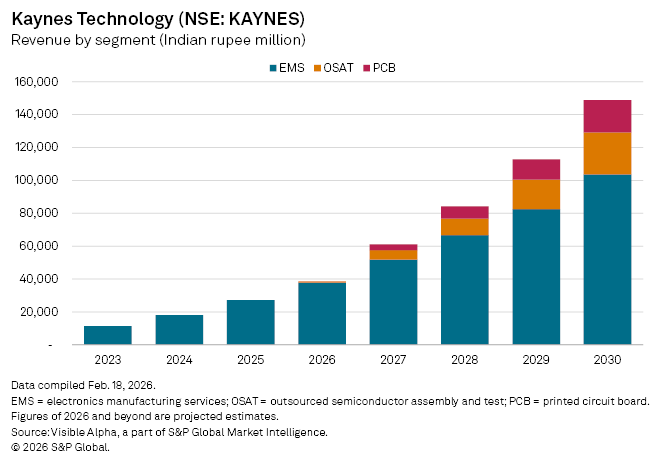
According to Visible Alpha consensus estimates, Kaynes is poised for accelerated growth over the coming years. The firm is forecast to deliver ₹38.4 billion in revenue in fiscal 2026, supported by nascent contributions from its OSAT business. With the addition of printed circuit board (PCB) operations, total revenues are expected to climb to ₹58.1 billion by 2027.
While OSAT and PCB activities remain early in their commercial life, analysts see them becoming meaningful contributors to the group’s top line. OSAT, which combines chip assembly, packaging and test services, is projected to generate ₹727 million in 2026 revenue, rising sharply to ₹5.7 billion in 2027. By 2030, OSAT alone could deliver roughly ₹25.6 billion in annual sales or about 19 % of total revenue, based on consensus forecasts.
PCB, a business segment tied to the production of complex circuit boards for electronics assembly, is slated to begin revenue generation in 2027 with ₹3.5 billion, growing to ₹7.3 billion in 2028, and reaching ₹19.6 billion by 2030. This trajectory would see PCBs account for roughly 14 % of group sales as demand from telecom, computing and industrial customers expands.
Kaynes’ investments come as global EMS and OSAT players increasingly target capacity closer to end markets, while regionalization trends in semiconductors prompt governments to subsidize local supply chains. For Kaynes, success in scaling OSAT and PCB operations could help unlock higher margins and reduce reliance on legacy contract manufacturing.
This article was published by Visible Alpha, part of S&P Global Market Intelligence and not by S&P Global Ratings, which is a separately managed division of S&P Global.
Content Type
Theme
Products & Offerings
Segment

