Research — February 13, 2026
Hyperscalers continue global data center expansion despite geopolitical tensions

By Jean Atelsek
Six major cloud providers collectively grew their public cloud region count by 7% in 2025, almost double the 2024 pace. New locations were launched in all geographic regions, with Mexico and Indonesia each gaining two regions and Saudi Arabia representing a hot spot for anticipated openings. Pushback from citizens and governments in Latin America and Europe has stalled buildouts

Public data center openings by six major cloud providers (Amazon Web Services Inc., Microsoft Corp., Google LLC, Oracle Corp., International Business Machines Corp. and Alibaba Group Holding Ltd.) rebounded in 2025, with 15 new facilities coming online in the US, Europe, Asia and Latin America. These launches were likely on the drawing board before the recent boom in capital investment for AI infrastructure and may reflect recovery after the macroeconomic strain of the COVID-19 pandemic. Vendors are highlighting their digital sovereignty credentials to reassure European customers following the EU Data Act in September 2025. Meanwhile, concern about the intense power and water demands of dense AI data centers is triggering public resistance that could put a damper on future expansion.

Public cloud region openings accelerate
AWS, Microsoft Azure Inc., Google Cloud, Oracle Cloud, IBM Cloud and Alibaba Cloud together opened 15 new public cloud regions in 2025, a solid pickup from the eight locations added in 2024. AWS launched facilities in Mexico, New Zealand, Taiwan and Thailand, as well as a second US Secret (US Secret-West) and an EU Sovereign Region in Germany (in January 2026). Azure rolled out services in Austria (the country's first hyperscaler landing), Belgium, Indonesia, Malaysia and Chile. Google and Alibaba each opened one region, Google in Sweden and Alibaba in Mexico. Oracle brought a second cloud region to Italy and launched its first one in Indonesia. IBM did not add any new public cloud sites.
This brings the total number of public cloud regions from these providers to 238, an increase of 7% from 2024.
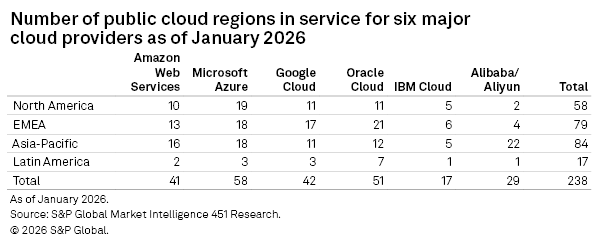
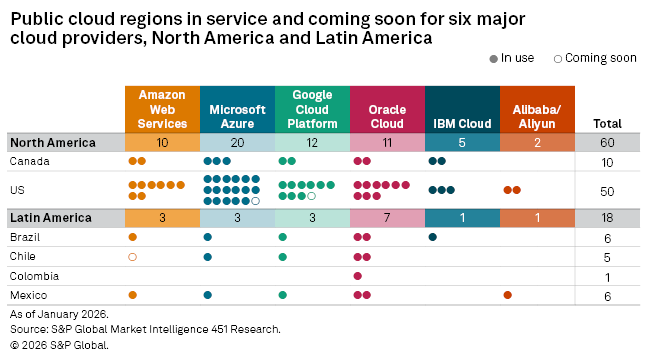
Latin America has seen an uptick in public cloud activity. The six companies now operate 17 regions there, up from eight in 2023. AWS, Azure, Google Cloud and Oracle Cloud now all have a public cloud presence in Brazil and Mexico; Chile will be next if AWS follows through on its intention to open a region there.
Google Cloud broke ground on a data center in Canelones, Uruguay, after receiving government approval in 2023. After environmental groups and the public expressed alarm at the facility's high projected water usage (Uruguay was experiencing a historic drought at the time), the company scaled down and reformulated the project, switching from water to air cooling. Although Uruguay's Ministry of Environment approved the revised plan in July 2024, Google has since removed Uruguay — along with five other planned openings (New Zealand, Austria, Greece, Kuwait and Norway) — from its website's "coming soon" roster.
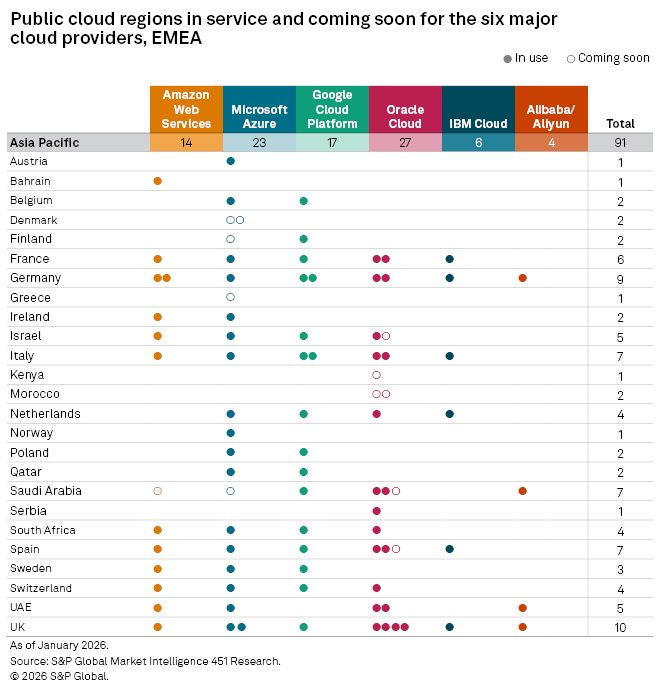
Buildouts in the Middle East have been brisk. Bahrain, Israel, Qatar, Saudi Arabia and the United Arab Emirates now have 16 regions in service, up from seven in 2021. In Africa, Oracle plans to open one region in Kenya and two in Morocco, which would bring the first public cloud availability to the continent beyond South Africa. Of the 12 "coming soon" launches for EMEA, the Middle East and Africa account for seven.
AWS cut the ribbon on its EU Sovereign Cloud facility in Brandenburg, Germany, on Jan. 15, 2026, promising physical and logical separation from existing AWS regions and compliance with strict data residency and sovereignty requirements as stipulated by the EU Data Act, which went into effect in September 2025. Oracle, which partners with colocation providers for data center capacity, has offered EU sovereign cloud services since 2023 in Madrid (in partnership with Digital Realty Trust Inc.) and Frankfurt (with Equinix Inc.). Google Cloud and Microsoft Azure have also intensified their EU sovereign cloud efforts in collaboration with EU partners.
Whether these efforts offer genuine protection from provisions of the US CLOUD Act — a 2018 law that stipulates that US-based cloud providers must comply with government requests for data no matter where it is stored — remains to be seen, especially given the current administration's aggressive interpretation of other statutes. In a push for state- and local-level digital sovereignty, and amid growing mistrust of US "big tech," municipalities in Denmark, Germany and France have recently moved employees off of Microsoft Windows and Microsoft 365 in favor of open-source alternatives such as Linux and LibreOffice.
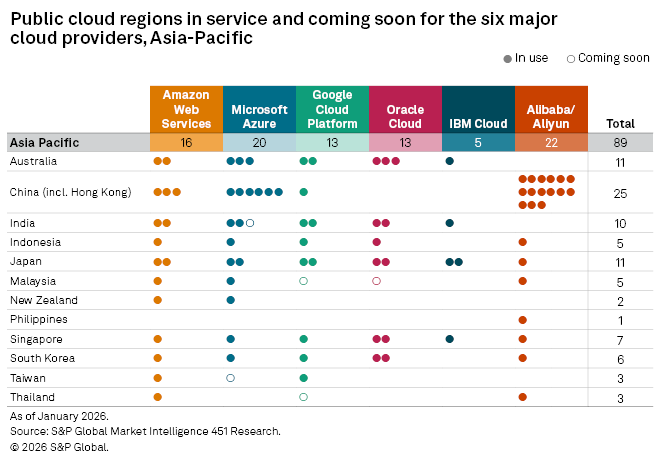
The cloud providers added six regions in Asia-Pacific in 2025, including a location in Bangkok, Thailand, opened by AWS, the first US-based hyperscaler to have a public cloud presence in the country (Alibaba has offered services there since 2022). Microsoft's Taiwan region has been in the works since 2020 and is expected to open this year. Alibaba shows its local Fuzhou and Nanjing regions in China as "closing down" on its website, but no date is given.
Content Type
Products & Offerings
Segment
Language