


Research — Jan. 13, 2026
Generative AI Digest: New models, US executive order

Google LLC's Gemini 3 release kicked off a flurry of model announcements — first Claude Opus 4.5, which helped Anthropic PBC regain leadership on some key agentic and coding benchmarks, and then OpenAI LLC's GPT‑5.2, which showed further gains on challenging reasoning benchmarks. The US legislative environment turned more tumultuous, with a new executive order aimed at curbing state AI regulations issued just as New York's Responsible AI Safety and Education Act was delivered to the governor's desk.

Amid a flurry of new proprietary model releases and leaderboard wrestling, AWS' Nova Forge announcement stands out with its focus on custom models. AWS is letting companies build private model variants by blending their data with Nova checkpoints. Most "response tailoring" is based on context engineering techniques, often due to the cost, complexity and limited support for fine‑tuning the largest proprietary models. As such, Nova Forge may represent a further tool in the customization tool kits of enterprises. Even when organizations have invested in training, the focus has often been on fine‑tuning, a post‑training step. AWS offers pre‑training, mid‑training and post‑training entry points with Nova Forge, with each bringing different compute costs, risk profiles and domain integration depth. While early‑stage data injection carries higher risks, Nova Forge's blending recipes are designed to preserve core skills. For companies requiring more native understanding of specialized domains, such as in industrial or regulated sectors, this service may make generative AI models significantly more applicable.

Product releases and updates
OpenAI released GPT‑5.2, rolling out in three forms — Instant, Thinking and Pro — within ChatGPT (initially for paid plans) and via the API. The company reports about 30% fewer hallucinations in the Thinking mode versus GPT‑5.1. The model seems to be oriented toward agentic professional applications, with OpenAI highlighting strong results on GDPval, a benchmark of well‑specified knowledge‑work tasks across 44 occupations, as well as the model's improved ability to execute longer, more complex projects. Performance appears to be "spiky," in the sense that 5.2. leads on several demanding reasoning benchmarks while scoring lower on some other popular assessments.
Kuaishou Technology released Kling O1, marketing it as the world's first unified multimodal video model. While this claim should be looked at with some skepticism due to the multimodal capabilities of OpenAI, Google and Runway video models, it is notable that the company has managed to fuse text, image and video inputs as part of a single prompt, and seemingly supports the editing and generating of net-new video using the same model.
Runway introduced GWM-1, with GWM a reference to "General World Model." Built above the foundations of video model Gen‑4.5, the family comes with three domain‑tuned variants: GWM Worlds (explorable environments), GWM Robotics (synthetic data and policy evaluation) and GWM Avatars (audio‑driven characters).
At re:Invent 2025, AWS launched the Nova 2 foundation model family (Lite, Pro, Sonic, Omni), with Sonic particularly notable as a speech-to-speech conversational AI model. The company also announced an expansion of Amazon Bedrock's agent platform with new Policy, Evaluations and Memory features, and three "frontier agents" (Kiro developer, AWS Security Agent and AWS DevOps Agent) built to work autonomously for lengthy periods. On the infrastructure side, AWS introduced EC2 Trn3 UltraServers powered by its Trainium3 chips (with Trainium4 previewed) and rolled out AWS AI Factories to bring managed AI compute into customer data centers. A new training service, Nova Forge, was also announced, which allows the building of tailored models, with companies able to merge their data with Amazon.com Inc. models at different training checkpoints.
Anthropic donated its highly popular Model Context Protocol to the Linux Foundation — more specifically, a directed fund known as the Agentic AI Foundation (AAIF). Anthropic suggests the governance model will remain unchanged, but as an AAIF founding project, alongside agentic development project goose (contributed by Block) and coding agent format AGENTS.md (OpenAI), it should ensure the project remains a neutral, open standard.
Augment Code launched an AI Code Review Agent designed for large, complex codebases. The generative AI coding startup announced that its agent is able to retrieve full, cross-file context and presented benchmarks that suggested the release scores well for accuracy and recall capabilities.
Mistral AI SAS announced the open‑weight Mistral 3 family, pairing the frontier Mistral Large 3 with compact Ministral 3 models (3B/8B/14B). Ministral appears to deliver strong edge‑friendly cost/performance, while Large 3 is competitive among open models on general instruction and multilingual/multimodal tasks. While Large 3 lags behind some notable Chinese open-weight LLMs on key reasoning benchmarks, it appears to perform well for general knowledge tasks.
NVIDIA Corp. unveiled Nemotron 3, an open family positioned for agentic AI needs. These hybrid mixture-of-experts models are named Nano (30 billion parameters, 3 billion active), Super (100 billion parameters, 10 billion active) and Ultra (500 billion parameters, 50 billion active), with model sizes aligned to the complexity of the tasks they are designed to target.
Funding & M&A
OpenAI announced that it is taking an ownership stake in Thrive Holdings, a company launched in April 2025 by one of its most significant investors, Thrive Capital. The structure embeds OpenAI's research, product and engineering teams inside Thrive's portfolio companies. Financial terms weren't disclosed, but the stake can reportedly grow if those businesses succeed. The announcement adds yet another notch to the "circular deal" critiques surrounding OpenAI.
AI foundation model company Anthropic announced it would be acquiring JavaScript runtime startup Bun. Bun has pledged to stay open-source and permissively licensed. Anthropic was a primary reference user for Bun, and the company also cited competing code-generation tools as users. Anthropic's ownership could give the business more control over a key technology for shipping Claude Code, with Bun's runtime performance helping Claude Code to deliver more quickly and efficiently. These efficiency enhancements may prove invaluable where agents are expected to deliver increasingly challenging, multi-step tasks.
AI risk startup Chatterbox Labs Limited has been acquired by Red Hat, with the intent to strengthen the security capabilities of the Red Hat AI portfolio. The London headquartered startup was incorporated in 2011 and had only announced a single $65,000 funding round in 2012, with an estimated head count of eight.
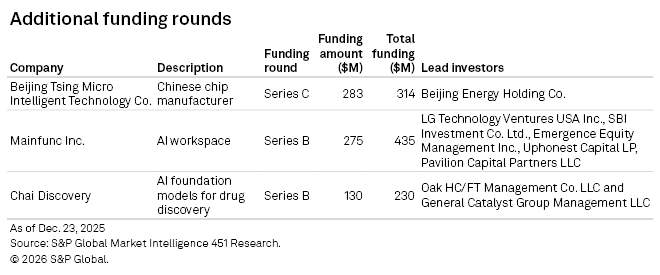
Efficiency-focused AI startup Unconventional AI announced that it had received $475 million in funding, co-led by new investors Andreessen Horowitz and Lightspeed Ventures. Little is known about the startup beyond its mission to deliver "biology-scale energy efficiency" and its CEO, Naveen Rao, who was CEO and co-founder of Mosaic ML Inc., which was acquired by Databricks Inc.
Visual AI generator startup Black Forest Labs announced a $300 million series B round at a $3.25 billion post-money valuation. The round was co-led by new investors Salesforce Ventures and AMP. The company suggested that proceeds would go toward further enhancements to its flagship model family, FLUX, and highlighted text-to-video models as an area of investment.
AI application deployment and inference software provider BaseTen Labs Inc. announced the acquisition of Parsed, a post-training specialist with significant research expertise in reinforcement learning. The acquisition announcement presents a partnership in which Parsed will help companies build enhanced, specialized AI capabilities from open-source models and Baseten will ensure those models are running at low latency, with higher levels of reliability.
OpenAI announced it would be acquiring Neptune to bring its training monitoring and experiment tracking tools in-house. Neptune's external services will wind down after the close. Terms of the deal were not disclosed; however, industry speculation pegs the deal to be worth less than $400 million in stock.
Politics and regulations
A US executive order seeks to curb state AI regulations by mobilizing federal agencies to challenge laws deemed burdensome or inconsistent with national priorities. It establishes a Justice Department AI Litigation Task Force, directs the Commerce Department to evaluate state statutes and tie BEAD funds to compliance, and asks the Federal Trade Commission and the Federal Communications Commission to consider preemptive consumer protection and disclosure standards. The order doesn't create a federal framework, and its legality is uncertain, inviting court challenges and reactions in Congress.
A bipartisan coalition of 42 state attorneys general sent letters to leading AI companies, among them Microsoft Corp., OpenAI, Google, Anthropic, Apple Inc., Meta Platforms Inc., Perplexity AI Inc., Replika and xAI, warning that "sycophantic and delusional" chatbot outputs pose risks to children and vulnerable users. They urged stronger safeguards, independent pre‑release audits and clear incident reporting that notifies users exposed to harmful interactions. California and Texas did not sign.
New York's Responsible AI Safety and Education (RAISE) Act, targeting frontier models with safety plans, third‑party review and incident‑disclosure obligations, was delivered to Governor Kathy Hochul. A bipartisan super PAC announced that it would be targeting the congressional campaign of Alex Bores, who co-sponsored the RAISE Act.
Australia released its National AI Plan on Dec. 2, aligning with the Future Made in Australia agenda. The plan focuses on capturing investment, building local capability and connectivity, spreading benefits through skills and public‑service improvements, and keeping Australians safe via an AI Safety Institute and adaptive use of existing laws. Led by Minister Tim Ayers and Assistant Minister Andrew Charlton, the plan funds the institute, promotes workforce development and signals a technology‑neutral regulatory posture while monitoring emerging risks.
India's Department for Promotion of Industry and Internal Trade released a working paper proposing a mandatory blanket license, allowing AI developers to train on all lawfully accessed copyrighted works in exchange for statutory royalties to creators. A collecting body would handle collection and distribution, but royalty rates are to be set by a government‑appointed committee. The paper opens a 30‑day comment window.
This article was published by S&P Global Market Intelligence and not by S&P Global Ratings, which is a separately managed division of S&P Global.
S&P Global Market Intelligence 451 Research is a technology research group within S&P Global Market Intelligence. For more about the group, please refer to the 451 Research overview and contact page
Content Type
Products & Offerings
Segment
Language