


RESEARCH — Dec 17, 2025
New major copper discoveries remain scarce; late-stage assets drive growth

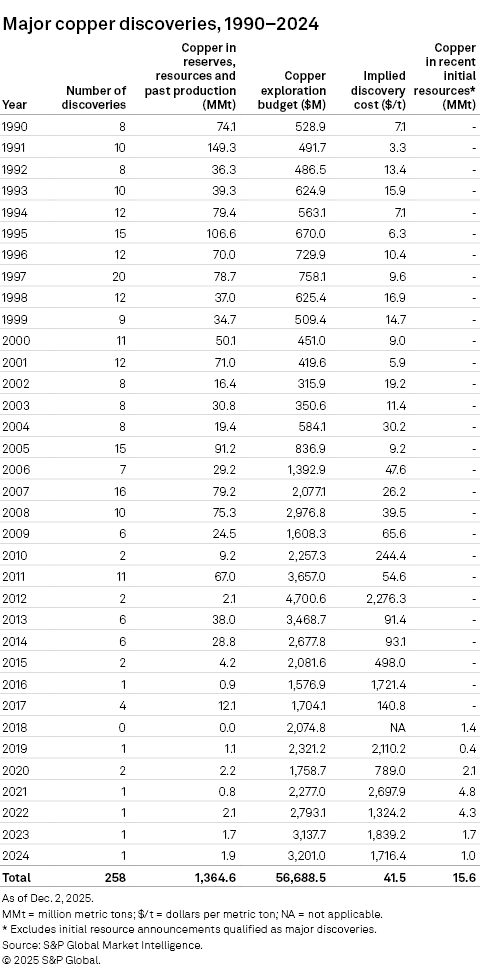
Our annual analysis of major copper discoveries has identified 258 copper deposits discovered between 1990 and 2024, containing 1.365 billion metric tons of copper in reserves, resources and past production. There was a net gain of 19 deposits in 2025, versus our 2024 analysis, mainly deriving from recently announced initial resources, along with some new entries from backfilled discoveries that now meet our total contained copper threshold. The volume of discovered copper in the 2025 analysis shows a 4% net increase, or 49 million metric tons. Most of this rise is due to the growth of resources and reserves on late-stage assets — those undergoing prefeasibility, scoping or feasibility studies.

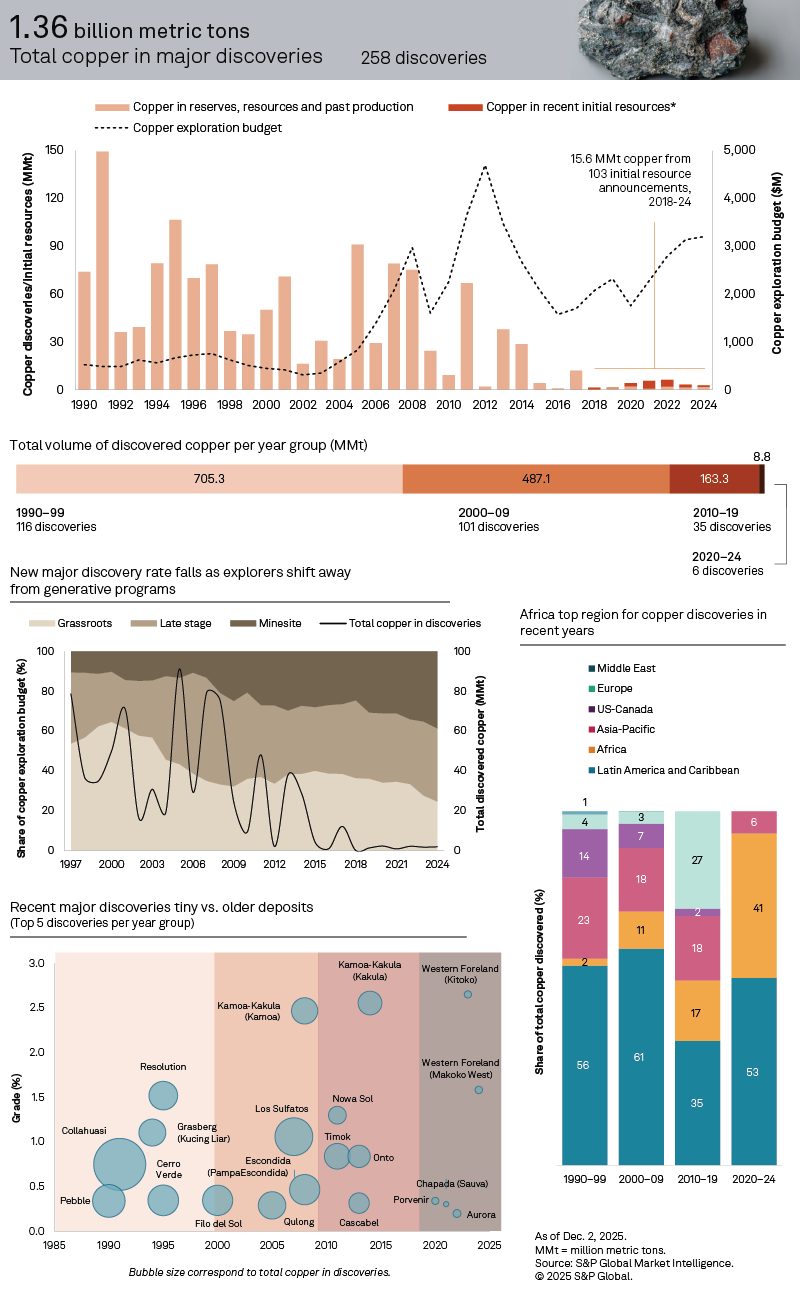
➤ Major copper discoveries in the decade from 2015 to 2024 remain lower in number and size compared to the prior decades, reflecting explorers' growing preference to expand existing mines, with lower allocations and less focus on generative programs, as part of companies' value-driven strategies.
➤ Most of the discovered copper volume rise in 2025 comes from the growth of some late-stage assets' reserves and resources.
➤ Latin America hosts most of the discovered copper globally; Africa has emerged as a new top hub of copper discoveries in the recent decade.
➤ With copper market projections still expecting deficits in the long run, developing these late-stage assets and discoveries is a race against time to fill the gap.

The S&P Global Energy discoveries dataset includes all deposits containing at least 500,000 metric tons of copper in reserves, resources and past production. The year of discovery corresponds with the year of the initial drill program that identified potentially economically viable mineralization, eventually resulting in a definition of copper in reserves and resources that meets or surpasses our major discovery threshold criterion.
A full list of the discoveries can be found in this Excel spreadsheet.
Stagnation persists in new major copper discoveries
Since 2007, the mining industry has increasingly prioritized expanding and developing deposits at or near existing mines over pursuing riskier, generative exploration programs. Our copper discoveries dataset clearly reflects this strategic shift, where a significant proportion of the growth in the discovered copper volume stems from assets initially found in the 1990s and early 2000s. Although the total copper discovered so far has grown year over year, more than 70% of that increase comes from late-stage assets — already well-advanced in the exploration pipeline — rather than from newly identified deposits.
Examining the broader trend, the rate and size of new copper discoveries remain lackluster compared to previous decades. Despite a rebound in copper exploration budgets since 2021, only six major discoveries totaling 8.8 MMt have been made in 2020–24. Furthermore, none of the deposits with the largest year-over-year volume increases were discovered in the 2015–24 decade; for example, Filo del Sol in Argentina, the biggest contributor to recent growth, was found in 2000. The largest discovery in the 2020–24 period, Aurora in Peru, is considerably smaller than the top discoveries of earlier periods (1990–99, 2000–09 and 2010–19), underscoring not only the lagging pace of discoveries but their diminishing significance.
Latin America still leads; Africa rises as top copper discovery hub
Similar to our 2024 findings, Latin America is the region with the most copper discovered since the 1990s. It hosts 758 MMt of total contained copper in 119 major discoveries, accounting for 56% of our dataset's total. Latin America remains the largest copper hub globally, both for exploration and production, and holds five of the top 10 discoveries in our records. The two largest, Collahuasi and Los Bronces Underground (Los Sulfatos), are in Chile, the top country both for exploration and for mined copper production. Moreover, almost all the newly added discoveries to our dataset came from initial resource announcements on projects in Latin America, specifically Chile, Peru, Argentina and Brazil, which are notable among the top countries explored for copper.
The Asia-Pacific region follows in distant second place, with 279 MMt of copper — or 20% of the global total — discovered in 63 deposits. More than half of this volume is found in currently producing assets, including the largest three: the Qulong deposit in China, and the older deposits Grasberg (Kucing Liar) in Indonesia and Oyu Tolgoi (Hugo Dummett) in Mongolia. No new major discoveries have been recorded in the region.
Coming in at third and accounting for 10% of the total discovered copper in our dataset is the US-Canada region. Among the new additions to the 2025 list from the initial resource announcements was the Hat deposit in British Columbia, which was discovered in 2013 and now ranks as the 15th largest in the region.
In the 2015–24 decade, Africa has emerged as the region holding the largest total discovered copper. It hosts 10.4 MMt of total copper discovered since 2015, accounting for 37% of the decade's total. Apart from the Opuwo asset in Namibia, almost all deposits are located within the Western Foreland project in Democratic Republic of Congo. The most recent discovery is the Makoko West deposit, a 1.87-MMt discovery in 2024 grading 1.6% copper.
Discoveries and the impending long-term copper supply deficit
Of the 258 major discoveries on our list, most remain undeveloped: 162 have yet to enter production, 134 of which have not even completed feasibility studies, and only 17 have reached the construction phase. The industry's current focus is primarily on older, previously discovered assets that have yet to advance. This strategy is often a way of mitigating economic, permitting or social challenges. Exploration budgets reflect this shift away from pursuing new discoveries. Grassroots copper exploration in 2024 and 2025 accounted for just 25% of the total base metal budget in both years — an all-time low share that continues to suppress the rate of major new discoveries.
The recent Commodity Briefing Service report shows the copper concentrate market to be in deficit in 2025–28 before a temporary shift toward surplus in 2029–31, and ultimately leaning into a large deficit starting in 2032. Furthermore, our latest copper project pipeline study indicates that the global copper mine supply, including operating mines and projects in the pipeline, is expected to peak at 27.3 MMt in 2030 and then decline to 25.1 MMt in 2035. The base case scenario for concentrate market projections anticipates a deeper deficit of 3.8 MMt in 2035. There is a possibility that this deficit could be averted if all the potential copper supply makes it to production; the report states that this is highly unlikely, however, given the challenges facing each individual project and the industry as a whole.
With an average timeline of approximately 17 years from discovery to production of copper mines — and even longer for projects initiated after 2025 — bringing these late-stage assets online is a race against time. Given the industry's reliance on older, undeveloped discoveries, bridging the expected supply gap will be a significant challenge.
This article was published by S&P Global Market Intelligence and not by S&P Global Ratings, which is a separately managed division of S&P Global.
Content Type
Theme
Location
Segment
Language