


RESEARCH — Dec 17, 2025
Generative AI Digest: New models and copyright disputes

Headline-grabbing legal developments surrounding copyright and landmark model launches made for a sector-shaping November. In Europe, copyright law developments featured prominently, with updates in the Getty Images Holdings Inc. v. Stability AI Ltd. case and OpenAI LLC's dispute with German music rights society GEMA. On the product front, Google LLC and Anthropic PBC rolled out major new model releases, while Microsoft Corp. used its Ignite event to spotlight a wave of agentic AI announcements. In the infrastructure space, CoreWeave Inc.'s planned acquisition of Core Scientific Inc. was terminated, while Lambda secured a significant funding round. This report covers key regulatory updates, new model launches, and funding and M&A activity shaping the market.

Google's Gemini 3 model received significant acclaim due to its notable performance gains in some of the most challenging reasoning and multimodal benchmarks. These gains challenge the assumption that large-scale improvements in large language model capabilities were plateauing, which gained traction amid the muted reception to OpenAI's GPT-5. While offering incremental improvements, GPT-5 did not meet the high expectations that preceded its release. According to its model card, Gemini 3 retains the sparse mixture-of-experts architecture of its predecessor, Gemini 2.5 Pro, but Google suggests it has seen enhancements to expert query routing. There also appear to be enhancements to its integration of native multimodal processing. A potentially underdiscussed implication of the release is that Gemini 3 was trained and is served entirely on Google Cloud Tensor Processing Units, not NVIDIA Corp. graphics processing units. With NVIDIA Corp. standing as the most valuable company in the US, could this start to eat into to its dominance?

Product releases and updates
The benchmark-surpassing Gemini 3 was introduced and promptly rolled out in preview across Vertex AI, Gemini Enterprise, Google AI Studio, Google Search and Google's newly announced agentic integrated development environment, Google Antigravity. Among Google Antigravity's standout features is browser control, an uncommon capability among GenAI-enabled IDEs. Google indicates that the platform is intended to support extended autonomous AI operations, incorporating capabilities such as asynchronous user feedback. The company also unveiled Nano Banana Pro, taking its original Nano Banana model (Gemini 2.5 Flash Image) and scaling it up with the power of Gemini 3 Pro to create a tool with the reasoning ability to handle complex requests and the professional control to deliver high-fidelity visuals.
Anthropic released Claude Opus 4.5, enabling the foundation model provider to reclaim some leadership positions in notable software engineering and agentic benchmarks. A notable characteristic of the release is that fewer output tokens are required to address challenging tasks than leading competitor models, which should help Anthropic mitigate the premium price point associated with its models.
Highlights from the Adobe Max conference include new AI assistants for conversational task automation, Firefly Image Model 5 and Firefly Custom Models for personalized styles. Firefly Creative Production, for bulk editing high volumes of images at once, saw focus, as did enhancements to the Firefly Boards collaboration platform. Adobe Inc. announced an array of generative AI features across its Creative Cloud portfolio (among 100 updates in the latest release), as well as expanded partner integrations, with models from Topaz Labs L.L.C. and Eleven Labs Inc. joining the ecosystem.
SAP SE introduced RPT-1 (Relational Pretrained Transformer), a foundation model designed specifically for a variety of forms of structured business data, including relational data. The company positions RPT-1 as enabling enterprises to perform predictive analytics and reasoning across tabular datasets without relying on the training processes typically required for pattern-recognition machine learning. Small, large and open-source variants of the model have been announced.
DeepMind Technologies Ltd. announced SIMA 2, the updated version of its Scalable Instructable Multiworld Agent introduced in 2024. The major shift is that SIMA 2 is capable of "reasoning" about tasks, moving beyond simple instruction following and being able to outline the steps it is taking to a user. The ability for SIMA to undertake more complex video game tasks may not seem particularly important for enterprises; however, the expectation is that these capabilities can start to extend into the physical world.
Canva Inc. announced a design foundation model, the aptly named Canva Design Model. This announcement took center stage as part of Canva's newly announced "creative operating system," with Canva suggesting the model "understands" structural composition, brand consistency and design logic. Canva was unwilling to share details about its architecture at the time, but notes that it is a proprietary model.
In late October, International Business Machines Corp. released Granite 4.0 Nano, available in two sizes — 350 million and 1 billion parameters — under the highly permissive Apache 2.0 license. The former appears to perform particularly well relative to models of a similar size, with benchmark scores comparable to popular open-source 1 billion-parameter models at one-third of the size.
Meta Platforms Inc. announced Segment Anything Model 3 (SAM 3), a text-prompted detection model that can identify and track objects in images and videos. The company also announced a suite of open-source 3D models, titled SAM 3D, which can reconstruct 3D scenes from images.
At Ignite 2025 in San Francisco, Microsoft announced an agentic control plane, Microsoft Agent 365, which includes an agent registry, access controls and performance management features, among other capabilities. Microsoft suggests this registry will soon include detected unsanctioned "shadow agents."
Chinese AI startup Moonshot AI has unveiled Kimi K2, an open-source mixture-of-experts model with one trillion parameters, designed for advanced reasoning and agentic workflows. The model demonstrates strong performance on coding, logic and multi-step reasoning tasks. Central to its stability and efficiency is the custom MuonClip optimizer.
Baidu Inc. announced ERNIE 5.0 at its Baidu World 2025 event. A proprietary model, in a departure from the open-source approach taken by many Chinese companies, Baidu claims comparable performance with Google 2.5 Pro and GPT-5 (High) against many benchmarks, and to have surpassed them for some multimodal reasoning, document and chart understanding tasks.
Seattle-based nonprofit AI research institute AI2 has launched OLMo 2, featuring high-performing models with 7 billion and 13 billion parameters. AI2 stands out for its commitment to open-source development, providing model weights, datasets, code, training recipes, intermediate checkpoints and instruction-tuned variants.
Funding & M&A
Adobe has acquired Invoke, a generative AI image creation and editing startup. The Invoke team will reportedly join Adobe to support its new AI Foundry managed service, which is a co-development initiative to help enterprises build custom generative AI models trained on their own data. While financial details remain undisclosed, Invoke's hosted services will shut down, and its open-source project will continue under community stewardship.
Anthropic announced that it will receive $15 billion in a round of funding. The transaction will include participation from new investor NVIDIA ($10 billion) and Microsoft ($5 billion). The round will be raised at a post-money valuation of $350 billion. Anthropic will use the proceeds to purchase $30 billion in Azure cloud computing capacity from Microsoft.
GPU cloud provider Lambda announced a $1.5 billion round led by new investor TWG Global. The company has now raised $2.3 billion in total funding. The company suggests proceeds will go toward buying additional NVIDIA GPUs, as well as building its own data centers.
Rich-media-generation startup Luma AI Inc. announced a $900 million series C round. The company has raised the funding at a valuation of $4 billion. The startup suggests it will use the funding to further its multimodal AI efforts, which appear to include the development of "world models," a category of foundation model that can deliver 3D interactive worlds.
CoreWeave's proposed acquisition of fellow GPU cloud provider Core Scientific encountered significant hurdles and was ultimately terminated after failing to secure shareholder approval. CoreWeave announced it had struck an all-stock deal worth $9 billion to buy Core Scientific in July.
Workday Inc. moved to acquire Pipedream Labs Inc., an AI-agent integration platform, advancing its plan to deliver actionable AI across HR and finance. Together with its recent Flowise and Paradox acquisitions, the deal sets the foundation for Workday's strategy to lead in agentic automation for talent and back-office operations.
Identity and access management provider Keycard has acquired Runebook Inc. to expand its ecosystem of software development kits, with the intent to make it easier for enterprises to build and adopt trusted MCP (Model Context Protocol)-powered AI agents.
Cloudflare Inc., a leading connectivity cloud company, announced that it intends to acquire Replicate, an AI platform that simplifies deploying and running AI models for developers. This acquisition is designed to ensure that developers building on Cloudflare will be able to access any AI model globally with just one line of code.
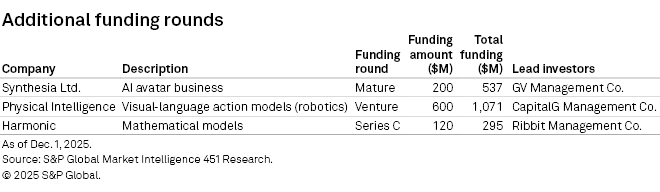
Sakana AI Co. Ltd., a Japanese startup building enterprise models optimized for Japanese language and culture, has secured a ¥20 billion ($135 million) series B funding round, valuing the company at $2.65 billion post-money and taking its total to roughly $379 million, making it Japan's most valuable startup. The round saw participation from local players motivated to develop local sovereign AI, as well as Silicon Valley heavyweights. These include Mitsubishi UFJ Financial Group Inc., Khosla Ventures, New Enterprise Associates and Lux Capital Management.
Politics and regulations
In a recent UK High Court ruling involving Getty Images Holdings Inc. and Stability AI, Getty withdrew its primary copyright infringement claims after failing to show that Stability AI's model training had occurred in the UK, a jurisdictional requirement. The court dismissed remaining secondary copyright claims, holding that Stable Diffusion's model weights were not "infringing copies" because they do not store or reproduce Getty's works. Only a handful of trademark infringement instances were upheld, relating to synthetic watermarks in early model outputs.
A German court ruled that OpenAI models violated copyright laws by using licensed musical works without permission, ordering the company to pay damages to music rights society GEMA.
The European Commission is preparing a package to simplify EU digital rules, with the intent to boost competitiveness. The proposal amends the EU AI Act and GDPR. It includes delaying obligations for high-risk AI systems from August 2026 to December 2027, easing data access for AI model training by narrowing personal data definitions and introducing mechanisms to improve consistency in data protection enforcement across Member States.
The current US administration called for unified federal rules for AI, suggesting that overregulation by specific states is undermining growth. House Republicans are seeking to override state AI laws, with competition from Chinese AI ascendancy a primary justification.
S&P Global Market Intelligence 451 Research is a technology research group within S&P Global Market Intelligence. For more about the group, please refer to the 451 Research overview and contact page
This article was published by S&P Global Market Intelligence and not by S&P Global Ratings, which is a separately managed division of S&P Global.
Content Type
Location
Products & Offerings
Segment
Language