Research — Sept. 16, 2025
Metaverse Digest: Generative AI interactive world-building accelerates
By Ian Hughes and Neil Barbour
In our most recent Metaverse Digest, we focused on the Augmented World Expo; this digest returns to normal with a wide-ranging set of occurrences in and around metaverse technology and use — the most significant being the release of several generative AI virtual-world-building approaches. In addition, S&P Global Inc. has published results for both its consumer and industrial worldwide metaverse surveys.

It is still early days for these 3D virtual-world-building GenAI applications and models. They follow on from significant advances in other media generation, such as video. Video creation ranges from AI image generators creating a few seconds of animation of any image to full production and direction of camera angles and action in scenes. These all need a degree of understanding about how things work, the physics of motion and how materials and objects interact with one another; this is also needed for an interactive 3D world. Additionally, NVIDIA Corp. made statements to the SIGGRAPH community that digital creative arts and design skills are going to be needed in an industrial setting, opening a wider set of job opportunities. The third year of the S&P Global worldwide metaverse industrial/enterprise and consumer surveys brings a large amount of data across a wide range of questions to help understand the metaverse undercurrent and evolution that carries on in the background, just as these digests continue to show that there is a lot of emerging technology being applied across the board.

Generative AI world-building accelerates
In 451 Research's recent Tech Trend in Focus: Generative AI for rich media, the wide-ranging use of GenAI in images, audio and video is described. It also mentions the emerging world-building approaches. With regard to AI world-building, this month saw:
– Google DeepMind announced and showed examples of its Genie 3, which generates diverse, interactive environments from text prompts with real-time navigation and environmental consistency.
– Tencent-Hunyuan released an open-source world generator on GitHub with HunyuanWorld 1.0, allowing developers to build and run the generator on their own machines.
– Dynamics Lab unveiled Mirage 2, which allows users to upload a starting image for a world, such as a person standing looking at scenery, along with a text-based world description (which can also be generated from the image). The application then starts to stream a live virtual world where the person becomes an animated, moving character, and the camera and the character can move through the environment.
– Runway AI Inc. added to its current video generation and control with a game-narrative-building tool, Runway Game Worlds. This creates a branching story — "choose your own adventure" style — from a set of prompts and then creates comic-book-style panel images to match the journey through the story.
– Microsoft Corp. released its experimental AI-powered Copilot 3D to help users create usable 3D models from 2D pictures, competing with services such as Meshly.
Adobe shutters Aero
Aero, Adobe Inc.'s multiplatform augmented reality (AR) creation tool released in 2019, will be completely removed from use in December 2025. The company says, "Aero was developed with the goal of eventually being used with mixed-reality glasses. The industry landscape for AR has changed since 2020. While Adobe is continuing to explore mixed reality, the team is choosing to focus its resources on alternative areas of development.
Lawsuits target Roblox over child safety
Roblox Corp., which hosts one of the largest collections of virtual worlds on the internet, is defending itself against accusations that its platform does not foster a safe space for children. Louisiana Attorney General Liz Murrill filed a suit in state court in August, alleging that the company has created an environment where child predators can "thrive, unite, hunt and victimize kids" due to insufficient safety measures. Roblox responded with a statement saying that the company is persistently attempting to improve its safety features.
Readyverse gets ready for players
New metaverse-style platform Readyverse has had a soft launch (general early access) online. We first covered the Ernest Cline-related platform in 2024. The aim is for its collection of games and virtual world experiences to support interoperable content and lean in on existing Warner Bros. IP, such as from the "Ready Player One" movie — the avatars from which appear as part of the launcher and onboarding. Readyverse uses an NFT (non-fungible token)-based approach to the content. It hosts a suite of games and experiences and acts like a metaverse hub, such as Roblox or Fortnite. We have covered this type of application in a previous report.
SIGGRAPH and the industrial metaverse
The annual graphics and animation research conference features many groundbreaking approaches to creating and manipulating digital content. Notable this year was NVIDIA's presentation, described as a special address. CEO Jenson Huang described AI as essential infrastructure, comparable to electricity and the internet, and looked toward an explosion of ideas in digital twins, robotics and physical AI. Other presenters then described real-time graphics and AI tools for artists to create massive, detailed worlds efficiently. Discussion then moved to physical AI and simulation with training of AI robotics in AI-driven virtual world simulations and its Cosmos World Foundation Model. NVIDIA also reminded those in the graphics arts field that their skills are now of significant value to industrial companies with the evolution of digital twins, digital thread and industrial metaverse.
S&P Global Worldwide B2B Global B2B Metaverse Survey 2025
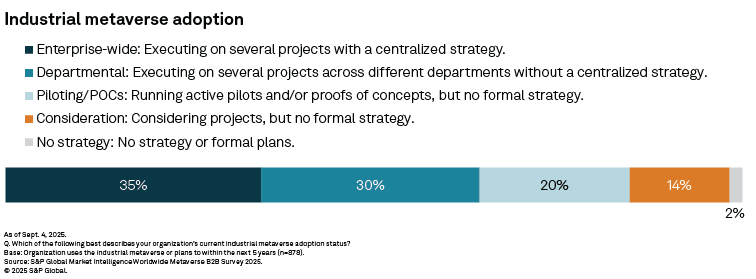
The survey results for industrial and enterprise users (business-to-business and business-to-consumer) show a significant use of industrial metaverse, with 35% of respondents citing enterprise-wide usage and 30% at a departmental level. This is a slight increase over the same time in 2024, with 33% enterprise-wide and 28% departmental in industrial internet adoption.
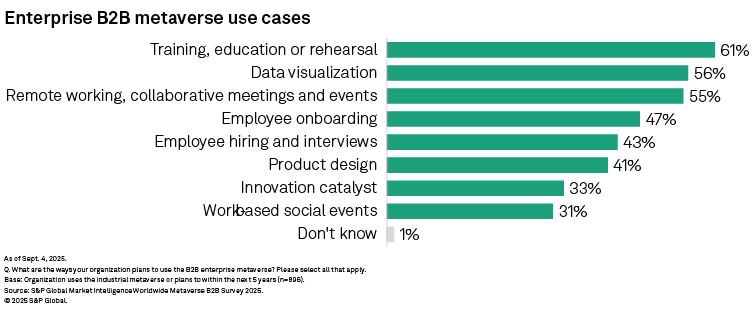
When asked about B2B enterprise use cases, the largest share of respondents shared that they would rely on metaverse tools for training, education and rehearsal (61%); data visualization (56%); and remote working, collaborative meetings and events (55%). These three applications reflect the breadth of spatially apt applications in the enterprise.
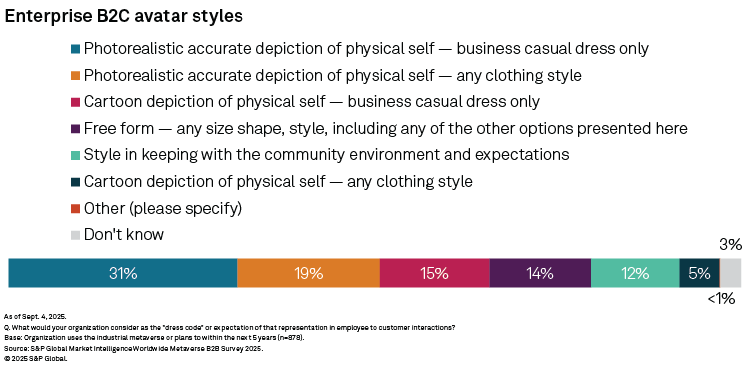
Also in the survey are questions about avatar representation from an enterprise point of view. Business-casual photo realism for avatars in interactions with customers gets 31% of the responses. This does not always fit with the platform's users' view of creative expression, although 25% of respondents are open to free-form avatars in any shape or style or a style in keeping with the community.
S&P Global Worldwide B2B Global Consumer Metaverse Survey 2025
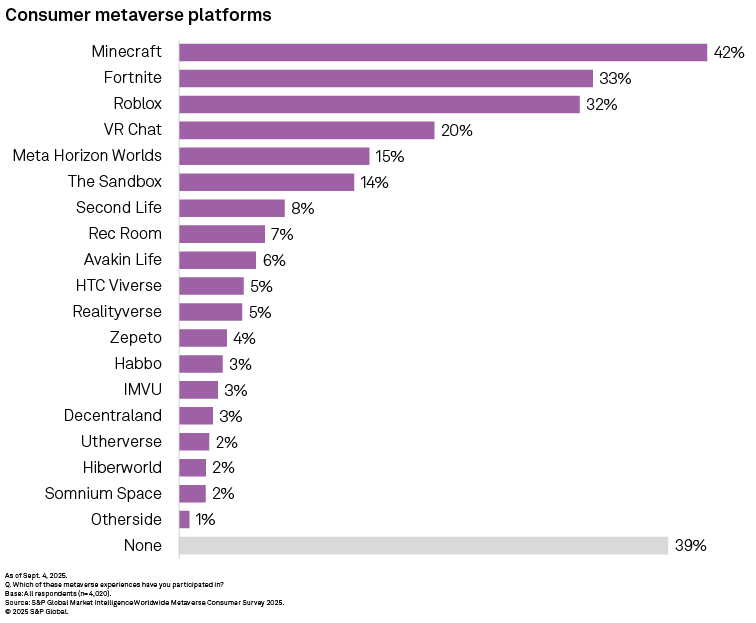
The consumer metaverse survey asks the general public about their use of and attitudes toward the metaverse and the wide range of experiences that relates to. Compared with industrial and enterprise use, consumers interact with the metaverse more so for entertainment and social purposes. For consumers, the platforms of choice for interacting with user-generated content are Minecraft, Fortnite and Roblox.
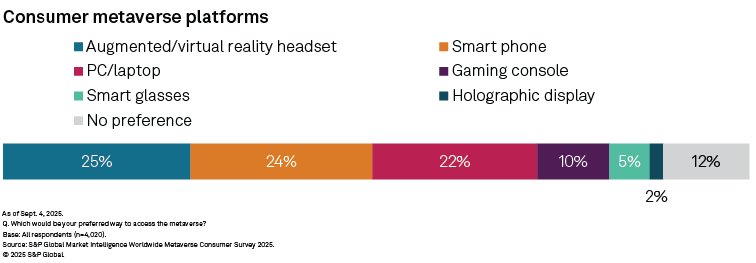
Metaverse access is often mistakenly associated with only being through virtual-reality (VR) or AR headsets. Consumers do use these, but also many other platforms, including smartphones, PCs and consoles.
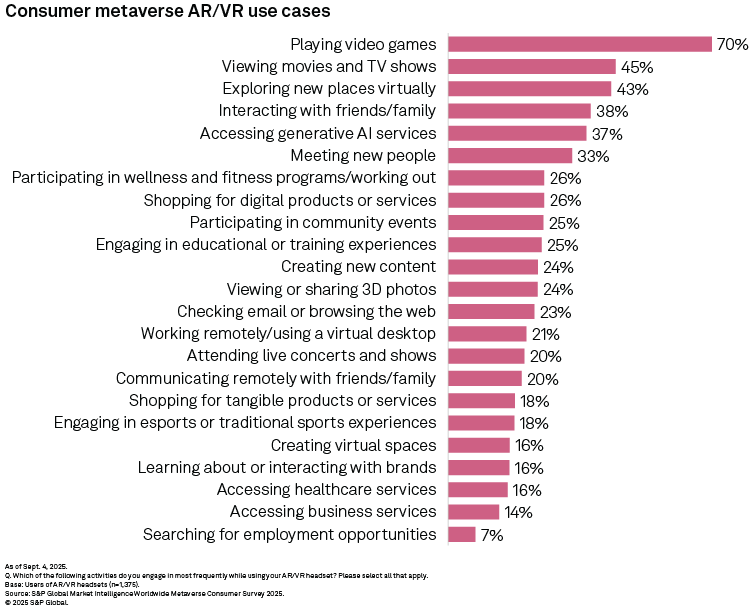
However, when using an AR/VR headset, the majority of applications at the top of the list are often more social ones. Games can be single-player experiences, as can watching and viewing movies, but other applications regarding friends and family, meeting new people, and exploring new places are more human and social despite the often-incorrect expectation that a headset is an insular experience.
Content Type
Products & Offerings
Segment
Language