Research — Sep 25, 2025
After Jimmy Kimmel returns, late-night's future remains in question

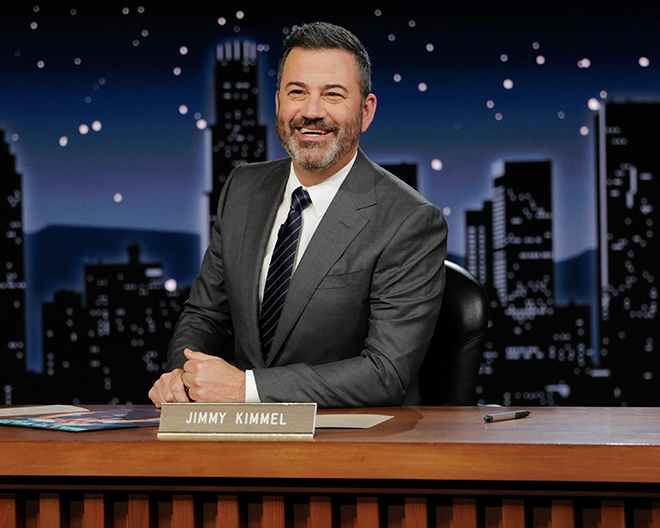
| The recent suspension and reinstatement of "Jimmy Kimmel Live!" is raising long-term questions about the future of late-night comedy. Source: Randy Holmes/ABC via Getty Images |
"Jimmy Kimmel Live!" has returned to ABC (US)'s lineup, but questions remain about the show's long-term prospects as two high-profile broadcast groups continue to preempt the show and viewers continue to watch more content online.
Following a four-night suspension, late-night host Jimmy Kimmel was back on air Sept. 23, beginning with a nearly 18-minute opening monologue that addressed remarks he made about the death of Charlie Kirk. "It was never my intention to make light of the murder of a young man," he said. "Nor was it my intention to blame any specific group for the actions of what was obviously a deeply disturbed individual."
Notably, though, viewers in about 20% of the country — including markets in Washington, DC; New Orleans; Nashville; Portland, Ore.; Salt Lake City; and St. Louis — could not watch the show on their local ABC station as the nation's two largest station operators, Nexstar Media Group Inc. and Sinclair Inc., continue to preempt the show. Together, the pair owns or manages about 60 ABC stations.
Between the ongoing preemption and the changing economics of television, analysts believe that late-night comedy shows could soon become a thing of the past. In May 2026, Paramount Skydance Corp.'s CBS (US) will exit the daypart when "The Late Show with Stephen Colbert" comes to an end. Kimmel's contract is also set to expire in May 2026, and many question whether it will be renewed or if the host wants to continue. The Trump administration has openly criticized NBC (US)'s late-night hosts Jimmy Fallon and Seth Meyers.
"In today's streaming-focused environment, the late-night shows hold less value as viewers are less inclined to binge-watch a season of Kimmel or Colbert," said Scott Robson, an analyst at S&P Global Market Intelligence Kagan. "The episodes hold less replay value as time goes on."
Late-night's future
Robson noted that late-night shows have faced several hurdles in recent years, including declining ratings and advertising revenue.
Late-night ad revenues have declined from nearly $440 million in 2018 to $220 million in 2024, according to reports. CBS said its decision to exit late-night was strictly a financial one.
The decline in ratings is not necessarily a sign that the shows are less popular, merely that viewers are consuming them differently. Audiences view clips of the shows on YouTube rather than watching on the linear network late at night. Kimmel's "Jimmy Kimmel is Back!" video on Alphabet Inc.'s YouTube had more than 21 million views by the end of Sept. 24, one day after the show aired live at 11:35 p.m. ET on Sept. 23. As part of its statement noting that it will continue its preemption, Nexstar noted "Jimmy Kimmel Live!" will be "available nationwide on multiple Disney-owned streaming products."
Beyond the fragmentation of viewership, Robson noted these shows are also facing new types of competition. "I think the growth of interview-style podcast shows on YouTube has increased competition for late-night shows and stolen some of that audience," he said.
Nevertheless, Robson does not believe late-night talk shows are going to disappear altogether anytime soon, noting that both Fallon and Meyers have deals that run through 2028.
Shift to streaming
Given the popularity of these late-night hosts on digital platforms, late-night is likely to evolve into streaming-first fare, said Brian Wieser, former Wall Street analyst and ad agency executive and now CEO of consultancy Madison and Wall. While attributing subscription revenue to specific content is difficult, he believes Kimmel, Colbert and other hosts could generate significant revenue for the networks' direct-to-consumer platforms.
"I don't think we will continue to see traditional late night," he said. "But it will be unsurprising if it's still intact with similar content release in different formats and environments."
A shift to streaming could also remove some of the political pressure, noted Lightshed Partners analyst and partner Rich Greenfield.
"While the [Federal Communications Commission] oversees broadcast television and must ensure TV station programming is in the public interest (including broadcast network programming aired by stations), it has no control over the content that airs on cable networks or streaming platforms," the analyst wrote, adding that he would not be surprised to see Comcast Corp.'s NBC shift its late-night sketch comedy show "Saturday Night Live" to cable network Bravo (US) and/or NBCUniversal's Peacock streaming service.
He noted that while "SNL" would lose meaningful reach and ad dollars by shifting to cable, SNL's content could be more engaging on those platforms.
Prior to Kimmel's suspension, FCC Chairman Brendan Carr said Kimmel appeared to have misled viewers. Carr also said broadcast station owners should require ABC to remove Kimmel from its late-night schedule. The FCC regulates radio, television and cable companies in the US.
"These companies can find ways to change conduct to take action, frankly, on Kimmel," Carr said on a Sept. 17 podcast. "Or, you know, there's going to be additional work for the FCC ahead."
However, speaking at a New York event Sept. 22, Carr said taking Kimmel off air had been a business decision from the companies involved and was not due to pressure from the federal government.
Other business at play
All things considered, analysts believe it is only a matter of when — not if — late-night comedy shows move off broadcast networks. Craig Huber, equity research analyst at Huber Research Partners LLC, said late-night could go away in "a fast decline," especially for the media companies trying to win regulatory approval for their pending deals.
"Nexstar is trying to buy TEGNA Inc. in a very large deal. I don't think they want to upset the federal government on gaining approval," Huber said. The Nexstar-TEGNA deal is worth $6.2 billion. "Similarly, we all know that Sinclair is looking to find a partner or sell itself. It's the same thing: They don't want to upset the federal government."
ABC's parent, Walt Disney Co., is also in the middle of a major deal, with ESPN Inc. looking to gain NFL Media assets in exchange for a 10% stake in the sports programmer. ESPN's nonbinding deal to acquire NFL Network, the league's fantasy holdings, and linear distribution and branding rights to the RedZone channel must also pass federal regulatory muster.
Rise of local
Local content, Huber noted, would be a good replacement option given both the economics and lack of national politics. "Why piss off half the audience out there?" he said.
Nexstar and Sinclair both replaced "Jimmy Kimmel Live!" with news programming and have not indicated how long they plan to continue the preemption.
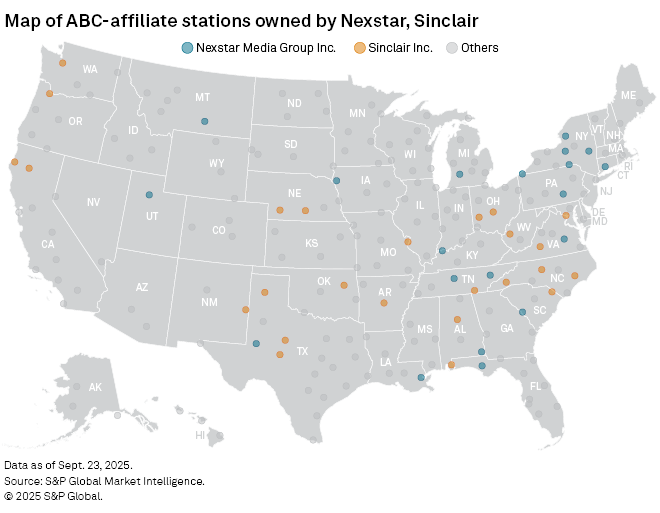
"Nexstar is continuing to evaluate the status of Jimmy Kimmel Live! on our ABC-affiliated local television stations, and the show will be preempted while we do so," Nexstar said in a Sept. 24 statement. "We are engaged in productive discussions with executives at The Walt Disney Company, with a focus on ensuring the program reflects and respects the diverse interests of the communities we serve."
Sinclair similarly said that discussions with Disney are "ongoing as we evaluate the show's potential return."
Robson and Wieser both agree local news is a likely option, but noted that stations could also look to replace late-night comedy shows with syndicated reruns of older shows.
"It will be low-cost content," Wieser said.
The fight continues
Although Kimmel addressed his remarks, the analysts do not expect President Donald Trump to drop his complaints about late-night fare that has been critical of his administration.
Following the announcement of the show's return, Trump indicated on his social media platform Truth Social that he was considering legal remedies. He referenced his previous defamation suit against ABC News over comments made by anchor George Stephanopoulos. In late 2024, ABC News settled that lawsuit by agreeing to pay $15 million to Trump's presidential library and $1 million in legal fees.
"I think we're going to test ABC out on this," Trump said in his post. "Last time I went after them, they gave me $16 Million Dollars. This one sounds even more lucrative."
Disney did not immediately respond to a request for comment regarding Trump's social media post. ABC noted on Sept. 24 that "Jimmy Kimmel Live!" returned Sept. 23 to almost 6.3 million total viewers, despite being preempted across 23% of US TV households. By comparison, "Jimmy Kimmel Live!" episodes averaged 1.77 million viewers in the second quarter, according to live-plus-seven-day ratings from Nielsen Holdings Ltd. Kimmel's Sept. 23 monologue had garnered 26 million viewers across YouTube and social media platforms, according to ABC.
This article was published by S&P Global Market Intelligence and not by S&P Global Ratings, which is a separately managed division of S&P Global.
Economics of Streaming Media is a regular feature from S&P Global Market Intelligence Kagan.
This article was published by S&P Global Market Intelligence and not by S&P Global Ratings, which is a separately managed division of S&P Global.