BLOG — Sept. 10, 2026
Satellite Versus Tower Economic Showdown

The August 3 bankruptcy filing from legacy satellite broadband operator HughesNet is a direct result of the success of the “new space” broadband era where profitable LEO broadband now dominates.
Towers arguably have infinite lifetimes. But LEO satellites, despite costing more, are basically disposable.
The return on investment in rural areas for wired fiber and cable networks can be dozens of years, which has kept wired ISPs from spending on such remote rollouts. Closing the digital divide in rural America requires radio frequency connections enabled by LEO satellites and ground-based towers using 5G equipment.
With the frenzy of activity surrounding satellite communications, we decided to take a comparative look at the pure broadband economics of going to space with satellites and staying on the ground with traditional towers.
But first, let’s review connectivity differences between towers and low earth orbit satellites. Basically, the farther a user is from the base station, the slower the speeds and the worse the latency. Specifically:
- Terrestrial tower users can only be a few miles from the base station at most. Fixed wireless download speeds can get as high as 1 Gbps when using new “next generation 5G” technologies like Tarana Wireless Inc., but are generally in the 100 Mbps+ range.
- LEO satellites are about 100 miles to 300 miles above ground level (and fly at about 18,000 miles per hour). Download speeds for LEO are often measured above 100 Mbps, with latency, in milliseconds, in the double digits.
- Geostationary satellites are over 10,000 miles overhead and orbit at the same rate as the Earth, anchoring themselves in the sky. Download speeds for GEO-based systems are about half or less compared to Starlink. And latency (in milliseconds) is so high that online gaming and VoIP calls are a stretch.
Gif from CIQ Pro: U.S. Broadband & Pay TV Trends: Satellite versus tower economic showdown
Cash flow
The bottom line is that cash flow margins are strong whether the base stations are on Earth or in orbit. But looking just at EBITDA and excluding capex, Starlink is already ahead of the pack.

Image from CIQ Pro: U.S. Broadband & Pay TV Trends: Satellite versus tower economic showdown
In the 5 years since its commercial availability, Space Exploration Technologies Corp.'s broadband service Starlink is already cash-flow positive with an adjusted EBITDA margin of 61% in the second quarter of 2026.
Smaller fixed wireless companies, also known as wireless ISPs (WISPs), can hit 50% cash flow margins quickly, especially if they utilize unlicensed spectrum.
Cash flow details on the fixed broadband operations are unavailable from the big 3 nationwide fixed wireless (FWA) operators AT&T Inc., Verizon Communications Inc. and T-Mobile US Inc. But the three combined logged a wireless adjusted EBITDA margin of 53% last quarter (as a percent of service revenue, including mobile and fixed wireless together). And because fixed wireless mostly utilizes the same infrastructure as mobile (towers and spectrum), costs can be shared.
Satellite costs have declined significantly since the Cold War era. In the "old space" days prior to 2011, the cost per kilogram to launch a satellite was $29,500, according to 451 research analyst Johan Mermij in the July 28 webinar “Orbit as the Next Data Frontier.” SpaceX executives expect this rate will get as low as $100 per kilogram in future Starship launches, a 99.7% decline.
Build cost and lifespan comparison
Towers arguably have infinite lifetimes. But LEO satellites, despite costing more, are basically disposable.
In the first half of 2026, SBA Communications Corp. (one of the big three tower companies in the US, along with American Tower Corp. and Crown Castle Inc.) built 189 towers globally for $61.6 million, or $325,963 each on average. This is less than a quarter of the $1.4 million it costs to build and launch a Starlink V3 LEO satellite.
Towers are designed to hold enough radio equipment to serve several tenants per pole. But it can take years to appease red tape requirements at the local, county, state and federal levels from concept to full operation. The amortization schedule for these terrestrial towers is generally 20-30 years, however with proper maintenance a tower can last for much longer (e.g. the Eiffel tower still stands after 137 years).
By the time a tower can be built, a LEO satellite may have already lived its entire life.
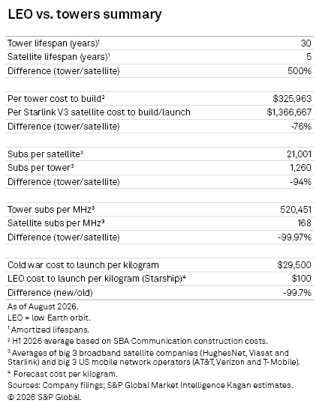
Image from CIQ Pro: U.S. Broadband & Pay TV Trends: Satellite versus tower economic showdown
The LEO satellite amortization schedule is only 5 years, just 17% of the amortization span of the 30-year terrestrial tower.
After 5 years, these satellites are dropped back into the atmosphere to burn up and are eventually replaced by new satellites.
According to FCC filings, Starlink is expected to de-orbit 609 satellites in 2026. They will burn up completely as they enter the Earth’s atmosphere.
While the return on investment of destroying a satellite every 5 years might be bewildering to ground-based network operators — not to mention being potentially environmentally unsound — LEO satellite costs should, as noted, continue to decline.
Subscribers by MHz of spectrum
While satellite companies are forced to share the same "road" of spectrum with competitors, MNOs each have their own private radio frequency highways.
The big 3 MNOs AT&T, T-Mobile and Verizon combined have 799 MHz of population-weighted average spectrum depth in the US, including low and mid-band spectrum ranges (600 MHz to 5 GHz) to power their national smartphone and fixed wireless operations. Within these bands, terrestrial wireless operators each "own" this spectrum, giving them full control (within FCC rules).
The same volume of spectrum for Starlink is 15 times that amount in the 10 GHz to 50 GHz range (Ka and Ku bands): 15,680 MHz (including 65 MHz worth of DISH’s terrestrial AWS 3/4/H-Block). GEO incumbents Viasat and HughesNet/Echostar have about four times as much spectrum as MNOs at 4,000 MHz and 3,600 MHz of spectrum, respectively.
Maintaining network quality when satco's all share the same spectrum requires dynamically, and in real-time, adjusting signal strength and other methods like:
- Beamforming: focusing a connection signal in a line (like a spotlight) and not broadcasting in all directions,
- Frequency and beam hopping: using adaptive frequency management to change frequencies in real time if interference is detected, and
- Space Division Multiple Access (SDMAs): using the same frequency for different users by isolating them based on their physical location.
The big three MNOs collectively serve over 415 million US fixed wireless connections and retail mobile subscriptions (including smartphones, tablets and laptops). Our figures exclude wholesale wireless customers, so the total number of subscribers served by MNOs is actually higher.
The big three satellite broadband operators serve just 3.9 million fixed broadband connections in the US.
In terms of subscribers served per MHz of spectrum, the delta is huge: 520,451 per MHz for terrestrial wireless versus just 168 per MHz for satellite. This comparison uses duplicated spectrum totals for satellites of the much-higher ranges of spectrum (Ka and Ku bands) where propagation is worse, and wider volumes of spectrum are used.

Image from CIQ Pro: U.S. Broadband & Pay TV Trends: Satellite versus tower economic showdown
Assuming it takes about 50,000 pole-style towers and 60,000 small cell nodes to provide near-nationwide coverage, MNOs serve about 1,260 subscribers per base station.
The same number for satco broadband operators collectively is 20 times higher at 21,001. We estimate only 186 satellites are in range of the 50 US states at any one time across the big three satellite providers, with most of these owned by Starlink.

Image from CIQ Pro: U.S. Broadband & Pay TV Trends: Satellite versus tower economic showdown
The temporary rural sweet spot?
Since satellite broadband launched in the US in 1998, rural areas have been its sweet spot.
Fixed wireless, which has also been around since the 1990s, is better suited for rural rollouts where low population density means radio frequencies (licensed and unlicensed) are relatively empty and available for broadband traffic.
But the return on investment in rural areas for wired fiber and cable networks can be dozens of years, which has kept wired ISPs from spending on such remote rollouts.
“The ceiling for (LEO operators) before they degrade service is 10 to 40 homes passed per square mile at the lowest broadband speed at 100 meg,” according to Verizon’s CEO Daniel Schulman regarding Starlink in the company’s second quarter 2026 earnings call. Schulman estimates satellite broadband has a total addressable market of between just 6 and 8 million locations in the US.
However, similar rural-only dismissals were initially made by cable operators when asked about the threat from national FWA services from the big three MNOs. Over time, however, fixed wireless has grown in suburban and even urban areas.
Already in five states, Starlink has more urban customers than rural ones, according to an April 2026 report from internet speed researchers Ookla. Incumbent geosynchronous-orbiting (GEO) satellite broadband operators DISH DBS Corp.'s HughesNet and Viasat Inc. have long focused on rural connectivity, but both have been losing customers to Starlink. In the last year ending June 2026, HughesNet and Viasat US broadband subs dropped by 24% and 33%, respectively, while Starlink was up 83%.

Overall, consumers are the biggest winners from the enhanced spectrum-based broadband competition that both fixed wireless and the new space LEO broadband operators are bringing. The closing of the digital divide will happen much faster thanks to these two broadband technologies. And with Amazon.com Inc.’s Leo launch on the horizon, competition should rocket higher.