Research — Sep 26, 2025
Are consumers ready for Meta Ray-Ban Display smart glasses?

By Neil Barbour
Meta Platforms Inc. announced its first display-based smart glasses at its annual Connect showcase on Sept. 17, which will likely go down as a landmark event in the history of connected devices. S&P Global Market Intelligence Kagan research suggests Meta is moving in at the right time. In a recent survey, nearly a quarter of respondents said they already use smart glasses and for those who don't, nearly half were interested in purchasing a pair over the next year.
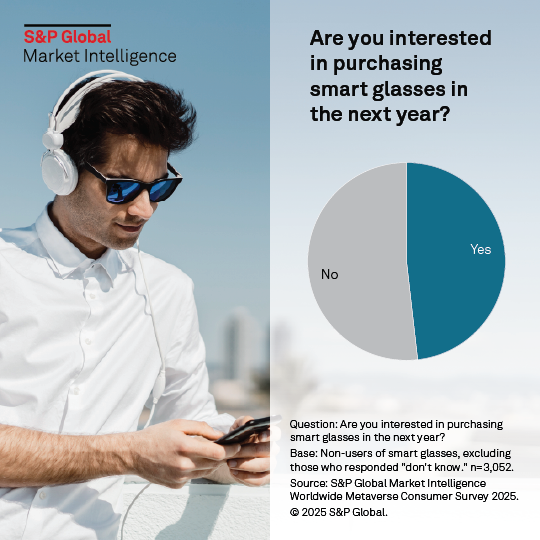
Read: Nearly half of consumers interested in buying smart glasses
When this survey was put into the field in May, consumers were more likely thinking about the AI-driven, audio-based smart glasses that companies such as Meta and Amazon.com Inc. had been selling for $200 to $400 alongside advertising campaigns featuring models, musicians and actors.
Meta continued to pull on that thread at Connect with the second-generation Ray-Ban Meta glasses ($379) and the fitness-oriented Oakley Meta Vanguard ($499).
What consumers might not have had in mind, at least yet anyway, was a pair of smart glasses with a screen embedded in the lenses. CEO Mark Zuckerberg personally donned the Meta Ray-Ban Display glasses and demonstrated a feature set that revolved around taking pictures and sending text messages with a new armband-based input device called the "neural band." Zuckerberg also attempted to take a video call from Meta CTO Andrew Bosworth, but the two could not complete the connection.
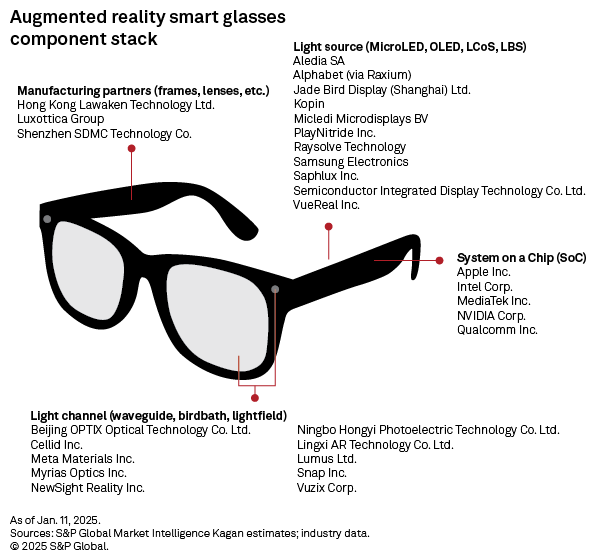
The display is limited to one eye and offset from the center of the frame to reduce distractions and intrusions. Meta confirmed that the display's component stack revolves around waveguide, which projects an image onto substrates embedded in the lenses, creating a sense of translucency for the user. The most recent waveguide tech is also obscure, though certainly not impossible to see, for people looking at someone wearing a pair of these smart glasses.
We have seen similar products at CES and Augmented World Expo over the years and have been impressed with the progress the segment has made. In fact, we declared at CES 2025 that smart glasses had entered the product phase after seeing a handful of promising demonstrations with display-based technology, and Meta's announcement confirms that we were more or less on schedule.
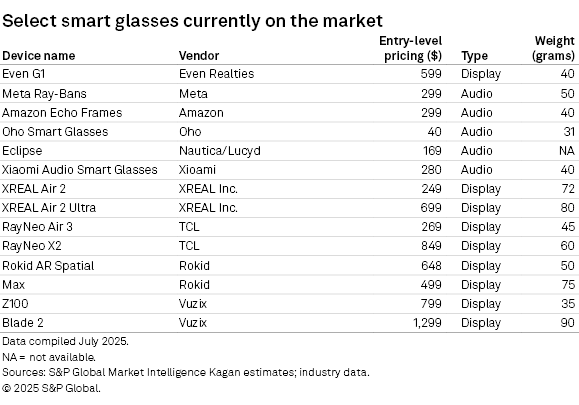
However, the Meta Ray-Ban Display glasses arrived a little chunkier and a little pricier than we suspect the average mass market consumer is willing to tolerate. They were visibly larger than the existing Meta Ray Ban glasses, which already make a relatively bold fashion statement, and will cost $799 when they launch Sept. 30. Furthermore, the troubled live demonstrations suggests that there are still a few bugs to be worked out of the system.
With that in mind, we will stand by our forecast for 1.2 million display-based smart glasses shipped in 2025, growing to 4.2 million in 2029, with the caveat that this market is moving quickly. We will reiterate that if Apple Inc. or Samsung Electronics Co. Ltd. move aggressively into the smart glasses market sooner rather than later, our forecast would likely be rendered too pessimistic.
This article was published by S&P Global Market Intelligence and not by S&P Global Ratings, which is a separately managed division of S&P Global.
Economics of Streaming Media is a regular feature from S&P Global Market Intelligence Kagan.
This article was published by S&P Global Market Intelligence and not by S&P Global Ratings, which is a separately managed division of S&P Global.