03 Sep, 2026
Virginia's critical minerals push runs into a crowded Atlantic

A Trump administration push to extract minerals from heavy sands off the Virginia coast must overcome opposition from fishing, shipping and tourism interests to move forward.
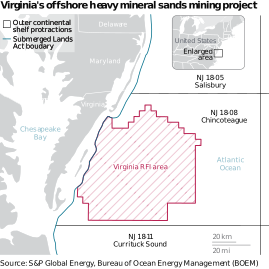
The Bureau of Ocean Energy Management closed a two-month public comment period Aug. 22 over whether it should sell leases in a 2,764-square-mile area. The region contains heavy mineral sands believed to host rare earth-bearing minerals, zircon and titanium, according to the US Geological Survey. Florida-based Odyssey Marine Exploration Inc. expressed interest in developing the resource, but has not yet completed exploration to establish the extent of the mineralization of the sands.
The Trump administration argues the US needs domestic critical minerals to reduce the country's dependence on China and other foreign suppliers. Beijing has increasingly used its position in critical mineral supply chains as leverage in trade disputes, exposing Western manufacturers to export restrictions and supply disruptions.
Opponents counter that the proposed leasing area is too economically and environmentally valuable to become a mining district.
"Seabed mining risks irreversible harm to the ocean," the Chincoteague Town Council said in a formal objection submitted during the public review. Chincoteague is a town on a barrier island on Virginia's eastern shore that relies heavily on tourism."The [Request for Information] area supports species and ecosystems that provide the backbone of coastal economies up and down the Atlantic coast," the council said.
The administration has also promoted offshore mineral development in Alaska and around American Samoa, where prospective projects have encountered public resistance due to their potential effects on fishing, Indigenous communities, and marine ecosystems.
 |
Business opposition
For opponents, the question is not whether critical minerals are important, but whether obtaining them could jeopardize other strategic assets.
The proposed mining area lies near the mouth of the Chesapeake Bay, a migration corridor and feeding ground for commercially and recreationally important species, including striped bass, scallops and oysters.
"Deep-sea mineral mining will directly affect our bottom fishing activities for species such as whelk, summer flounder, croaker and scallop. Mineral mining will disturb the sediment that has buried contaminants, resulting in that material being transported through daily and seasonal currents," the Virginia Watermen's Association, which represents commercial fishermen in the state, said in a comment to the BOEM. "This will directly affect commercially valuable fish and shellfish."
At least 45 Virginia counties and cities have a substantial dependence on the seafood industry, according to Virginia Seafood, a trade association of Virginia's commercial fishing, aquaculture and harvesting industries.
Dredging in the area could threaten local beach tourism and recreational fishing, commenters said.
"Virginia's recreational fishing, commercial fishing, and coastal tourism industries already produce substantial employment and tax revenue," the American Saltwater Guides Association, a recreational-fishing advocacy organization representing saltwater fishing guides, charter operators and anglers, said in a comment submitted during the public review. "Long-term damage to those sectors could easily outweigh any short-term mineral profits."
The seabed forms part of the infrastructure supporting deep-draft navigation to one of the nation's busiest port complexes, the Virginia Maritime Association, a trade association for ports and supply chain industries in the state, said in a comment.
Because a mine must operate where the mineral deposit exists, critics such as the Virginia Maritime Association say it may be difficult to avoid conflicts with established shipping routes.
Norfolk, Virginia, which lies just south of the proposed dredging area, is the largest coal port in the US. In the June quarter, miners exported 7.3 million metric tons of coal through the port with Europe as the primary destination, according to S&P Global Market Intelligence data.
Hampton Roads and the surrounding offshore region host naval bases, including Virginia Capes Operating Area, a major Navy training complex, and Naval Station Norfolk, one of the world's largest naval bases. Representatives for the bases did not respond to requests for comment.
"The proposed lease area they are looking at right now covers a zone formally designated as a danger zone by the military that potentially contains munitions and explosives of concern," Megan Huynh, senior attorney and leader of the Wetlands and Coasts Program at the Southern Environmental Law Center, told Platts, part of S&P Global Energy.
Those concerns were echoed by local environmental advocates, who argue the lease area is already integral to Virginia's coastal economy and marine ecosystems.
"Virginia's coast is not an empty industrial zone. It supports our tourism economy, commercial and recreational fisheries, aquaculture industry, military operations, wildlife habitat, and coastal communities," Lynnhaven River NOW, a Virginia Beach-based environmental nonprofit and watershed-protection organization, said in a comment to the government. "From Virginia Beach to the Eastern Shore, our communities depend on clean water, healthy marine ecosystems, and a thriving ocean economy."
Dredging norms
Odyssey Marine, which made an unsolicited request on Nov. 13, 2025, that kicked off the BOEM review, argued that offshore mineral development is being viewed as a novel activity, even though dredging has long been part of Virginia's coastal economy.
"Dredging itself is not new to Virginia's offshore environment," the company told Platts in an email. "Similar technologies are routinely used in the region for navigation channel maintenance, beach nourishment, and offshore sand recovery under established federal and state regulatory oversight."
Odyssey Marine said the area could contain significant quantities of minerals that the US government considers critical to defense and economic security.
"The United States currently relies heavily on imports for zircon and titanium mineral feedstocks," Odyssey said.
The company said that its project is still at the earliest stage of the BOEM process and that multiple years of exploration, resource delineation and environmental review would be required before considering commercial development.
The United States is 100% reliant on imports of titanium sponge, while remaining significantly dependent on imports of titanium mineral concentrates and roughly 50% reliant on imports of zirconium, according to the US Geological Survey.
"At full commercial scale, the project has the potential to significantly increase domestic production of these critical minerals and at full commercial scale could more than double current US production of certain mineral products — while helping establish the workforce, processing capacity, and supply chain infrastructure needed to support future development of offshore mineral resources," Odyssey Marine said.