09 Sep, 2026
US job losses mount in AI-exposed sectors despite labor market strength

By Brian Scheid
Joblessness is falling and employment is broadly growing, but there are signs of the widening impact AI is having on the labor market.
"If you squint, you might see the outlines of the AI displacement," Brad Conger, chief investment officer at Hirtle & Co., said in an interview.
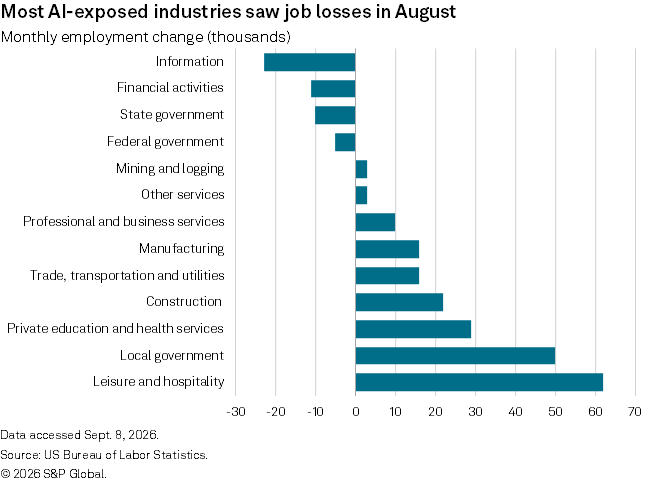
The latest US jobs report painted a mostly robust labor market picture, but sectors seen as having the highest rates of AI adoption, particularly information and financial activities, recorded net job losses in August. Of the surprising 162,000 jobs added during the month, key contributing sectors included construction, manufacturing, as well as trade, transportation and utilities. These sectors boosted employment amid the boom in building, equipping and powering AI data centers throughout the US.
Tech jobs in decline
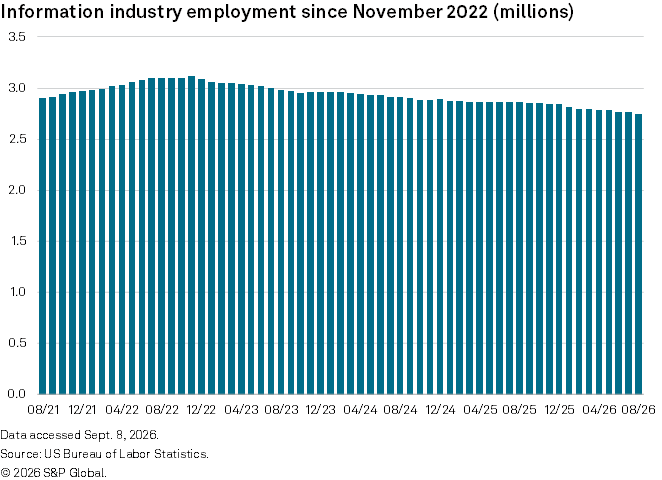
Economists and market strategists believe it is too early to see clear signs of how AI will change the American workforce, but there are some early indications of where it could be headed. AI's impact is likely to vary across the economy, with knowledge-based services seeing some clear, initial effects, Jim Baird, chief investment officer of Plante Moran Financial Advisors, told S&P Global Market Intelligence.
AI tools that can improve efficiencies in routine, information-driven work will slow entry-level hiring. However, the scope will differ by industry, company and worker experience level, according to Baird.
"As more firms adopt these tools, some may reassess how much and how quickly they need to add workers," Baird said. "Just as prior technological innovations affected different parts of the economy in different ways, AI is likely to have a varied impact across industries."
Some new types of jobs will be created to support the growth of AI, including roles tied to development, implementation, sales, data center construction, skilled trades, administration, finance and other support functions, Baird said.
"These data centers aren't going to build themselves, and it's giving employment opportunities to workers who wouldn't have otherwise had them, given residential investment and housing activity remains depressed," Brian LeBlanc, head of economic analysis at PNC Economics Research, said in an interview.
Some of this weakness could be due to higher interest rates and the impacts of many tech companies reducing their workforce after "over-hiring" immediately after the COVID-19 pandemic. Still, AI is clearly disrupting the labor market, LeBlanc said, but its effects are proving to be much slower and less clearly defined than initially anticipated.
"We're very good at forecasting which industries might be disrupted by a new technology, but we're also very bad at forecasting what new industries might emerge as a direct consequence of the technology," LeBlanc said. "We haven't seen a technological advancement yet that on net destroyed jobs."
Adjusting to AI
A survey released by researchers at the Federal Reserve Bank of New York found that among service firms with some level of AI adoption, 34% have adjusted their workforces by retraining employees, 15% have hired fewer workers, and 13% have hired more. Only 4% have laid off workers.
In the manufacturing sector, 22% of companies with some AI adoption chose to retrain workers, while 6% hired fewer workers with no increases in hiring nor layoffs, according to the survey.
A July report from Apollo Global Management found that workers in AI-exposed occupations were seeing slower wage growth, while employment levels remained steady. This suggests that companies are responding to AI productivity gains through wage compression, rather than workforce reductions, Dan North, a senior economist at Allianz Trade Americas, said.
"Historically, revolutionary new technologies have been met by fears of job destruction," North said in an interview. "And it is true that new technologies do destroy some jobs, but they also create others. There are indeed winners and losers."
On net, new tech creates more jobs than it destroys, but workers may need to adapt or leave the labor force.
For now, jobs with limited physical interaction that use repeatable decisions, such as data entry, coding, engineering, accounting and customer service, are most at risk of AI displacement, North said.
However, job losses in technology have been relatively limited and it is difficult to pin many workforce shifts on AI so far.
"The evidence is pretty ambiguous at this point, but I do believe ultimately AI will indeed cause a significant shift in employment and, like all major new technologies, will improve productivity and the human condition," North said.
Job-killing or growth-supporting?
AI's effects on the American workforce have the potential to be significant over time, as the technology shifts jobs, tasks and roles, but the impacts will not fall clearly along industry lines, Guy Berger, a senior fellow at the Burning Glass Institute, said in an interview.
"Lots of folks think primarily of the exposure gradient. High adoption industry means automation and job loss and low adoption industry means job retention," Berger said. "But it can go another way. High adoption industries expanding certain roles over time as the technology enables them, low adoption industries may struggle to retain workers as they pursue higher wages elsewhere."
Baird at Plante Moran cautioned against viewing AI adoption as a means to reduce payrolls, since many businesses will use AI to improve productivity, expand capacity and support growth.
"For many organizations, the goal will be to change how work gets done to fuel growth, not simply to eliminate jobs," Baird said. "Technological disruption does not necessarily mean economic destruction."