10 Sep, 2026
Ukrainian banks post strong Q2 operating results amid tax headwinds

By Beata Fojcik
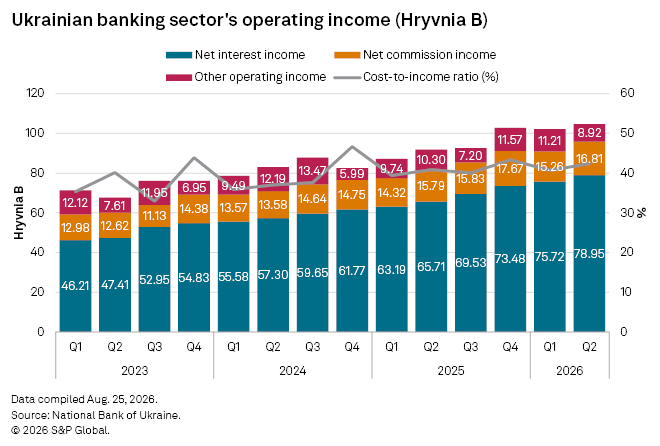
The Ukrainian banking sector's operating income grew by double digits in the second quarter, fueled by strong net interest income and higher earnings from commissions, even as a 50% profit tax reduced net profit by nearly a third year over year.
Lenders active in Ukraine reported a total operating income of 104.7 billion hryvnia ($2.33 billion) for the quarter, a 14% increase year over year, data from the National Bank of Ukraine showed. Quarter over quarter, operating income grew 2.4%.
"Profitability is supported by a sustained high net interest margin of 7.8%," the central bank said Aug. 14. "The expansion of lending and higher yields on loan portfolios ensured strong asset returns overall, while funding costs remained nearly unchanged."
Second-quarter net interest income surged 20% year over year and 4.3% quarter over quarter to almost 79 billion hryvnia.
Net fee and commission income increased 10.2% compared to the previous quarter and 6.5% year over year to 16.8 billion hryvnia, mainly due to higher income from payment operations.
Operating costs grew 6.7% quarter over quarter and 18.2% year over year, but the cost-to-income ratio has remained largely stable for four consecutive years, standing at 42.4% in the second quarter versus 40.9% a year earlier, the central bank said in its August Banking Sector Review.
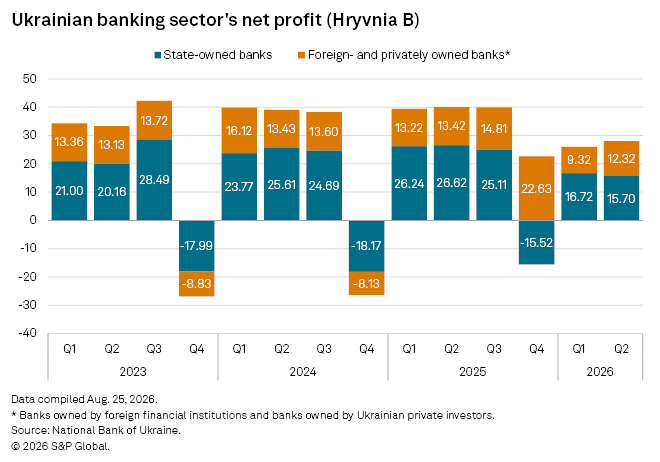
A high net interest margin and moderate provisioning drove a 7.6% increase in net profit quarter over quarter. However, net profit was still 30% lower year over year, totaling 28 billion hryvnia, due to the 50% income tax introduced for Ukrainian banks at the start of 2026.
"The profit earned supports banks' capital and their lending potential, however, the introduction of the 50% profit tax in 2026 offsets this positive effect," the central bank said.
In June, the Ukrainian parliament's finance, tax and customs policy committee approved a bill to extend the 50% bank tax rate through 2027, despite earlier criticism from the central bank. The bill has not yet been put to a vote in parliament.
The International Monetary Fund warned that the repeated imposition of the tax distorts the economy, incentivizes banks to find ways to reduce their tax burden, and limits their capacity to strengthen capital for lending and postwar reconstruction.
"Thus, for the years after 2027, windfall taxation on bank profits should be eliminated in favor of higher-quality, permanent measures in line with the authorities' agenda," the IMF said in a July 6 report on Ukraine.
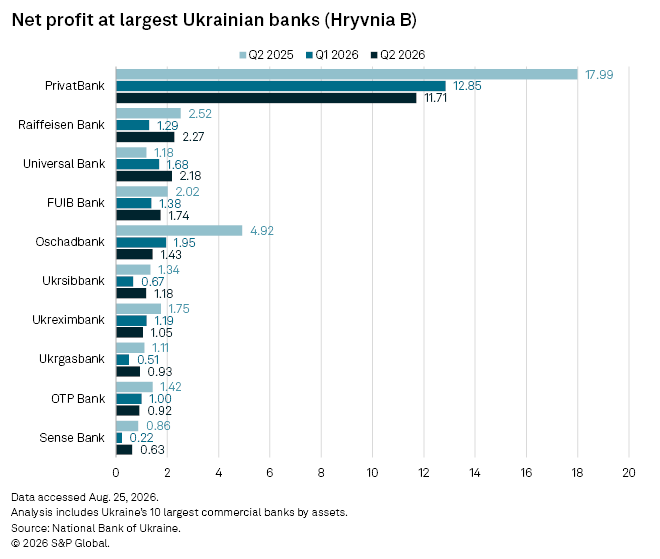
Second-quarter net profit at PJSC Universal Bank, owned by Ukrainian private investors, surged 84% year over year and 30% quarter over quarter to 2.2 billion hryvnia.
Raiffeisen Bank JSC and Joint Stock Company Ukrsibbank, owned by Austria-based Raiffeisen Bank International AG and French banking group BNP Paribas SA, respectively, posted relatively modest annual profit declines but strong quarterly profit growth of nearly 76%.
Double-digit loan growth
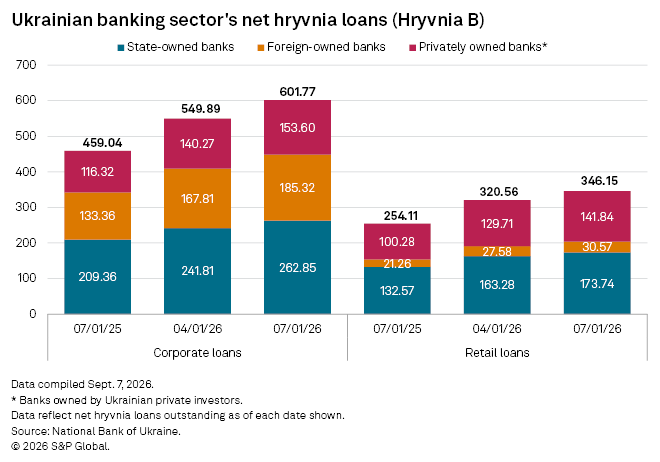
Net hryvnia loans to households grew 36.2% year over year to 346.2 billion hryvnia, with unsecured loans dominating the segment. Corporate loans expanded 31.1% year over year to 601.8 billion hryvnia.
Foreign- and privately owned banks outpaced state-owned lenders in both retail and corporate loan growth, although the central bank told S&P Global Market Intelligence that these trends shift over time and do not indicate a persistent or systematic outperformance by any group.
Ukraine accounted for the fastest lending growth among Hungary-based OTP Bank Nyrt.'s markets, adjusted for foreign currency, CFO László Bencsik said Aug. 5, although the growth was from a small base.
"But I think this shows our commitment to the country, and I believe that business can be done profitably even in this environment," Bencsik said. "We also consider this as an investment into the future of the country."
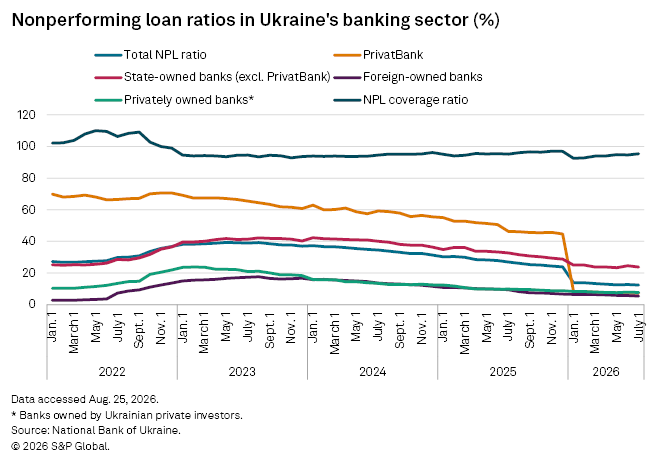
The Ukrainian banking sector's asset quality improved in the second quarter, with the nonperforming loan (NPL) ratio dropping 14.6 percentage points year over year to 12.5%, the lowest level in 17 years, according to the central bank. The decline reflects both robust growth in high-quality new loans and active resolution of legacy bad debts.
The NPL ratio fell to 18% for state banks, declined to 7.7% for private banks and decreased to 5.5% for foreign banks.
"Nonperforming loans are also well covered by provisions, at over 90%, providing banks with a substantial buffer against potential credit losses," the central bank told Market Intelligence.
Sense Bank controversy
Ukraine's Prime Minister Serhiy Koretskyi in August requested that the country's finance ministry accelerate the process of selling state-owned JSC Sense Bank, with proceeds from the sale to be used to finance Ukraine's defense forces.
Sense Bank became central to Ukraine's recent anti-corruption probe after investigators alleged it was used as a vehicle for laundering criminal proceeds. According to Ukraine's National Anti-Corruption Bureau and Specialized Anti-Corruption Prosecutor's Office, 150 million hryvnia was funneled through Sense Bank accounts in June to post bail for a suspect in another major corruption case related to Ukraine's state nuclear company Energoatom.
The investigation named several high-profile suspects, including Mykola Hladyshenko, chairman of Sense Bank's supervisory board, and management board Chairman Oleksiy Stupak. Both have since been dismissed.
Neither Sense Bank nor the finance ministry responded to Market Intelligence's requests for comment. Sense Bank said on its website in August that it was cooperating with law enforcement and continuing preparations for potential privatization.
The central bank also did not comment directly on how the recent investigation might affect Sense Bank's privatization prospects, but emphasized that Ukraine's banks remain attractive to investors due to their operational capacity, efficiency and substantial room for credit expansion.
"We do see interest from foreign financial groups — both those already present in the Ukrainian market and those not currently operating here — in expanding operations or securing authorization to operate in Ukraine," the central bank told Market Intelligence.
It noted the recent entry of Estonian financial institution Iute Group and Lithuania-based UAB Zen.com into the market through acquisitions of insolvent domestic lenders.
|