08 Sep, 2026
Swedish banks face profit blow from possible tax hike as election nears
By Adrian Jimenea and Cheska Lozano
|
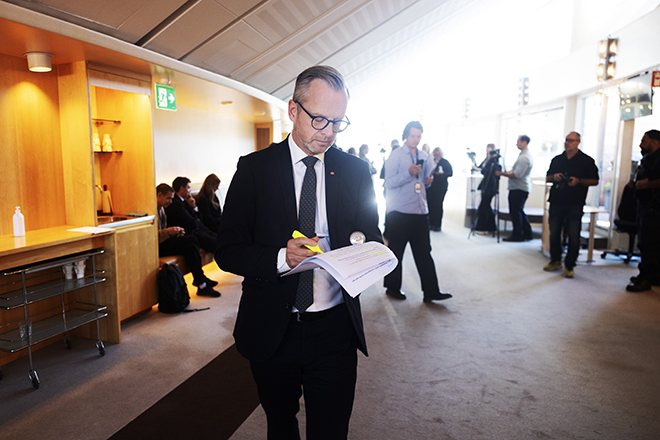
Mikael Damberg, a former finance minister and the current economic spokesperson for the Social Democrats. |
The prospect of higher taxes hangs in the balance for Sweden's largest banks in the lead-up to the country's general election on Sept. 13.
Imposing a "temporary tax" on banks' net interest income is a key pitch of the Social Democrats, the main opposition party that is leading the polls with 27% support. The center-left bloc — Social Democrats, Left Party, Green Party and Center Party — holds a combined 50.3% support.
The elections pose a material tail risk to the earnings of Swedish banks, Citi Research analysts warned in a note. Svenska Handelsbanken AB (publ) would be hit hardest as its additional tax charge could be equivalent to 8% of its 2027 pretax profit, according to Citi's calculations.
The impact on Swedbank AB (publ) and Skandinaviska Enskilda Banken AB (publ) is estimated at around 6% and 3% of 2027 pretax profit, respectively.
The tax would aim to raise roughly 12.6 billion Swedish kronor ($1.31 billion) from surplus net interest income above the historical average. The party has not specified how historical averages would be calculated.
Earnings pressure
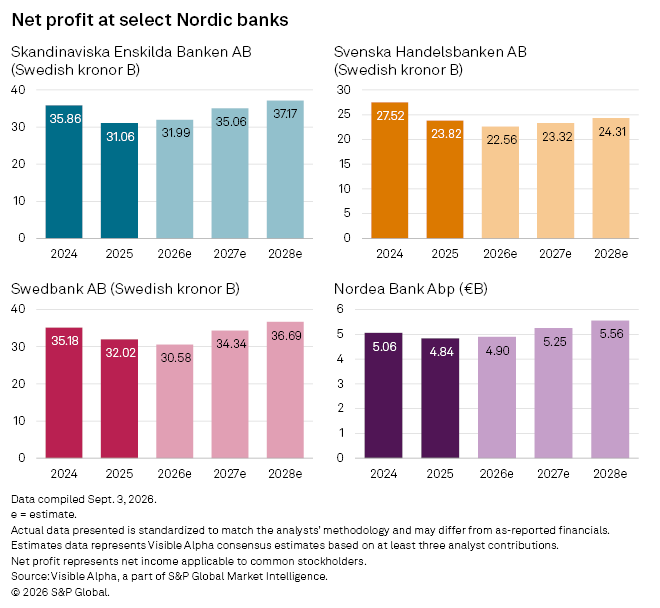
The Riksbank, Sweden's central bank, has cut its benchmark interest rates in recent years, largely driving diminished profits at the country's biggest lenders. Swedbank, Handelsbanken, SEB and Nordea Bank Abp — which moved its headquarters to Finland in 2018 but still counts Sweden as its largest market — all reported lower net profits in 2025 versus 2024.
Swedbank and Handelsbanken are also projected to report lower profits again in 2026, according to the latest Visible Alpha estimates. Earnings at SEB and Nordea are projected to pick up slightly.
In June, the Riksbank said the chances of a rate hike later in 2026 have increased since its March assessment, as the war in the Middle East exacerbates inflationary pressures. Consequently, the outlook for banks' net interest income has become more optimistic than a few quarters ago.
"We saw banks move very quickly to raise interest rates, but much more slowly to lower them," Mikael Damberg, the Social Democrats' economic spokesperson, said in a Bloomberg News interview in June.
At a Sept. 3 press conference, Damberg said a study would be needed to determine if banks continue to earn excess profits, Sweden Herald reported.
Concentrated market
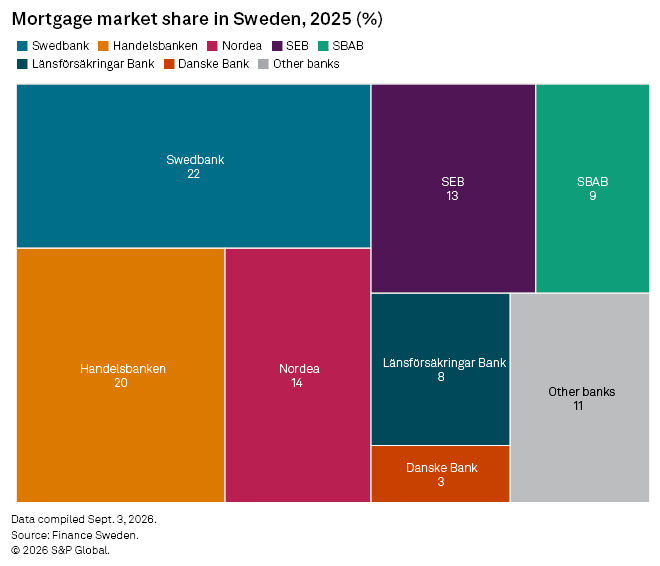
Sweden's banking sector is dominated by four banks that together had a 69% market share of mortgages in the country in 2025, according to data from Finance Sweden, the country's banking association. Swedbank had the largest market share at 22%, followed by Handelsbanken at 20%, Nordea at 14% and SEB at 13%.
The seven largest Swedish banks and two publicly owned credit institutions have since 2022 also been paying a so-called risk tax, which applies to firms with gross debt linked to Swedish operations exceeding 150 billion kronor.
That year, the total risk tax paid was 6.3 billion kronor, according to a study by Finance Sweden. The threshold amount increases annually based on an index, according to International Tax Review.
The risk tax is currently being challenged in EU courts mainly on the grounds that it is tantamount to state aid, which requires formal approval from the European Commission.
'Mortgage tax'
Banks and the coalition government have criticized the Social Democrats' plan, with incumbent Prime Minister Ulf Kristersson calling the plan a "new mortgage tax" because of its effect on borrowing costs.
Finance Sweden, which counts the four banks as among its 31 members, estimated that fully offsetting any additional tax would be shouldered by clients, increasing mortgage rates by approximately 0.2% to 0.3%. The average pass-through of changes in interbank offered rates to mortgage rates is already higher in Sweden than in Norway and on par with Finland, the lobby group said in a report.
"Finance Sweden does not support the proposal…we believe that sector-specific taxes risk reducing credit supply, investment and economic growth, while increasing the cost of financing across the economy," a spokesperson for the lobby group said.
Sweden charges a 20.6% flat-rate corporate tax. A Nordea spokesperson, citing Finance Sweden, said the effective tax rate for banks is roughly 25.6% because of the risk tax. The Social Democrats' bank tax would further raise this to 37.2%.
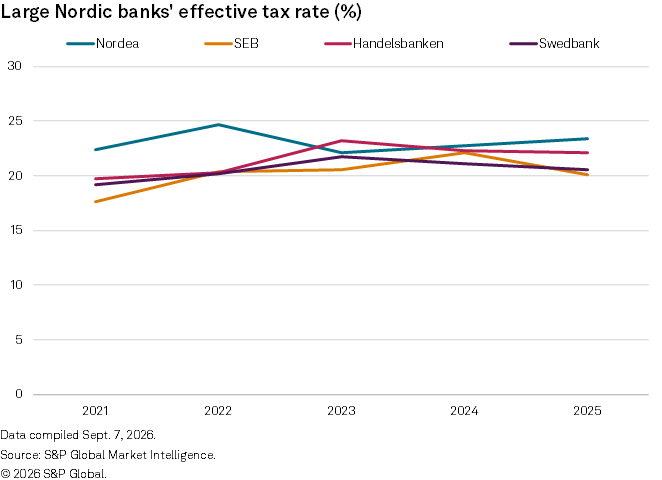
In his Bloomberg interview, Damberg said the tax would not be introduced in the short term. It would need further investigation and therefore would not be included in the party's first budget plan if it and its allies win the elections, Damberg said during the Sept. 3 conference.
Banks react
Sector-specific taxes "create uncertainty and distort competition," a Swedbank spokesperson said, while declining to comment on any new potential bank taxes. The bank is "critical" of the risk tax, as well as of the current government's decision to keep and increase it, the spokesperson said.
SEB did not comment but directed inquiries to Finance Sweden. Asked about the tax during a recent earnings call, SEB CEO Johan Torgeby said: "Feasibility is a completely different matter, and I think it's not going to be that easy."
"The impact would depend on the final design of the tax," the Finance Sweden spokesperson said.
Handelsbanken declined to comment on the possible tax.
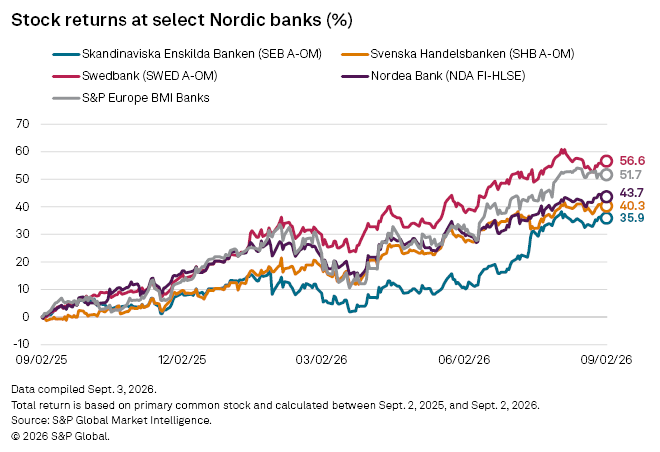
In the last 12 months, SEB, Handelsbanken and Nordea all underperformed the 51.7% growth of the S&P Europe BMI Banks Index. Only Swedbank outpaced the index with a 56.6% rise.