10 Sep, 2026
Strong, steady dividends boost appeal of South African banks
By Matthew Savides and Beenish Bashir
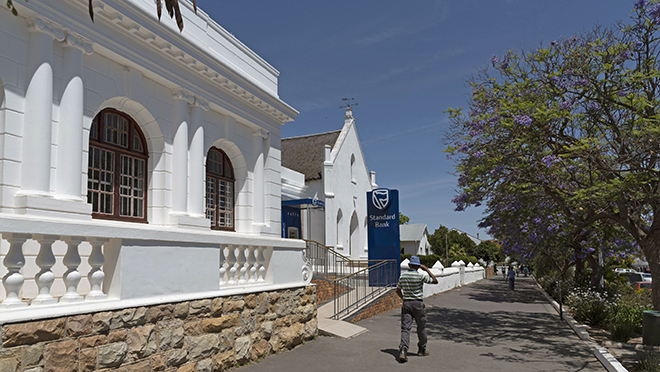
| Standard Bank is forecast to achieve the strongest dividend growth of South Africa's four largest lenders in the coming years. Source: Education Images/Universal Images Group via Getty Images Europe. |
South African banks are poised to pay higher dividends in the next two years as growing profits and increased stability feed back to investors.
The country's four big banks — Standard Bank Group Ltd., FirstRand Ltd., Nedbank Group Ltd. and Absa Group Ltd. — are expected to post dividend per share (DPS) increases ranging from 11.5% to 28.1% over the next two years, Visible Alpha data shows.
The banking sector is one of the most stable dividend payers among Johannesburg Stock Exchange-listed companies, Marnus Piekaar, head of fundamental research at Johannesburg-based PSG Wealth, told S&P Global Market Intelligence in an interview.
"The dividend yield for South African banks is definitely something investors are looking at. The banks try to stay more constant in the dividends they pay. It's more measured, it's more predictable," Piekaar said.
South African banks should increase profits in the coming years, even as geopolitical tensions threaten to slow recent economic recovery. Analysts expect the lenders to leverage this position to expand their customer bases across the continent and boost payouts to investors.
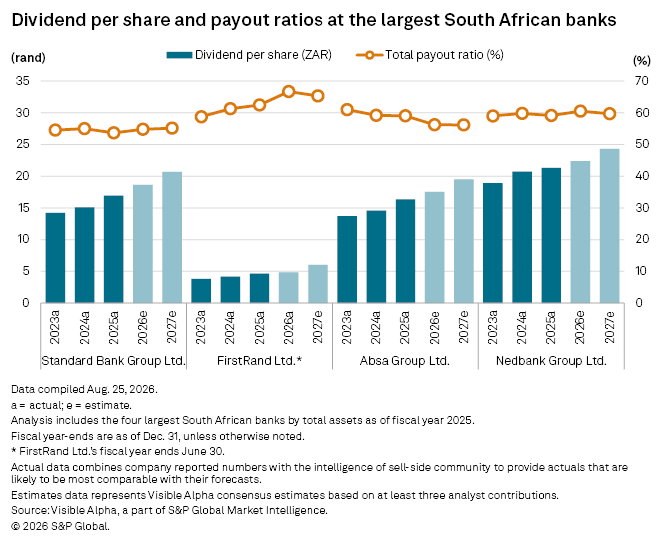
FirstRand is expected to record the highest DPS growth over the next two years, increasing 28.1% from 2025 for full-year 2027, according to Visible Alpha data.
Standard Bank, Africa's largest bank by assets, follows, with a projected increase of 25.4% in the same period. DPS at Absa and Nedbank are expected to increase by 18.9% and 11.5%, respectively.
Total payout ratios should be stable over the 2023-2027 period, Visible Alpha data shows.
"South African banks are demonstrating highly resilient capital distribution profiles, with FirstRand and Standard Bank leading the sector's dividend growth trajectory," said Abhirup Dutta, equity research and fixed income specialist at S&P Global Market Intelligence's Dividend Forecasting team.
Dutta pointed to strong underlying metrics, which support the banks' expected solid payouts.
In Standard Bank's case, management has indicated that its 2026 dividend payout ratio is expected to be at the top end of its range, citing "sustained strong performance," Dutta said. The lender also has significant headroom for strategic investments, acquisitions, partnerships, dividends and share buybacks, ensuring flexibility for future shareholder distributions, Dutta said.
For Nedbank, NII growth slightly above mid-single digits means its payout would also be at the higher end of its target range.
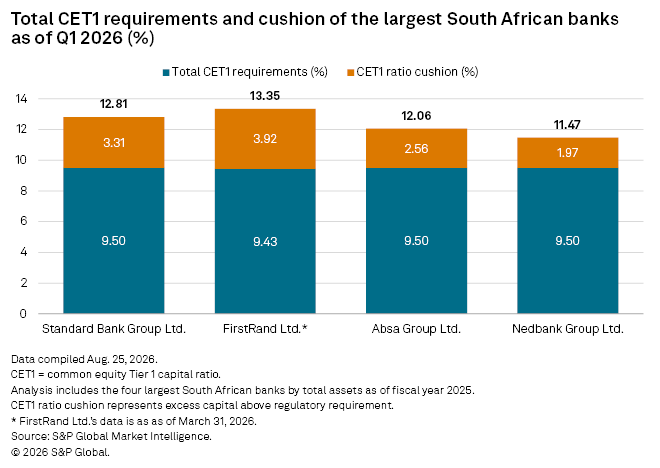
All the banks have significant cushions above their CET1 requirements, according to Market Intelligence data, indicating that they have the headroom for distributions.
"As a sector, South African banks offer investors exposure to well-regulated businesses generating strong returns, with returns on equity (ROEs) above 15% and relatively high dividend yields," said Sandra Villars, partner for financial services at Oliver Wyman.
The banks' strong ROEs provide a "substantial premium" to the global banking average of about 10%, said Mohan Sambandan, partner, financial services lead, at McKinsey & Co.
Add to that the concentration in the sector — the four largest banks control roughly 82% of domestic assets — and South African lenders enjoy significant economies of scale and competitive advantages, which have helped support stability in the banking system, Sambandan said.
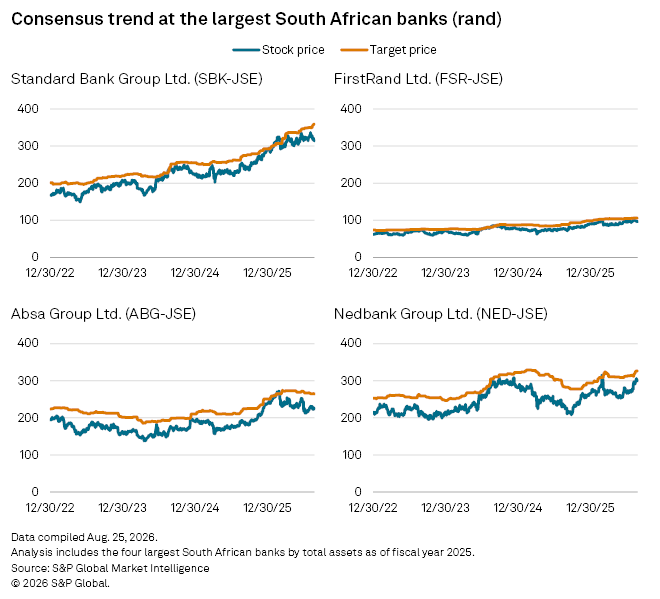
Of the four banks, Standard Bank has delivered the strongest total returns to investors in recent years, at 139.4% since the start of 2023. Absa had the weakest returns at 53.8%.
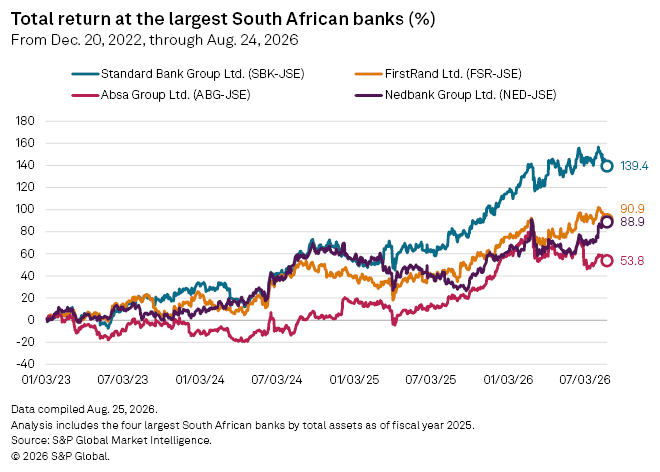
All four banks are trading below their consensus target prices, according to Market Intelligence data, suggesting that analysts see room for further upside.
Visible Alpha is a part of S&P Global Market Intelligence.
|