09 Sep, 2026
South African lenders seek continental expansion amid sluggish domestic economy
By Matthew Savides and Cheska Lozano
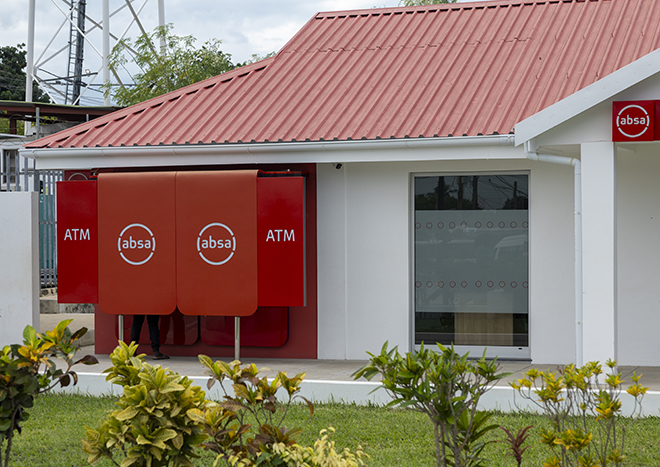
| Absa is among the South African banks looking to expand its presence in the east of the continent. Source: Eric Lafforgue/Art in All of Us/Corbis News via Getty Images Europe. |
A sluggish domestic economy is prompting South African banks to expand their operations in higher-growth African markets.
South Africa's GDP is expected to rise around 1.3% for 2026, according to S&P Global Market Intelligence data. Comparatively, GDP is expected to grow in Kenya by 4.5%, in Nigeria by 3.7%, in Ghana by 4.8%, and in Tanzania by 6%.
The chance of greater growth opportunities abroad has prompted banks, including Nedbank Group Ltd. and Absa Group Ltd., to pursue M&A and expansion in East Africa and increase their geographical diversity.
A key target is Kenya, which is considered a "gateway into East Africa," Nyathi said. Not only does it have a large economy, but many South African banks already have subsidiaries there, and it has fewer regulatory restrictions than other nations.
"The ability to tap into a growing market and a positive market, I think, is what's really encouraging the investment," Kevin Hoff, director at BDO South Africa, told Market Intelligence.
South African banks are well-positioned to take advantage of the resilience they've built up in recent years. The big four lenders are expected to record combined profit growth of 4.6% year-over-year for full-year 2026 and 17.1% in 2027.
Significant moves made in Kenya
Nedbank made a 14.88 billion rand (around $930 million) offer in January to buy 66% of Kenya-based NCBA Group PLC, a deal that would be the second-largest involving a South African bank in the past 10 years. The bank said in June that it had received regulatory approval, and CEO Jason Quinn said during the company's most recent earnings call that NCBA shareholders had approved the offer.
"The transaction ... supports our ambition to diversify our earnings and expand in attractive East African markets," Quinn said.
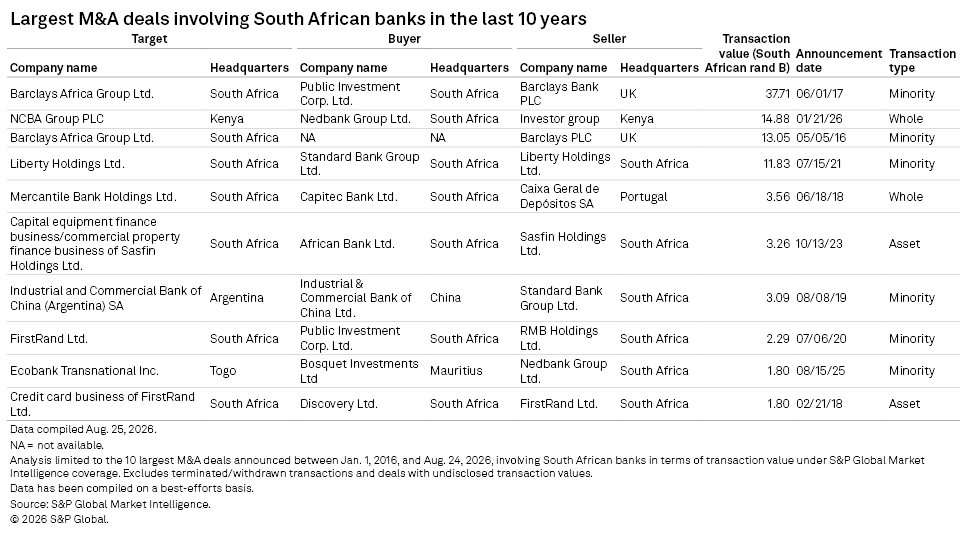
"The outcome reinforces Absa Group's conviction in the business and the opportunities that lie ahead in Kenya and the broader East African market," the bank said in a statement, with Charles Russon, group executive for Africa regions, quoted as saying that Kenya was "a strategically important market…and central to our East Africa growth ambitions."
Outside of these deals, all of South Africa's big four lenders said during their most recent earnings calls that they were looking to grow in the rest of the continent.
Standard Bank Group Ltd., Africa's largest bank by assets, said it sees opportunities to "expand and deepen" its position across Africa, and that it had invested an additional $80 million in Tanzania in July 2026 and was on track to increase its shareholding in Angola in the second half of the year.
FirstRand Ltd. said that eastern Africa was a "key market we want to enter."
"We've had discussions. It didn't come to fruition, and we're looking at [an] appropriate vehicle," chief value officer Andries du Toit said in response to an analyst question.
A tonic for an oversaturated market
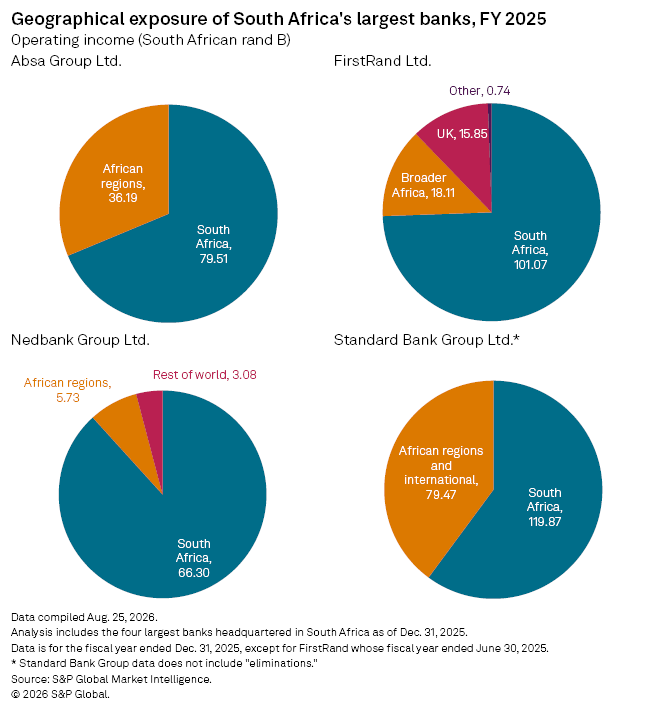
Market Intelligence data shows that African operations already add significant value to South African banks' books.
The contributions to operating income were smaller for FirstRand, where "broader Africa" accounted for 13%, and for Nedbank, where Africa accounted for less than 8%.
But this expansion "is not all a retail play," Hoff said. Investment banking, particularly related to infrastructure funding, is also a key part of the picture.
"I think retail is a piece, but I think the wholesale investment banking and corporate side is a big play as well," he said.
Not plain sailing
The retail space is also highly competitive, Hoff added, and banks might struggle from an agility and competitiveness standpoint.
Nyathi also highlighted risks associated with regulators in many African states. For example, some countries, including Rwanda and Ethiopia, have complex regulatory environments.
"So it makes it easier to go into Kenya than Rwanda or any other East African country," she said.
Similarly, McKinsey's Sambandan said that, despite the revenue upside, cross-border expansion introduces additional complexity.
"Institutions must navigate highly disparate regulatory regimes, fragmented capital adequacy requirements and different regulatory timelines, which can increase group-wide compliance and risk-management requirements," Sambandan said.
"As long as it is slow and measured... I think that the expansion into Africa is going to give good opportunity, given the strong growth outlook in Africa and emerging markets in general," he said.
|