08 Sep, 2026
South African bank profits set to withstand geopolitical tensions
By Matthew Savides and Uneeb Asim
South African banks are expected to post strong profit growth in the coming years, even as the Middle East war threatens to push inflation higher and put pressure on their loan books.
Profits at the country's four biggest lenders — Standard Bank Group Ltd., FirstRand Ltd., Absa Group Ltd. and Nedbank Group Ltd. — are forecast to increase 4.6% year-over-year to reach a combined 139.10 billion South African rand ($8.65 billion) for full-year 2026, according to Visible Alpha consensus estimates. This is expected to jump a further 17.1% to 162.90 billion rand for the full-year 2027.
The more stable economic environment is a big driver. GDP has grown, electricity supply challenges have largely abated, the rand has strengthened, and financial reforms — which have helped South Africa's removal from the Financial Action Task Force gray list — put the economy on a significantly healthier footing than in recent years.
Combined with the positive impact of relatively high interest rates on their revenue, this has resulted in banks "sitting on a strong balance sheet," said Marnus Piekaar, head of fundamental research at Johannesburg-based PSG Wealth.
"The sector looks really healthy. The underlying earning capacity is looking quite good as well. And, yes, the profitability is attractive," Piekaar said in an interview.
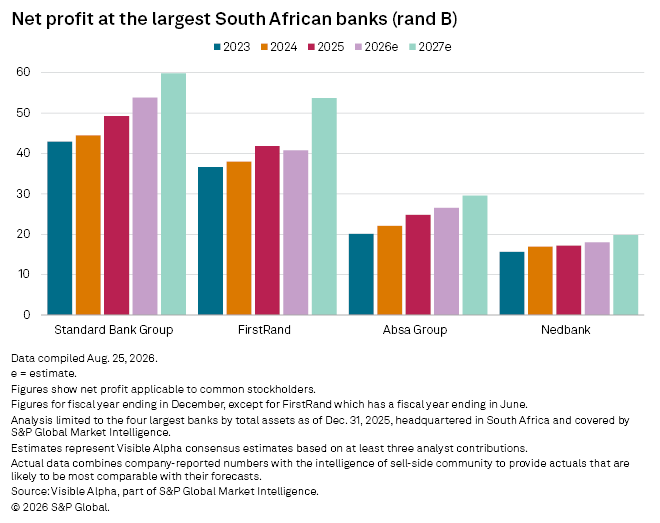
FirstRand is predicted to record a 2.4% profit decline in for full-year 2026 — the only one of the big four where a decline is forecast — before recording a 31.6% increase in 2027. FirstRand's UK subsidiary Aldermore Bank PLC has been hit by a motor finance redress scheme and has been put up for sale.
Banks weathering geopolitical storms
The banks' strong position means they are expected to weather geopolitical tensions, particularly as the conflict in the Middle East feeds inflation and drives interest rates higher. South Africa is heavily reliant on road freight, so fuel price increases have significant knock-on effects.
The country's economy was poised for strong growth at the beginning of the year, but this is tapering off. Inflation is forecast to rise to 4.3% in 2026 from 3.2% in 2025, reflecting elevated petroleum prices and an increase in public transportation costs, said Charlotte Masvongo, associate director, financial services ratings, at S&P Global Ratings.
The South African Reserve Bank (SARB) told S&P Global Market Intelligence that while its baseline GDP growth forecast remains broadly unchanged, "the risks to both growth and inflation have become more pronounced." Inflation is expected to remain above 4% until early 2027, with GDP growth estimated at around 1.2%.
Even so, the central bank believes the banking sector is "adequately capitalized and liquid."
"We expect the banking sector to be resilient and capable of absorbing the slightly higher credit losses stemming from this shock, given banks' strong capitalization and balance sheet strength," Ratings' Masvongo said.
Lenders used to higher interest rate environment
The SARB increased its prime lending rate 25 basis points to 10.50% in May, and many analysts believe another hike is likely before the end of the year.
South African banks are used to operating in a higher-interest-rate environment, Piekaar said. The country's prime lending rate was as low as 7% at the beginning of 2021, then climbed to a high of 11.75% for most of 2023 and 2024.
"Even with some additional shocks and interest rate increases, I think the banks are well-positioned. The declining interest cycle was only about 18 months, so they know how to deal with the high interest rates," he said.
However, higher interest rates could further hit under-pressure
The household debt to nominal income ratio was 62.2% in March 2026, which represents "a significant credit concern," Thandeka Nyathi, banking risk analyst in Market Intelligence's economics and country risk team, said in an interview.
"A whole lot of lending goes to households. And if that ratio remains very high, it poses credit quality risks," Nyathi said. As such, she expects banks to increase their provisioning with the upcoming hike in the interest rate to prepare for the potential rise in nonperforming loans.
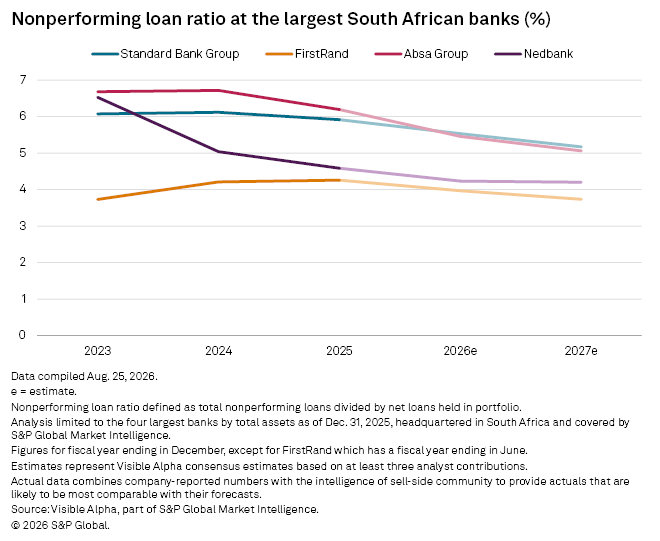
Ratings anticipates an increase in credit losses and nonperforming loans to between 90 bps and 110 bps, and 5.0-5.5% in 2026, from 90 bps and 4.9% in 2025, respectively. Still, analysts expect the country's largest lenders to report stable or lower nonperforming loan ratios through 2027, Visible Alpha data shows.
Unemployment is a red flag. Statistics South Africa reported in August that unemployment was 33.6% in the second quarter of the year, with the youth unemployment rate even higher, at 47.4%.
"Banks are watching these risks closely and continue to maintain strong buffers," Villars said.
Noninterest income helps stability
"They have had to look at alternative sources of income, and they've really done that well. That's really helped their diversity and their stability," Hoff said.
Noninterest income has increased significantly among the four largest lenders, Market Intelligence data shows. For Standard Bank, it grew to 89.03 billion rand for 2025 from 80.48 billion rand the year prior, and is expected to climb to 103.04 billion rand for full-year 2027.
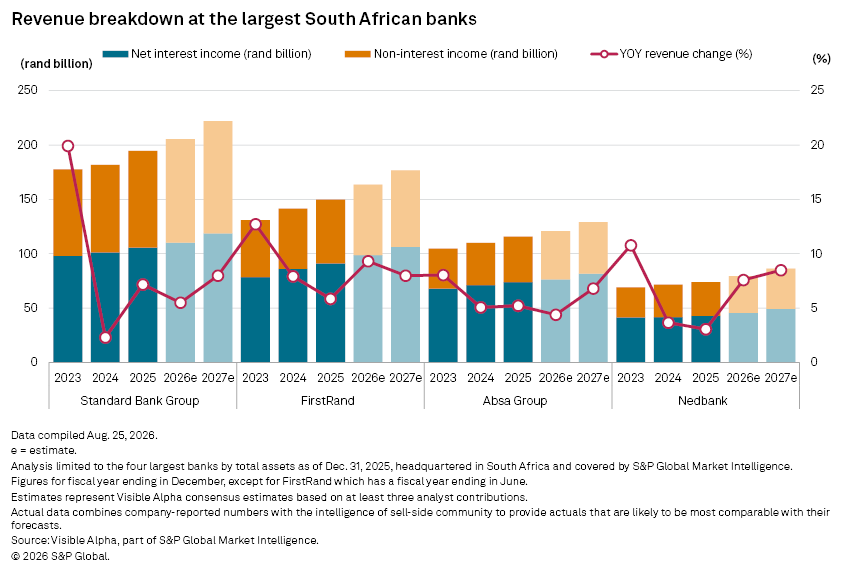
Absa is forecast to have the lowest growth of the four, but is still expected to climb nearly 13% to 47.15 billion rand in 2027 from 41.76 billion rand in 2025.
"South Africa's banking sector is, overall, in very good shape and remains one of the strongest sectors in the economy," Villars said.
Visible Alpha is a part of S&P Global Market Intelligence.