09 Sep, 2026
Secondaries growth poised to outlast liquidity squeeze
Growth in the private equity secondaries market is expected to outlast the investor liquidity squeeze, fueling a record surge in secondary deals.
For all vintage years back to 2018, the median ratio of distributions to paid-in capital from private equity investments remains below a 1x multiple, meaning limited partners have paid in more capital than has been distributed back in profits, according to S&P Global Market Intelligence data as of the first quarter of 2026.
A more challenging exit environment has slowed the return of profits to investors, with Bain & Co. reporting in June that distributions from private equity funds as a percentage of net asset value were at record lows for four consecutive years through 2025.
Low distributions catalyzed significant growth in private equity secondaries as private equity investors, known as limited partners (LPs), turned to secondary transactions to free up capital locked in illiquid fund structures, said Alex Zeizel, a Proskauer Rose LLC partner and member of the law firm's private funds group. A rebound in exits could relieve liquidity pressure but is unlikely to reverse the expansion of the secondaries market, she added.
"As distributions normalize, maybe that growth rate takes a dip year over year, but I don't think we're going backwards at any point. Secondaries have become so entrenched as a viable portfolio management tool for both [fund managers] and LPs, I think we're only going up," Zeizel said.
Record transaction activity
Transaction activity in the secondaries market is pacing for a third consecutive annual record. Investment bank Evercore recorded total secondary transaction value of $121 billion in the first half of the year, up 20% year over year and the highest first-half total on record, according to a report released in July.
Typically, 60% to 70% of secondaries transaction activity takes place in the second half of the year, putting a third consecutive annual record for secondaries deal value well within reach, said Rob Emerson, co-head of secondaries practice at Latham & Watkins LLC.
Secondaries observers anticipate total 2026 deal value could exceed $250 billion, more than double the full-year total recorded as recently as 2023, Blackstone Inc. President Jonathan Gray said at a conference presentation in June. Gray said the so-called Saaspocalypse clouding the outlook for private equity's software investments would be a boost to secondaries deal activity.
"There are LPs out there who would like to see more liquidity, particularly some of these areas where it's harder to get liquidity like software," Gray said.
Comfort and innovation
While liquidity pressures have played a significant role in secondaries' recent growth, innovation and growing comfort with secondaries as a tool for active portfolio management will power the asset class over the longer term, said Bruno Bertrand-Delfau, a Proskauer partner and co-head of the law firm’s secondary transactions and liquidity solutions practice.
"Starting with a very simple LP interest transfers, the market has moved to much more varied and rich toolkit today," Bertrand-Delfau said.
A prime example is general partner-led transactions, which transfer a portfolio company from one fund to another called a continuation vehicle, creating an opportunity for LPs to cash out or reinvest. GP-led secondaries value increased 35% year over year to $65 billion in the first half, growing even faster than LP-led secondaries, according to Evercore.
|
Secondaries fundraising is within reach of a fourth consecutive annual increase.
Capital commitments to secondaries funds totaled $46.6 billion through the first half of 2026, just over half the prior-year total of $92.9 billion, according to With Intelligence data. While overall private equity fundraising declined between 2023 and 2025, fundraising for secondaries strategies increased in each year.
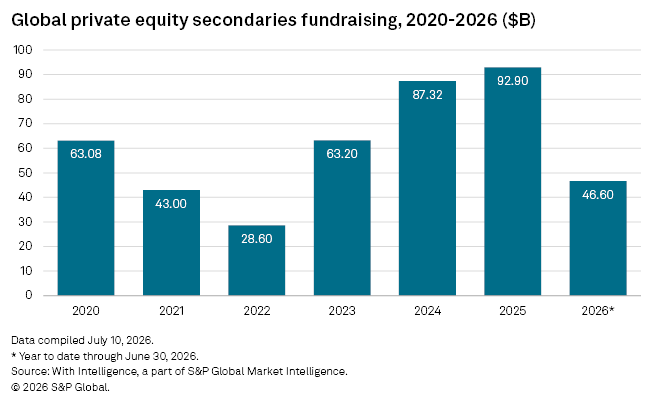
Despite that fundraising momentum, Evercore in June calculated the capital overhang multiple for secondaries at 1.0x, meaning there was only enough dry powder for a year of transaction activity.
"Definitely, it's still under scale," Bertrand-Delfau said. "What you can hear from all the market participants on the buy side is that they are overwhelmed by opportunities and they can only dedicate financial and human resources to a few of them."
Outlook
Bertrand-Delfau described secondaries transaction activity in the first half of the year as "subdued," despite its record pace. Concerns about the impact of AI on software company valuations and the geopolitical uncertainty stemming from the war in the Middle East were a drag on transaction activity, he said.
"If all that is contained, we should have a very strong end to the year, and that should continue into 2027," he said.