10 Sep, 2026
Price volatility, shrinking buyer pool slow private equity exits in fossil fuels
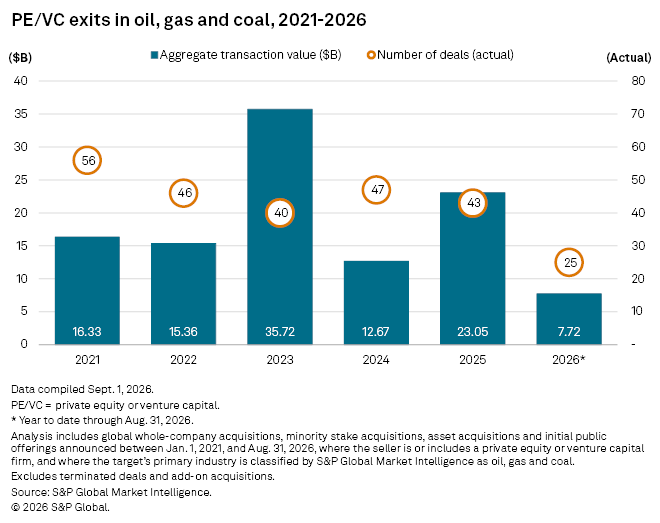
Global private equity and venture capital exits in the oil, gas and coal sector slowed in the first eight months of 2026, falling 24.2% year over year to 25 transactions.
The total volume at the end of August accounted for less than 60% of the 43 exits recorded for full year 2025, according to S&P Global Market Intelligence data.
Exit value totaled $7.72 billion, down 64.1% year over year.
While demand for fossil fuel assets remains healthy, exits are slowing because the number of public oil and gas companies that traditionally bought private equity-backed assets has declined amid consolidation, said Matt Miller, managing partner at private equity firm Grey Rock Investment Partners.
"There's about 50% fewer public companies now in oil and gas exploration and production than there were 10 years ago," Miller said.
The remaining public companies are competing for increasingly scarce drilling inventory and need larger acquisition targets to make a meaningful difference to their production or reserves.
"The number of attractive targets is shrinking. With larger swaths of the core shale plays being developed or controlled by the larger firms, it is getting harder and harder for private equity to amass assets that are attractive for takeover," Miller said.
Price volatility
Price volatility related to the war in the Middle East has weighed on exits, especially in the oil market.
This makes it challenging for buyers and sellers to agree on asset valuations, said John Grand, M&A and private equity partner at law firm Vinson & Elkins LLP.
"At the same time, elevated oil prices have allowed private equity firms to recognize strong returns, reducing the urgency to sell."
While demand for power generation, particularly for proliferating data centers, is supporting the market, natural gas prices remain "stubbornly" low, Grand said, adding that the weakness has prompted sellers to postpone their sale processes.
Volatile commodity prices have also clouded the growth outlook for fossil-fuel companies, making it more challenging to find buyers for their assets, added Greg Portell, global markets lead partner at consulting firm Kearney Inc.
- + Download
+ Explore the key trends shaping private equity investment in oil, gas and coal.
+ Stay up to date
Top markets
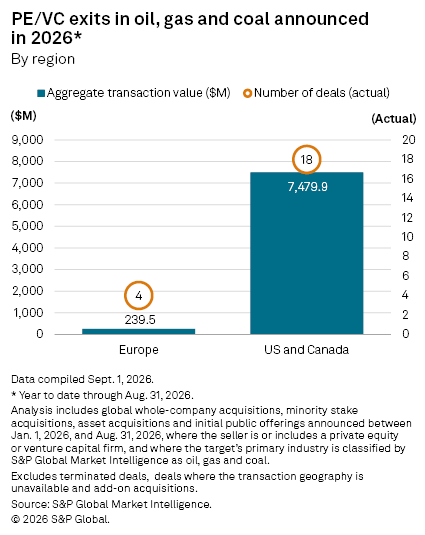
The US and Canada accounted for the largest share of private equity exits in the oil, gas and coal sector, recording 18 transactions, or 72% of the total through the end of August, according to Market Intelligence data.
Europe, including the UK, recorded four exits.
Europe recorded a sharper drop in exits, falling 42.9% year over year compared with a 21.7% decline in the US.
The potential long-term decline in Europe's fossil-fuel demand could affect the region's attractiveness to investors, said Oliver Holtkemper, a partner at consulting firm Roland Berger GmbH.
Europe's natural gas demand between August 2022 and January 2026 was about 19% lower than the 2017-2021 average, according to the European Commission.
Top exits
Of the 25 private equity fossil fuel divestments as of the end of August, four were secondary sales. Trade sales accounted for the remainder.
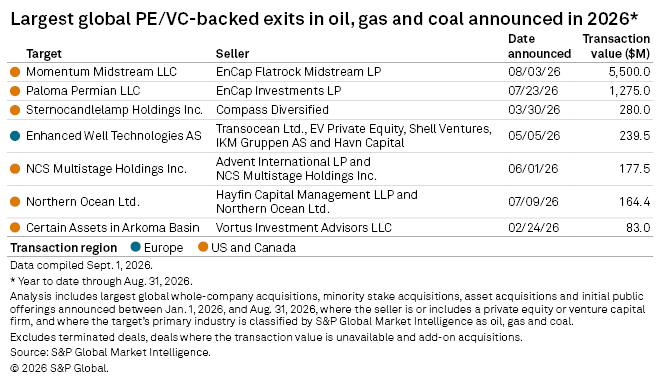
The largest private equity exit globally was recorded in the US: EnCap Flatrock Midstream LP's $5.5 billion sale of Momentum Midstream LLC. The deal closed Sept. 3.
In Europe, the largest exit was the more than $239 million sale of Norway-based Enhanced Well Technologies AS to Expro Ltd. The seller was an investor group comprising Transocean Ltd., EV Private Equity, Shell Ventures, IKM Gruppen AS and Havn Capital.
Private equity exits in the sector could pick up if commodity prices become more predictable. Greater certainty would make it easier to value assets and agree on transaction prices, Grand said.