24 Sep, 2026
Pressure on Fed may intensify as next rate decision falls near Election Day

By Brian Scheid
After hiking interest rates in the face of political pressure to lower them, the US Federal Reserve will be faced with another rate decision in October, less than a week before the midterm elections expected to determine control of Congress.
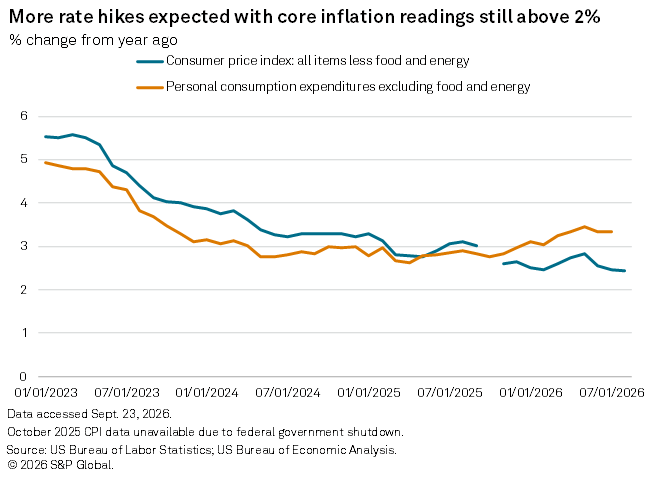
The Fed's looming decision to hike or not will likely hinge on upcoming inflation data, but it could be influenced somewhat by the proximity of the Nov. 3 election, economists and market strategists believe.
The rate decision could also serve as a test of the Fed's credibility, which has been challenged by the Trump administration's efforts to influence policy. It could also boost market volatility since Fed Chairman Kevin Warsh opposes forward guidance and is unlikely to indicate which way the Fed may go in the weeks leading up to the October decision.
"Chairman Warsh and other Fed officials have been emphatic about the Fed's independence and its inflation-fighting credibility," Michael Arone, chief investment strategist at State Street Investment Management, said in an interview. "There's no turning back now. The Fed must make policy based on the economic data and its dual mandate, not the political calendar."
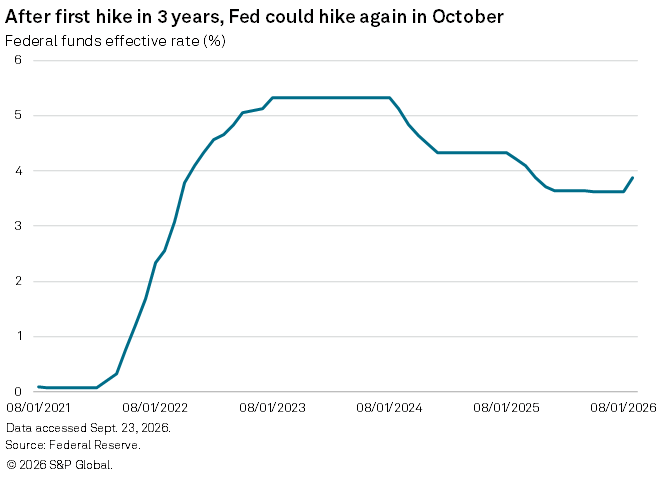
The futures market is currently betting that the Fed will raise its benchmark federal funds rate by 25 basis points at the Oct. 28 meeting. As of Sept. 23, more than 70% of the market was forecasting a hike at the upcoming meeting, while less than 30% expected the central bank to keep its benchmark rate at the current target level between 3.75% and 4%, according to CME FedWatch.
While expected, rate hikes so close to a federal election are uncommon.
Over the past 54 years, the Fed has increased rates only three times out of 27 meetings held after Oct. 1 in an election year, or 11% of the time, according to a study by Mark Shore, a director and economist with CME Group. The study also shows that Fed has cut rates at six of these meetings, or 22% of the time, while leaving rates unchanged 18 times, or 67% of the time.
Warsh and other Fed officials will likely emphasize that any rate decision will be made outside of politics. However, any rate move is still likely to face partisan criticism.
"A preelection rate hike would be unlikely to immediately impact the economy or election, though President Trump could use his platform to criticize the central bank in an effort to motivate voters," Matthew Weller, global head of market research with StoneX, said in an interview.
"October's interest rate decision is likely to lead to market volatility regardless of what Kevin Warsh and company decide, with a rate hike potentially weighing on the stock market and marginally raising borrowing costs for consumers on the eve of the midterms."
The election is unlikely to be a "limiting factor" in the Fed's rate decision, according to Thomas Simons, chief US economist at Jefferies. Still, a rate hike may not necessarily be viewed negatively by voters, Simons said.
"There is an argument to be made that higher rates might actually encourage more support for the incumbents as senior citizens with high savings enjoy higher interest income," Simons told S&P Global Market Intelligence. "And the Fed encourages a confidence that they are going to reduce inflation, irrespective of the wishes of the president for lower rates."
A 25-basis-point hike in late October is unlikely to have any immediate change in consumer and business borrowing rates, but it will likely bolster the sense of soaring borrowing costs and feelings of further financial strain, according to Derek Tang, a policy economist with Monetary Policy Analytics.
"The election, on the margin, probably does matter to Fed policymakers if the case for moving is marginal. The bias would be to wait until December," Tang said. "But the hesitance is not so big as to rule out an October hike fully if the data say they should go ahead."