02 Sep, 2026
Outsize transaction moves private equity pharma deals to $17.8B
By Noreen Izabel Jazul and Nimisha Jain
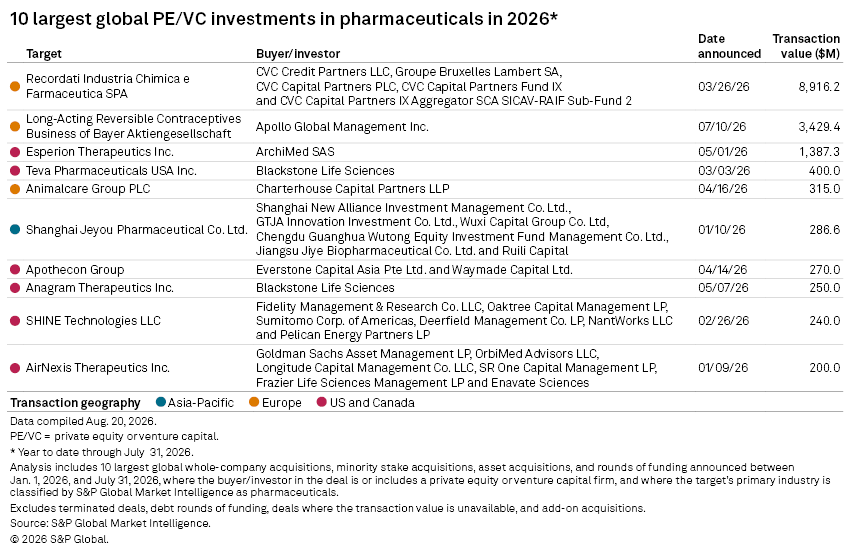
The proposed privatization of Italian drugmaker Recordati Industria Chimica e Farmaceutica SpA boosted the aggregate value of private equity and venture capital transactions in pharmaceuticals to $17.81 billion in the year through July 31.
In May, CVC Capital Partners PLC and Groupe Bruxelles Lambert SA signed a definitive agreement to take Recordati private for about $8.92 billion. The pending deal has put the pharmaceutical sector on track to exceed the 2025 full-year total of $24.81 billion, according to an analysis of S&P Global Market Intelligence data.
In July alone, the sector recorded a total transaction value of $3.74 billion, topping the second quarter's $3.21 billion.
Pharmaceutical manufacturers are attracting more private equity and venture capital because they offer visible, near-term exits, especially large drugmakers that buy late-stage clinical assets to refill pipelines ahead of patent expirations, said Anthony Del Rio, partner and national chair of the healthcare practice at law firm Katten.
"Large pharma is looking at roughly $300 billion of revenue rolling off patents by the end of the decade," Del Rio said. "Knowing there are strategic buyers at the end of the hold period allows for greater confidence in the investment thesis."
Deal volume, however, fell 11.0% year over year to 105 in the first seven months of 2026, according to Market Intelligence data.
Investment is narrowing to fewer bets. Investors prioritize early clinical studies that use patient safety and feasibility data to reduce scientific and technical uncertainty, even if these opportunities are more costly, said Betty Pio, partner in the healthcare and life sciences practice of consulting firm Kearney Inc.
Oncology, AI draw investment
Companies developing oncology and metabolic drugs have been the primary targets of private equity investment.
Oncology is one of Recordati's core therapeutic areas and is also a focus for Apothecon Group, which raised $270 million in a venture funding round.
Metabolic drugs have drawn significant investment following the rapid commercial success of GLP-1 weight-loss treatments, said Brad Stewart, life sciences national leader at consulting firm BDO. However, Stewart cautioned that the weight-loss drug market is becoming saturated.
AI integration in pharma companies is increasingly becoming part of the investment thesis, but the emphasis is on practical value creation, said Kristin Pothier, KPMG US LLP and Americas life sciences sector leader.
Investors are backing technologies that improve research and development productivity, identify better drug targets, streamline development, accelerate decision-making and enhance commercialization efficiency, Pothier added.
AI- and data-enabled platforms, along with the broader GLP-1 ecosystem, should attract interest as companies invest across the patient journey.
"We expect deal value and activity to improve as confidence builds and pipelines become clearer, but this is unlikely to become a volume-driven market," Pothier said. "Investors remain willing to pay for differentiated assets with clear clinical and commercial potential, but they are doing so with far greater rigor than in previous cycles."
- Download a spreadsheet with data featured in this story.
- Explore the key trends shaping limited partner investments in AI.
- Stay up to date on the latest private equity headlines.

Europe leads all regions
Europe attracted the largest amount of capital across all regions, drawing $12.69 billion, or more than 70% of the sector's total private equity and venture capital deal value.
The US and Canada followed with $3.32 billion.
Europe offers strong manufacturing capabilities and relatively affordable pharma assets compared with the US, said Del Rio. "From a policy perspective, Europe may be more predictable."
Investors, however, face risks such as fragmented drug pricing and reimbursement across countries, and potential government review delays for cross-border deals. "Late-stage growth capital is also thinner in Europe, so the exit frequently still runs through a US strategic buyer," Del Rio said.
Asia-Pacific recorded the most number of deals from January through July, with 62, compared with 21 in the US and Canada and 19 in Europe.
In China, Kearney's Pio said drugs have the potential to move from discovery to early human studies faster and at lower cost, though policy uncertainty may limit foreign investment in the sector.
In August, the Biotech Investment National Security Act was introduced in the US Senate. The bill would add biotechnology to the list of sectors subject to outbound investment screening and would require the Treasury Department to review certain US pharma licensing deals, joint ventures and equity investments involving Chinese "covered foreign persons."
Chinese biopharmaceutical company Shanghai Jeyou Pharmaceutical Co. Ltd. raised $286.6 million in a series A round, with participation exclusively from Chinese firms.
Top deals
The largest deal globally during the measured period was the planned privatization of Milan-based Recordati, which is expected to close in the fourth quarter.
While Europe led in total transaction value, the US and Canada accounted for six of the top 10 deals announced in the year to July 31.
The largest deal in the US was ArchiMed SAS' $1.39 billion acquisition of Michigan-based Esperion Therapeutics Inc., which closed in July. Esperion specializes in cardiometabolic medicine, which addresses diseases involving heart health and metabolic processes.