14 Sep, 2026
OTP Bank's big Baltic bet faces Russia scrutiny, but analysts see upside

By Beata Fojcik
OTP Bank Nyrt.'s acquisition of Baltic lender Luminor Holding AS will significantly expand the Hungarian bank's European reach, but the deal faces rigorous regulatory scrutiny and reputational headwinds due to OTP's presence in Russia.
OTP Bank signed an agreement in July to buy 100% of Luminor Holding, the parent company of Baltic lender Luminor Bank AS, from DNB Bank ASA and private equity funds managed by Blackstone Inc.
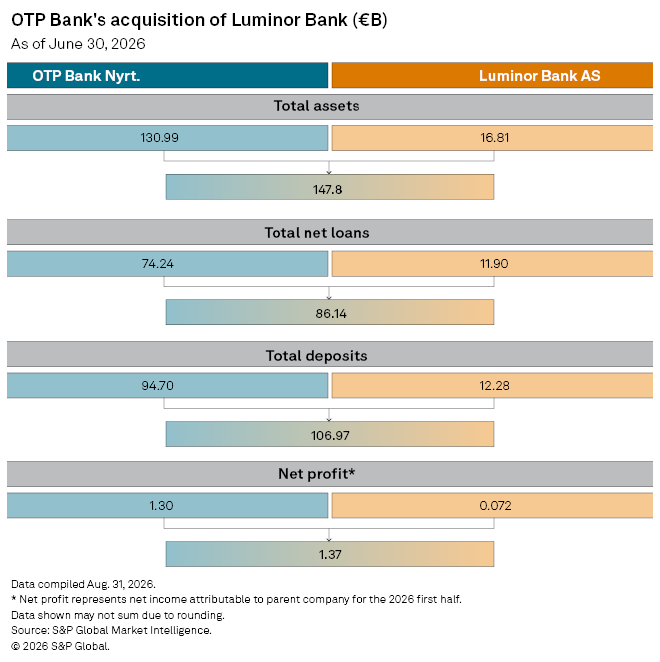
The acquisition will increase OTP Bank's total assets and customer deposits by roughly 13% and net loans by 16%, based on second-quarter figures, S&P Global Market Intelligence data show. OTP Group's euro-area exposure will increase to 50% from the current 42%.
OTP considers the transaction as an entry into the developed euro-area markets of Estonia, Latvia and Lithuania and a platform for future growth in the Baltics, Chief Strategy and Finance Officer Laszlo Bencsik said during the bank's Aug. 5 earnings call.
It is OTP's biggest ever deal, twice the size of recent acquisitions in Slovenia and Uzbekistan, marking a major step in its pan-European expansion strategy, Scope Ratings said on July 24.
Russia exposure causes concern
The transaction will be assessed by the European Central Bank and Estonia's financial supervisor Finantsinspektsioon as Luminor is headquartered in Estonia, while its Latvian and Lithuanian businesses operate as branches. Latvian and Lithuanian central banks will also be involved in the process through the ECB's supervisory framework.
The Baltic regulators emphasized that the review is at an early stage. Finantsinspektsioon told S&P Global Market Intelligence it could not comment on the substance of potential proceedings, but that any review would include a thorough examination of the acquirer and the implications for the target institution.
Latvia's central bank said OTP's reputational risk profile is assessed as "elevated" to "high," citing the lender's continued operations in Russia, growth in business volumes and profitability there, dividend income generated from Russia and concerns that its activities could be perceived as providing economic support to the Russian economy.
Lithuania's central bank also said that OTP's Russian presence raises "legitimate questions" that will need to be addressed during the review process.
OTP Bank declined to comment on the transaction or the approval process. Bencsik did acknowledge the sensitivity of the issue during the August call amid Russia's ongoing war with Ukraine.
"The nature of OTP Group is somewhat politically sensitive in the Baltics," Bencsik said. He added that discussions with local supervisors and the ECB before the transaction was announced led OTP to believe that "objectively, there doesn't seem to be any potential big roadblock to a transaction," adding that the approval process would take time.
"We very much hope that the process will be objective and fair," Bencsik said.
Reputational considerations and operational risks linked to OTP's presence in Russia are unlikely to diminish in the near term, according to S&P Global Market Intelligence senior economist Pedram Moezzi. Nonetheless, OTP's successful track record of expanding into foreign markets is likely to support its application, while the European Commission has reiterated its support for greater cross-border integration in the EU banking sector, Moezzi said.
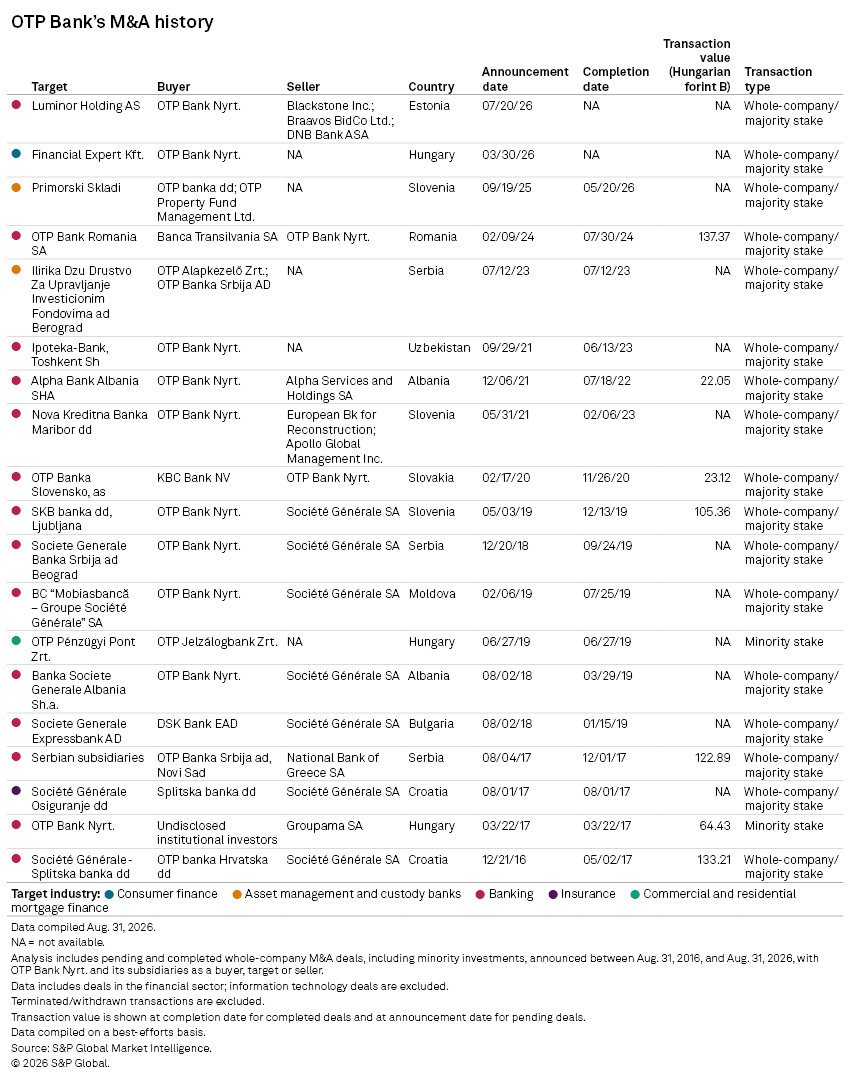
OTP has been one of Europe's most active banks in M&A, helping transform the group from a predominantly Hungarian lender into a regional group spanning Central and Eastern Europe and Central Asia.
Strong acquisition rationale
Despite regulatory uncertainty, analysts broadly acknowledge the strategic rationale for the acquisition.
OTP Bank's entry into the Baltic market likely reflects strong growth dynamics in the region's banking sectors and economies, with profitability metrics comparing favorably with the EU average, according to Moezzi.
"Overall, it is a good move to position OTP as a relevant pan-European lender and platform," Raiffeisen Research head Gunter Deuber told Market Intelligence. He added that access to the Baltic market should further strengthen OTP's digital capabilities, given the region's highly advanced digital banking landscape.
In the second quarter, Luminor Bank generated a net interest margin of 2.7% and return on equity (ROE) of approximately 8%, compared with ROE of 14.7% for Baltic lender AS Citadele banka and roughly 20% for the Baltic operations of Nordic lenders Skandinaviska Enskilda Banken AB (publ) and Swedbank AB (publ), Market Intelligence data showed.
Luminor's cost-to-income ratio was 63.6%, significantly higher than its peers'. The bank said in its second-quarter financial report that the weaker profit and efficiency metrics mainly reflected costs from its multiyear technology transformation and its capital position remaining above target, which diluted reported ROE.
"We see a decent chance that OTP may lift the profitability of the Luminor franchise closer to the 15% level," Deuber said, adding that returns of 18% to 20% could be achievable during particularly favorable operating periods.
Beyond operational efficiencies, analysts believe OTP could drive higher returns at Luminor by expanding select higher-margin retail banking activities.
"OTP may tap certain market segments that are not catered to by the Nordic banks, especially in retail and consumer lending," Deuber said. He added that OTP has a proven track record in higher-margin retail lending, while the Baltic markets' risk profile could support lower nonperforming loan ratios than those reported by OTP at the group level.
OTP Bank's nonperforming loan ratio was 3.2% in the second quarter, compared with 2.1% at Luminor Bank.
Scope Ratings cautioned, however, that improving Luminor's performance may not be straightforward given the competitive dynamics of the Baltic banking market. The agency said in July that Nordic lenders such as Swedbank and SEB benefit from lean operating models, large and cheaper customer deposit bases and strong access to wholesale funding.
Potential for further Baltic acquisitions
OTP Bank's ambitions in the Baltics could extend beyond the Luminor deal.
"Our intention or aim is to challenge the market leaders, and that can be done through organic growth, but that also could be done through further acquisitions," Bencsik said.
Acquisitions have been a core growth strategy for OTP over the past decade, and the concentration of assets in the Baltic banking sector could present additional, smaller acquisition opportunities in the future, Moezzi said. OTP is also likely betting on the European Commission's drive to boost banking competitiveness, which is expected to ease restrictions on pan-EU banking groups, according to the analyst.
While additional bank acquisitions may prove challenging, OTP could strengthen its market position through deals involving asset managers, payment companies or leasing operations instead of bank takeovers, Deuber said.
OTP's international operations have become the main driver of the group's performance following the years of acquisitions. Foreign subsidiaries accounted for 66.6% of group revenue, 77.0% of profit after tax and 55.9% of total assets in 2025, compared with 57.1%, 44.5% and 41.3%, respectively, in 2018.
With a greater presence in developed euro-area markets, the transaction is generally viewed by analysts as credit positive for OTP.
Long-term, the deal could reduce OTP Group's risk profile, which may add to rating upside, Deuber said. The greater improvement in OTP's risk profile, as well as in equity and funding costs, may come from Hungary embarking on "a credible euro area rapprochement" over the next two years.
"In combination with such a scenario, the increased share of euro area markets may lead to rating upsides for OTP Group," Deuber said.
|