16 Sep, 2026
Indian shadow banks set to improve asset quality as prior cleanup supports gains
By Yuvraj Singh and Uneeb Asim
Indian shadow banks are expected to build on recent gains in asset quality with better underwriting and cleaner loan books as economic growth supports borrowers' ability to repay.
The combined share of Stage 2 and Stage 3 loans at major Indian shadow banks, or nonbanking financial companies (NBFCs), fell to 3.85% in the fiscal year ended March 31, from a peak of 10.59% in fiscal 2022, according to an analysis by S&P Global Market Intelligence of 20 NBFCs with more than 1 billion Indian rupees each in assets.
Under IFRS 9, the loan-staging framework followed by most Indian NBFCs, Stage 2 loans are those where credit risk has increased significantly since origination, while Stage 3 loans are considered credit-impaired or in default.
The improvement came even as loan books grew. Gross customer loans at the firms in the sample nearly doubled to about 50 trillion rupees in the fiscal year ended March 31, from 27 trillion rupees four years prior.
"The asset quality of NBFCs improved partly because the economy improved, but also because the system paid the price for the previous lending cycle and then tightened underwriting," Ajitabh Bharti, executive director and co-founder of CapitalXB, told Market Intelligence on Sept. 8. "That distinction matters when judging what happens next."
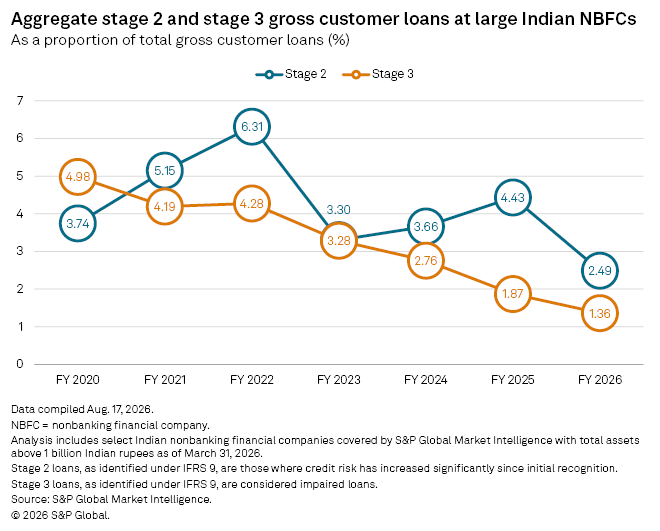
The tough twenties
Indian nonbank lenders entered the pandemic with a legacy of stress from an earlier credit cycle. COVID-19 added another layer of pressure. As lockdowns disrupted incomes and business activity, retail borrowers and small businesses struggled to keep up with repayments, pushing up bad loans.
The tide began to turn as businesses reopened, employment recovered and borrower cash flows improved. Simultaneously, the sector moved toward tighter customer selection, more stringent credit checks, greater use of transaction data and more sophisticated collection systems, Bharti noted.
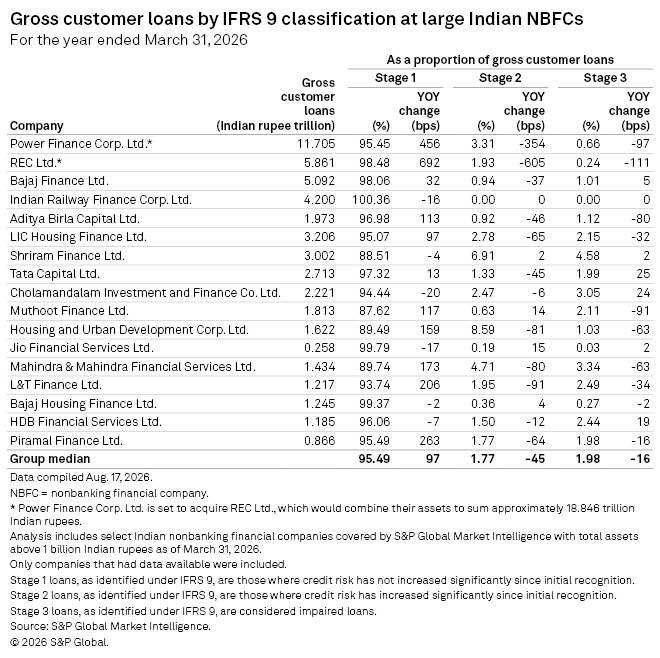
Tighter regulations put a leash on risk
The Reserve Bank of India (RBI) introduced a scale-based regulation framework for NBFCs in 2022, dividing them into four layers based on size, activity and perceived risk. The new framework brought stronger safeguards around liquidity, capital, governance and concentration risk, particularly for larger lenders.
For larger NBFCs, exposure to a single counterparty was capped at 20% and to a group of connected counterparties at 25%. They are also required to maintain differential provisioning between 0.25% and 2%, depending on risk.
The regulatory shift also changed the economics of aggressive unsecured lending.
"Regulators deliberately slowed areas where credit growth appeared excessive," Bharti said. "Microfinance is a good example: tighter limits on borrower leverage and multiple lending reduced over-indebtedness, and newer pools are consequently behaving better."
The central bank also increased risk weights on unsecured consumer credit. "The increase in risk weights on unsecured retail lending effectively raised the capital cost of aggressive growth, encouraging lenders to strengthen underwriting standards and focus on portfolio quality rather than volume growth," Bharti said.
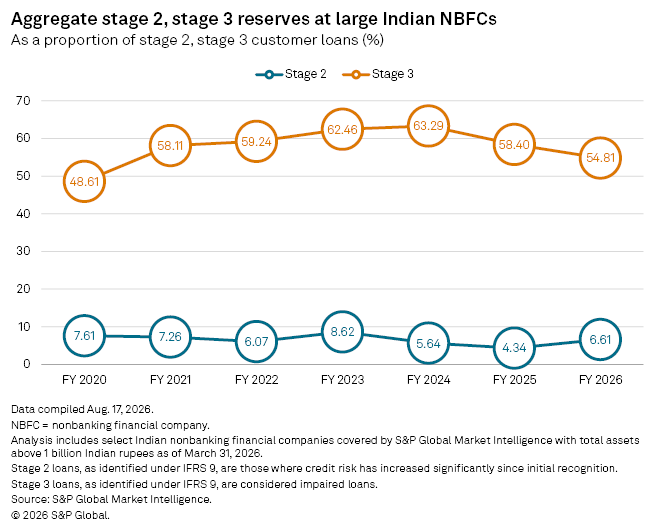
Expected credit loss provisions rose sharply in 2022 and 2023. Provision coverage for Stage 2 loans, which carry a lifetime expected credit loss requirement, rose to 8.62% in the fiscal year ended March 2023, according to Market Intelligence data.
For Stage 3 loans, where borrowers are considered to be credit-impaired and much closer to default, coverage peaked at 63.29% in the fiscal year ended March 2024. The higher provisioning meant lenders had to recognize deterioration costs earlier, while tighter capital requirements made rapid growth in riskier segments more expensive.
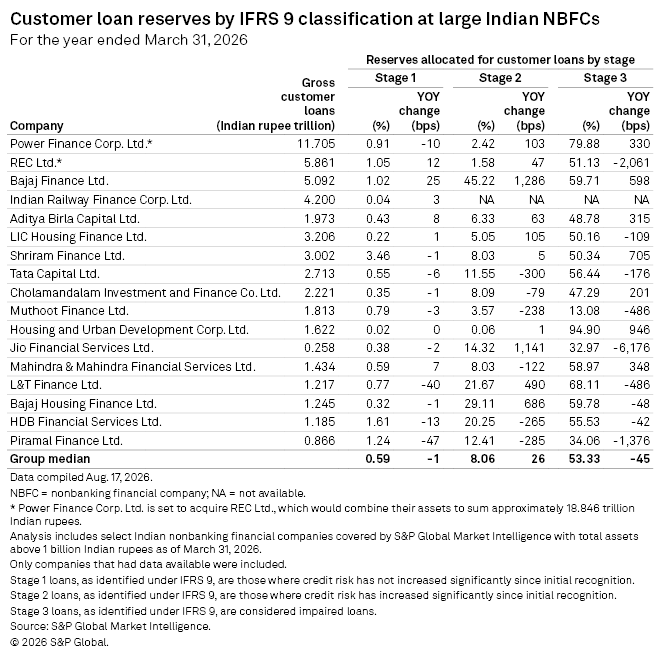
Balance sheets now look healthier
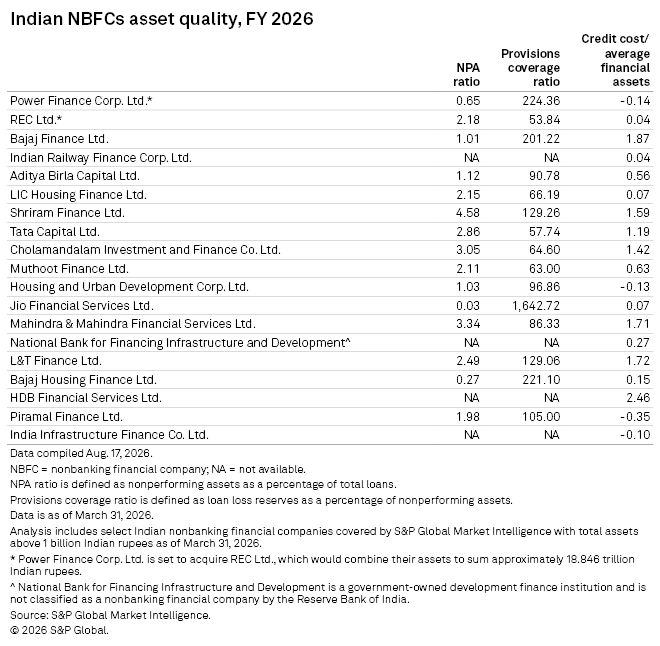
Most large NBFCs now report nonperforming asset ratios below 4%, with Shriram Finance Ltd. the only exception among the lenders reviewed, at 4.58%.
Credit costs have also moderated, although they remain elevated at some lenders. HDB Financial Services Ltd., for instance, reported credit costs of 2.46% in the fiscal year that ended on March 31.
NBFCs have also shifted away from some of the riskier unsecured segments toward secured lending such as housing, vehicle and gold loans, which typically have lower loss rates, according to Pratik Shah, a partner at EY India.
The change was partly encouraged by regulation and partly driven by lenders themselves, Shah told Market Intelligence.
Funding remains the weak link
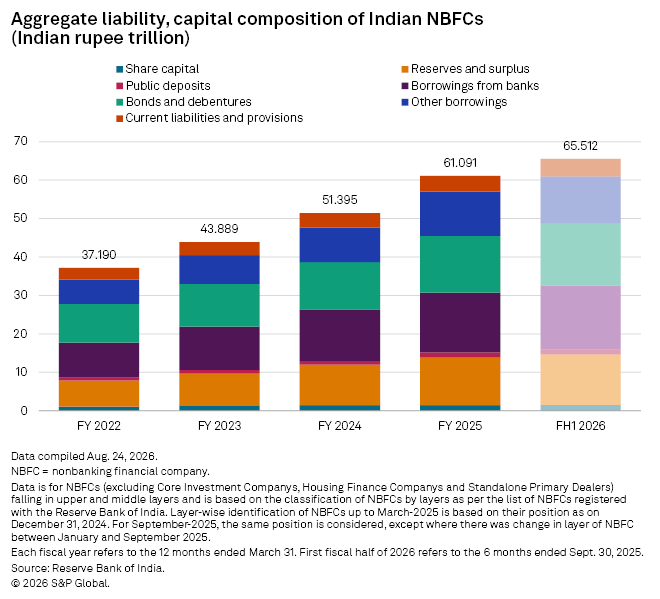
Most shadow banks do not accept deposits and depend on banks and capital markets for funding. Larger NBFCs with AAA and AA+ ratings can tap the bond market more readily, while lower-rated lenders tend to rely more heavily on bank credit.
"The liability profile for most AAA-rated NBFCs has not changed much over the past few years. Those that see rating upgrades start participating in bond markets and thus see a shift away from bank lines," Nomura analyst Shreya Shivani told Market Intelligence.
Borrowings from banks and debt markets each account for about a quarter of the liability franchise of large NBFCs, according to Market Intelligence data, with both shares remaining broadly stable over the past few fiscal years.
As of Sept. 16, US$1 was equivalent to 95.93 Indian rupees.
|