29 Sep, 2026
Healthier US household debt may limit impacts of US Fed rate hikes

By Brian Scheid
The US Federal Reserve is again fighting persistently high inflation with higher interest rates, but the central bank's shift in monetary policy may prove far less effective, as American households are less sensitive to sudden changes in borrowing costs.
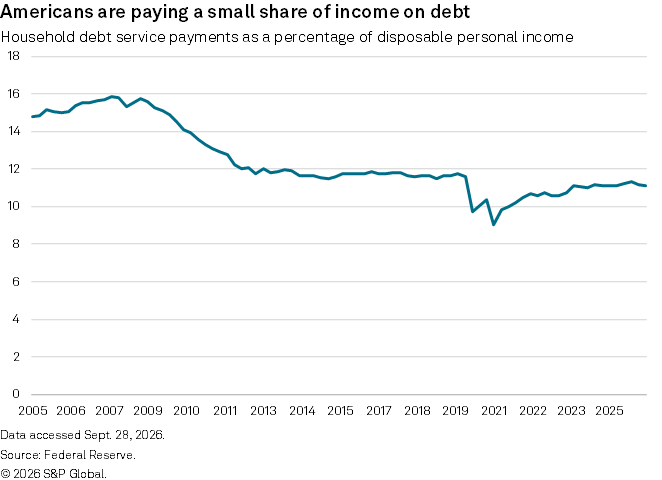
Fewer homebuyers are taking on variable rate debt, traditionally a main channel for rate hikes to impact consumer spending, while per capita consumer debt remains below pre-pandemic levels, and aggregate debt is relatively low and stable when compared to previous stretches when the Fed has hiked rates.
"Household balance sheets are in the best condition they have been in years," Joe Brusuelas, principal and chief economist at RSM US LLP, said in an interview. "Therefore, one should anticipate that Fed rate hikes are not going to slow down the economy in ways that many anticipate."
The average American owed less than $63,500 in debt in the second quarter of 2026, when adjusted for inflation, according to the Federal Reserve Bank of New York's Center for Microeconomic Data. Per capita debt is now down more than 23% from its peak in 2008 and 5% below its pre-pandemic level, the data shows.
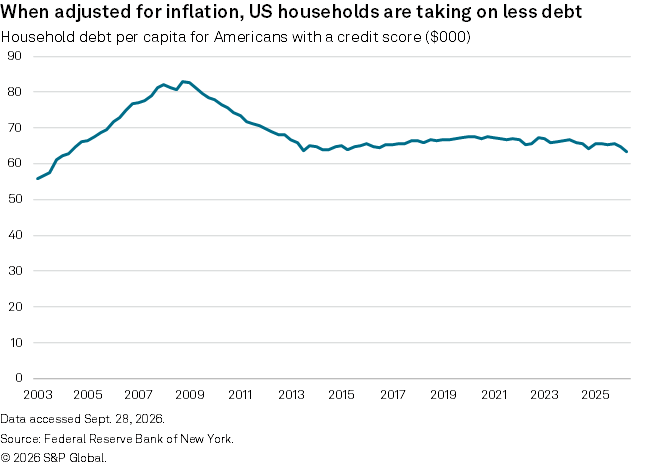
"A much smaller share of households is directly exposed to higher policy rates than in past cycles, reducing the immediate impact of Fed tightening on household cash flows and spending," Brian LeBlanc, head of economic analysis at PNC Economics Research, said in an interview. "The direct pass-through to consumers remains more muted than in prior cycles."
The relative health of US household balance sheets has complicated the Fed's push to bring inflation down to a 2% target, a task the central bank has been unable to accomplish for more than five years.
At the same time, the chief causes of stubbornly higher inflation, particularly higher energy prices tied to the war with Iran, tariff impacts and massive investments into AI infrastructure, are unlikely to be lessened by higher rates.
"Higher rates are not going to bring down oil prices and will probably do little to tame airline fares or freight costs," James Knightley, chief international economist at ING, told S&P Global Market Intelligence. "In fact, it could make things worse by forcing struggling firms out of business."
The Fed wants core personal consumption expenditures, which strips out volatile food and energy prices, to grow annually by 2% or less. Annual growth fell as low as 2.6% in April, but has been above 3% for the rest of 2026 and has held at just over 3.3% since June.
Still, consumers' views of the economy are in decline.
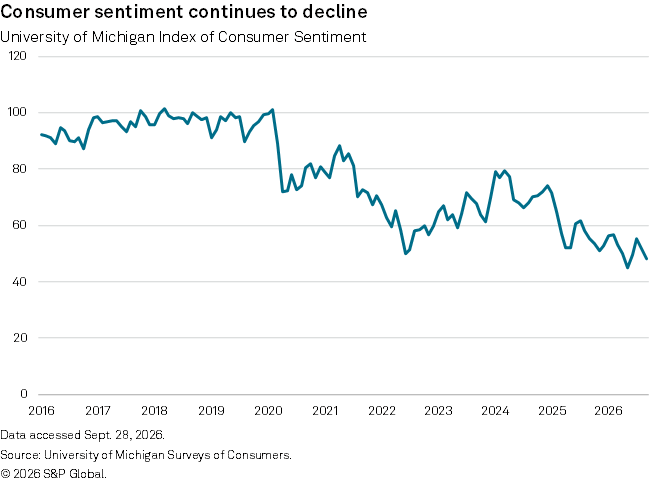
The University of Michigan's Index of Consumer Sentiment, which tracks Americans' views on personal finances and the broader economy, dipped to 48.1 in September — its lowest reading since May and a nearly 15% decline since January.
The Fed approved its first rate hike earlier this month, and the majority of the futures market expects two more hikes before the end of this year, according to CME FedWatch.
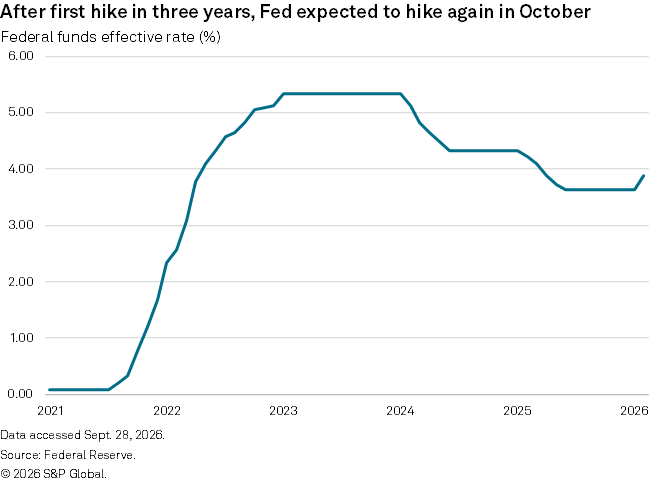
While it can take a while for higher rates to impact consumer spending, this current hiking cycle could take far longer.
"While not without some pain, the consumer can probably handle current interest rate levels," Oren Klachkin, a financial market economist at Nationwide, said in an interview. "Slowing the economy would likely require far more Fed tightening than is currently priced in, coupled with tighter financial conditions and a weaker wealth effect."
The Fed's push for higher rates is now running into a consumer economy less sensitive to rate hikes. This can be clearly seen in the domestic housing market, where most homeowners are locked into a mortgage rate significantly below current levels.
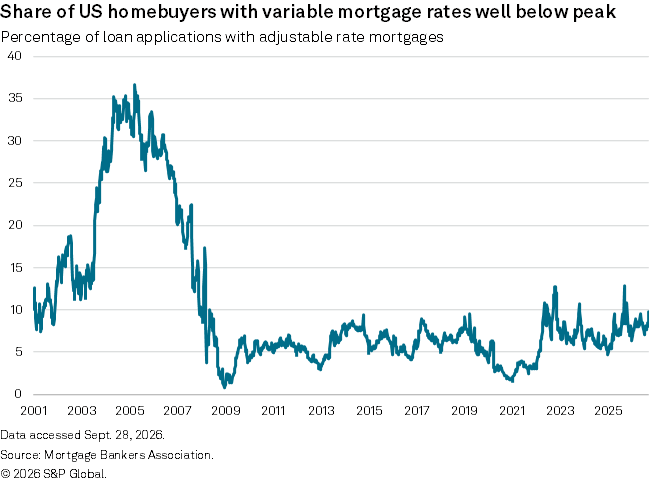
Less than 10% of mortgage loan applications were for adjustable-rate mortgages as of Sept. 18, well below the level 20 years ago, when 27% of applications were for adjustable-rate mortgages, according to the Mortgage Bankers Association.
In spite of higher inflation, the economy remains in "very good condition," although the distribution of gains from this growth is going toward the upper 40% of households, which are responsible for nearly 70% of all spending, said Brusuelas at RSM.
This imbalance is an impediment to Fed hikes affecting consumer behavior, as higher rates primarily work through the most rate-sensitive sectors, including housing and manufacturing, before impacting employment in construction and the auto sector. However, these sectors are not driving the economy; the build-out of AI infrastructure is, Brusuelas said. And with little push within Congress to rein in fiscal policies to restore price stability, the Fed's policy choices appear limited.
"That means more, not less, rate hikes are probable even if the efficiency of those policy actions is less robust than it was over the past years due to the ongoing structural transformation of the American economy," Brusuelas said.
Still, while higher rates from the Fed may have less of an effect on US consumers, particularly those at the upper ends of income, tighter monetary policy will slow the rapid pace of growth at a time when Americans are already squeezed by inflation and higher energy prices, according to Michael O'Rourke, chief market strategist at JonesTrading.
"I would not describe the American consumer as immune, I would say they are stretched and feeling greater pressure in other areas," said O'Rourke. "The upper leg of the K-shaped economy remains strong and will take time before they feel pressure."
The hikes come after six years of significant wealth gains by the top 20% of households by income. These upper-income households are responsible for as much as 60% of spending. Spending from these upper-income households could see little change as higher rates take root, ING's Knightley said.
"Higher borrowing costs have been nullified to some extent by this growing skew to who is driving consumer spending growth," Knightley said.