15 Sep, 2026
Global bond sell-off signals potential boost for eurozone banks

| European Central Bank President Christine Lagarde raised interest rates Sept. 10 amid a surge in sovereign bond yields. Source: NurPhoto/Getty Images News via Getty Images Europe. |
Eurozone banks are set to benefit from the recent spike in sovereign bond yields, which should support wider margins and increased income in their lending businesses.
The bloc's banks have experienced a slowdown in net interest income (NII) growth in recent quarters due to lower interest rates. NII — most banks' largest source of revenue — is the difference between what banks earn from lending and pay for funding.
Higher yields on highly rated sovereign bonds, which are generally considered the lowest-risk financial asset, tend to push up yields on riskier products such as loans to homeowners, businesses or consumers.
"Higher government bond yields reflect the expectation for higher interest rates being priced in," Johann Scholtz, bank equity analyst at Morningstar DBRS, said in an interview. "That typically is a positive for banks."
The European Central Bank raised its benchmark deposit facility rate by 25 basis points to 2.5% on Sept. 10. Markets see a further 25 bps increase as likely before the end of 2026.
Expectations of higher interest rates due to stubborn inflation, limited progress on reducing government budget deficits, and competition for funding from AI companies are driving the sell-off in sovereign bonds.
'Dark art'
Lenders should be able to easily manage the recent drop in the value of their significant sovereign debt holdings, Marchel Alexandrovich, economist and partner at consultancy Saltmarsh Economics, said in an interview. The price of bonds falls as yields rise, and eurozone lenders hold almost €2.5 trillion of eurozone government debt.
Banks can reclassify bonds in their accounts to mitigate the impact of falling yields by transferring those previously labeled as "trading securities" or "available for sale," which must be reported at fair value and so reflect any losses, to "held to maturity," which are generally reported at amortized cost.
"This is like the dark art of how banks run their balance sheet and how they present the data [on bond holdings]," said Alexandrovich, who spent 11 years at global investment bank Jefferies. "Banks can allocate any of these holdings to their trading portfolio or buy-and-hold portfolio."
Some banks with sizable fixed-income trading desks might even benefit from the market volatility driven by rising interest rates and their uncertain trajectory.
"Uncertainty around rates staying higher for longer creates opportunities for hedges. It creates more activity," said Scholtz.
A move by eurozone banks in recent years to diversify their holdings of sovereign debt, which were traditionally composed of domestic government bonds, should also spread the burden of any distress in a specific sovereign's bonds.
Eurozone lenders have almost doubled their holdings of non-domestic sovereign bonds to more than €1 trillion since the beginning of 2022, growing at twice the rate of the increase in total holdings during the same period, ECB data shows.
"There's a lot more cross-country exposure than there was in the past," said Alexandrovich.
Negative impacts
Still, this diversification of eurozone banks' holdings is a double-edged sword.
"If a European government's debt comes under pressure, there'll be wider spillover than maybe there was in the past because other countries' banks hold that debt more than they did before," said Alexandrovich.
Higher sovereign bond yields also increase funding costs for banks, Fabio Ianno, vice president, senior credit officer at Moody's Ratings, said in an interview.
"The cost of banks' wholesale issuances, especially of more junior instruments, is correlated to a pretty high extent to the cost of government bond yields," he said. "Government bond yields going up means that banks need to pay more to issue their debt, to refinance their debt, in the market."
The recent jitters in global sovereign bond markets prompted a sell-off in the shares of some of Europe's largest lenders. French banks were particularly affected as fears grew about their exposure to the country's sovereign bonds, which have posted the largest losses among peers during the recent sell-off. 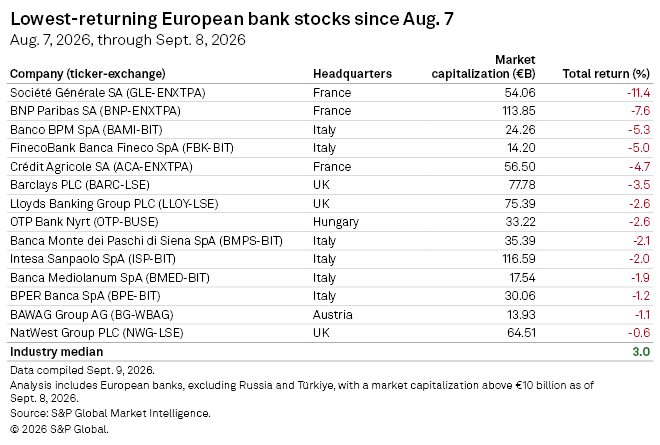
Société Générale SA recorded a negative total return of 11.4% between Aug. 7 and Sept. 8, reflecting its greater reliance on the French market than its listed domestic peers, S&P Global Market Intelligence data shows. BNP Paribas SA was down 7.6% in the same period, while Crédit Agricole SA dipped by 4.7%.
The sell-off in French banks' shares was likely driven more by sentiment around the country's economic prospects as the government's fiscal position deteriorates rather than concerns about the banks' exposure to the country's debt, said Scholtz.
"The French banks are a little bit of a proxy for the French economy," he said.
The funding costs of some French banks, particularly those with the same credit rating as the French sovereign, could further increase if France's credit rating is downgraded, Nicolas Charnay, managing director and sector lead, European financial institutions at S&P Global Ratings, said during a webinar in July.
BNP Paribas and Crédit Agricole each share an A+ rating from S&P with the French sovereign, while SocGen has an A rating, Market Intelligence data shows.
When exacerbating already difficult fiscal positions for governments, higher sovereign bond yields can also reduce their flexibility to support banks, further impacting lenders' credit profiles, Charnay added.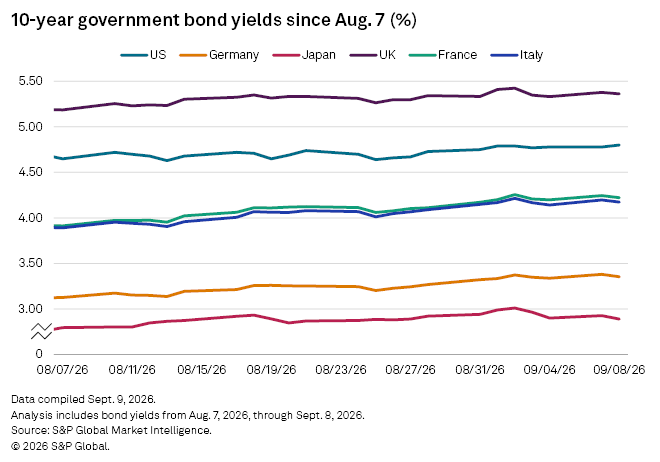
Yields on the sovereign bonds of most of the world's largest economies — the US, Germany, Japan, the UK, France and Italy — have risen sharply in recent weeks, Market Intelligence data shows. France experienced the largest increase between Aug. 7 and Sept. 8 at 31bps, followed by Italy at 28bps and the UK at 27bps.
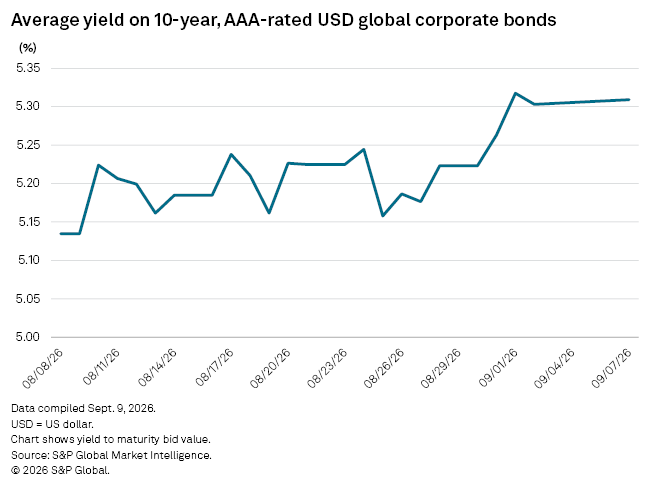
The yield on 10-year USD corporate bonds rose by 18 basis points between Aug. 8 and Sept. 7, the data shows.
Even so, the ECB's past willingness to intervene in sovereign bond markets in a time of stress should reassure the market in the months ahead, said Alexandrovich.
The eurozone sovereign debt crisis was effectively ended in 2012 when ECB president Mario Draghi announced that the central bank was willing to do "whatever it takes to preserve the euro," which calmed markets and quickly reduced borrowing costs for struggling countries.
"If you're a European investor, you should never be doubting the ECB's ability to step in and to support the markets because they've demonstrated that ability," said Alexandrovich.
|