16 Sep, 2026
German state banks face rising asset quality risks in 2026 from war, CRE stress

Germany's state banks face growing asset quality pressure in 2026, driven by the ripple effects of the Iran war and persistent stress in sectors like commercial real estate.
The so-called landesbanken — state-run lenders acting as central institutions for the German savings bank sector — reported mixed results for the first half of 2026 as higher rates and financial market volatility hit fair-value income, while macroeconomic headwinds drove higher provisions. All banks reported earnings during the month of August.
Banks' credit costs are expected to remain elevated in the second half of this year, with loans at significant risk of default and nonperforming loans likely to rise year over year, said Marco Diamantini, European bank rating analyst at Fitch Ratings.
"The key pressures are geopolitical fallout from the war in Iran, high energy prices, a weakening of external demand for German exports, and ongoing stress in commercial real estate and construction sectors," Diamantini said in an emailed comment.
Three out of four banks — Landesbank Baden-Württemberg (LBBW), Landesbank Hessen-Thüringen Girozentrale (Helaba), and Norddeutsche Landesbank Girozentrale (NordLB) — booked higher loan loss provisions for the first half of 2026 compared with the same period of 2025, S&P Global Market Intelligence data shows. Bayerische Landesbank (BayernLB) was the only one to report lower provisions year over year, the data shows.
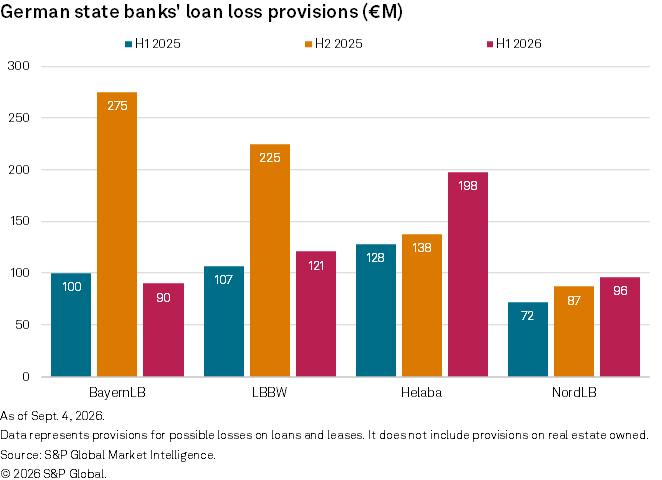
LBBW, the largest by assets among the four banks, explained the increase in provisions with macroeconomic headwinds affecting its real estate and corporate exposures. NordLB said it made additional provisions for potential losses in its structured finance business, commercial real estate (CRE) portfolio and its corporate customer and savings bank network.
Helaba reported the highest increase in provisions — to €198 million in the first half from €129 million a year earlier. This was driven mainly by rising credit pressures in its real estate portfolio, with some added provisions for geopolitical risk too, the bank said in its first-half earnings release.
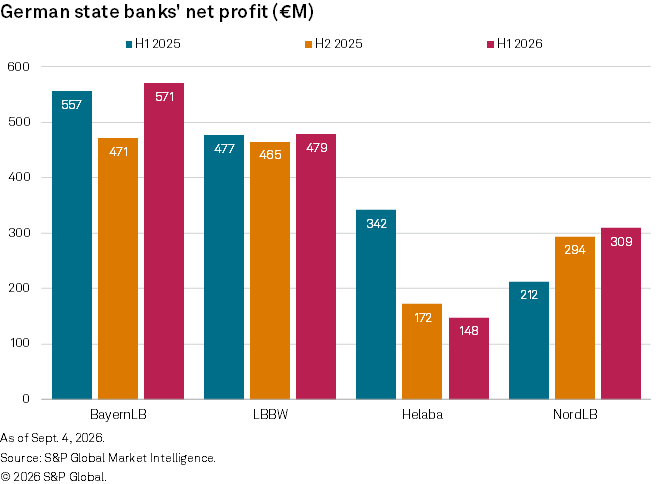
Helaba was the only bank to book a lower profit than a year ago. Its first-half net profit plunged to €148 million from €342 million in the first six months of 2025, Market Intelligence data shows. The bank attributed the profit drop to losses in its CRE book and a lower fair value result. Fair value results reflect changes in the market prices of financial assets and liabilities — such as securities, derivatives and real estate — held by the banks.
Profit outlook
Earlier in 2026, BayernLB, Helaba and LBBW guided for moderate declines in full-year pretax profit versus 2025, while NordLB projected a moderate profit increase. In their first-half earnings reports now, BayernLB, LBBW and NordLB reiterated their previous guidance, while Helaba lowered its 2026 target.
Helaba now expects a full-year pretax profit of €500 million, compared to the previously projected €600 million to €700 million in 2026. In 2025, the bank made a pretax profit of €731 million.
Despite the guidance downgrade for this year, Helaba still believes it can raise its pretax profit to €1 billion within the next five years, CEO Thomas Groß said in the bank's latest earnings release. "We are currently sharpening the focus of our investments, accelerating our growth initiatives and have introduced rigorous cost-saving measures," Groß said.
"Most of the large landesbanken should deliver 2026 results broadly in line with, or in NordLB's case better than, 2025. Helaba remains the main outlier because of the ongoing adjustment in its real estate business," Fitch's Diamantini said. Helaba could reach its €1 billion profit target within four to five years "only if cost discipline is maintained and credit costs decline," the analyst said.
Reducing expense for external consultancy and more selective recruitment are expected to drive cost savings and help Helaba curb cost growth in 2026, a spokesperson for the bank told Market Intelligence. Over the medium term, the bank aims to reduce its cost growth rate to below the inflation rate, the spokesperson said.
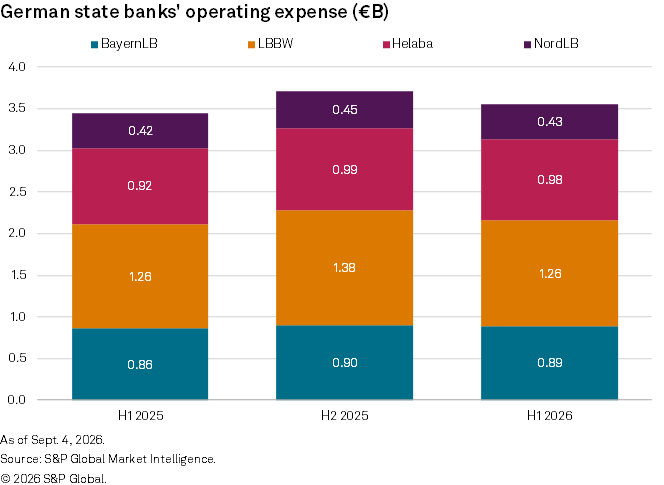
Operating costs at all state banks remained largely stable in the 18 months through June 2026, Market Intelligence data shows.
Earnings resilience
Strong growth in new business and net fee and commission income (NFCI) confirms that Helaba is on the right track strategically, Groß said in the earnings statement. The bank was also able to reduce its NPL ratio through targeted portfolio management, the CEO noted.
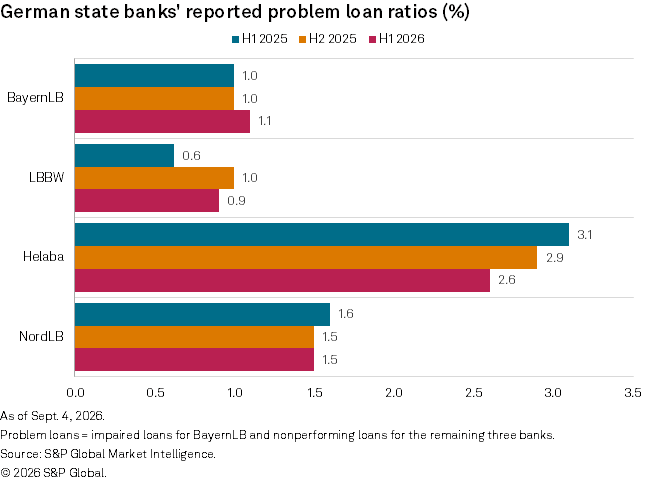
Helaba's reported NPL ratio recorded the steepest decline compared to peer ratios, falling to 2.6% in the first half of 2026 from 3.1% a year earlier. In contrast, BayernLB's and LBBW's ratios increased, while NordLB's ratio remained flat year over year, Market Intelligence data shows.
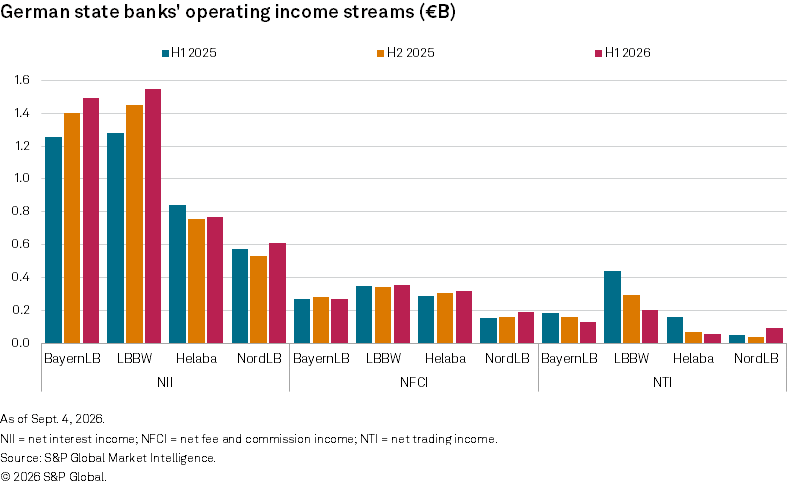
While net trading income (NTI) was weaker at most banks, most of them reported higher net interest income (NII) and NFCI for the first half of 2026. NTI fell year over year at all banks except for NordLB, NII grew at all except for Helaba, while NFCI increased at Helaba, LBBW and NordLB, and remained stable at BayernLB, Market Intelligence data shows.
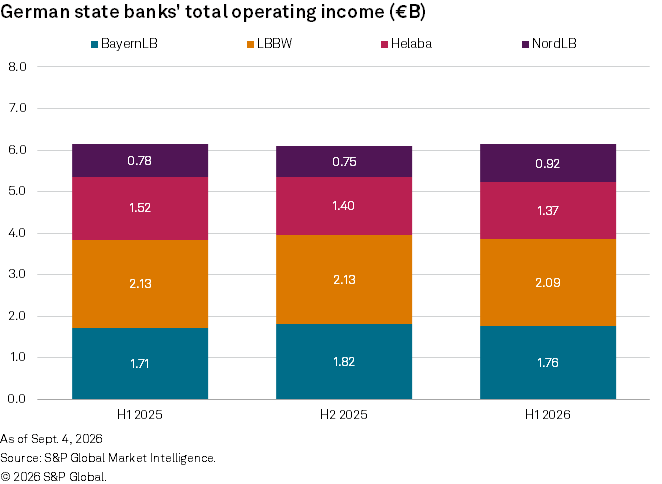
Overall, operating income grew at NordLB and BayernLB, but decreased at Helaba and LBBW, according to the data.
Banks' earnings "will likely remain sensitive to credit costs and market volatility," but will also continue to reflect the costs and benefits of ongoing strategic initiatives aimed to broaden their client bases, diversify revenue streams, improve productivity, and strengthen their technological capabilities, Morningstar DBRS credit analysts said in a Sept. 2 note.
Asset quality pressure is "manageable," but banks' CRE and corporate exposures "require close monitoring," analysts said.
Banks confident
The landesbanken consider themselves well positioned to navigate the more challenging environment, with NordLB and LBBW being more upbeat in their outlook.
"The current period of economic upheaval is bringing challenges, but also major opportunities for our customers and ourselves," LBBW CEO Rainer Neske said in the group's earnings release.
LBBW's diversified loan book and broad range of offerings enable it to seize new business opportunities and tackle ongoing challenges, a spokesperson said. The bank has "a substantial extra buffer" of reserves to manage potential stress in its loan portfolio, the spokesperson said.
LBBW held additional allowances for potential loan losses of €800 million as of June 30, according to its latest earnings release.
NordLB's first-half results demonstrate its ability to achieve a higher pretax profit in 2026 despite the macroeconomic and geopolitical uncertainty, CEO Jörg Frischholz said in the group's earnings release.
The positive performance reflects both strong income growth and sustained cost discipline, a spokesperson said. NordLB monitors all of its sector exposures on an ongoing basis as part of its credit risk management framework, the spokesperson said. The bank does not disclose "internal forecasts or projections on the future development of risk provisions," the spokesperson said.
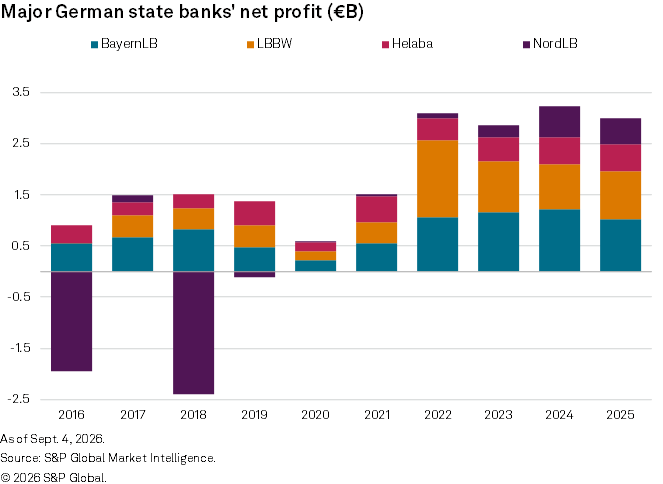
Over the past four years, German state bank profits have been at their highest level in a decade, Market Intelligence data shows.
Compared to other large banks operating in Germany, the landesbanken had slightly higher problem loan ratios, medium-range return on equity, and were among the best capitalized in 2025, the data shows.