11 Sep, 2026
Female representation on US REIT boards dips after 11 years of increases

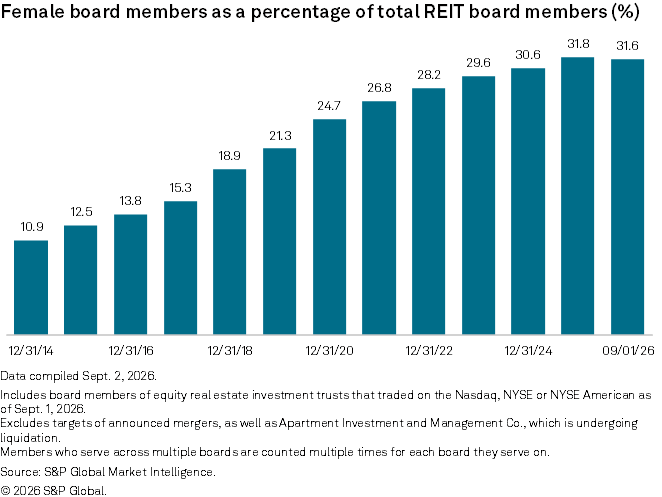
The percentage of women on the boards of directors at US real estate investment trusts ticked slightly downward compared to year-end 2025, following 11 consecutive years of increases.
Women held 364 seats on US REIT boards as of Sept. 1, representing 31.6% of the total REIT board members, according to a recent analysis by S&P Global Market Intelligence. For comparison, women represented 31.8% of board seats at the same REITs as of the end of 2025. That said, the figure remains much higher than the 10.9% of board seats held by women at the end of 2014.
The analysis included REITs that trade on the Nasdaq, NYSE or NYSE American, excluding LXP Industrial Trust, which agreed to be taken private by Brookfield Asset Management Ltd. and Canada Pension Plan Investment Board, as well as Aimco, which is in the process of liquidating.
Larger-cap REITs hold a higher percentage of women on boards
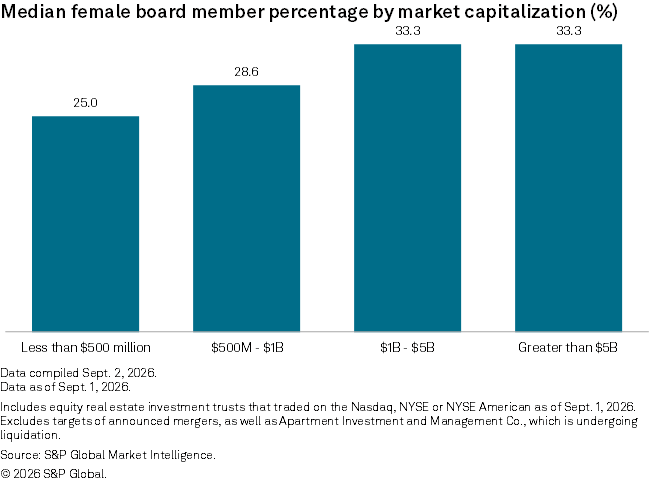
REITs with larger market capitalizations generally held higher percentages of women on their board of directors compared to smaller-cap REITs.
Women represented one-third of board constituents at REITs with more than $1 billion in market capitalization, on a median basis, compared to women holding a median 28.6% of board positions at REITs with market capitalizations between $500 million and $1 billion. For the smallest REITs with market capitalizations under $500 million, women held 25% of board positions, on a median basis.
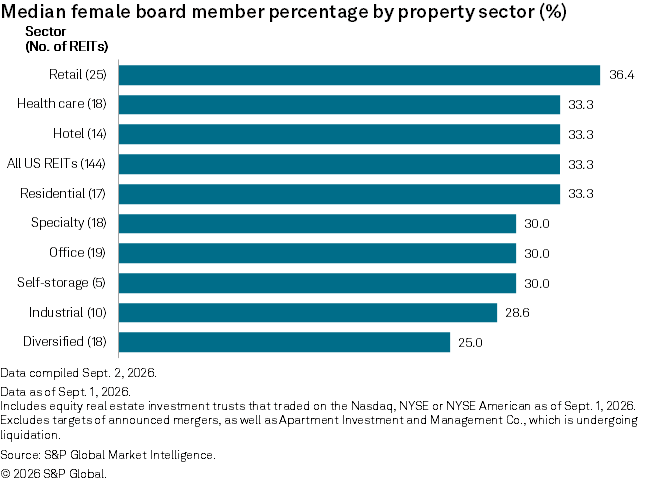
While there wasn't a significant difference across property sectors in the gender composition of board members, retail REITs had a slightly higher percentage of female board members, at a median of 36.4%.
Women held one-third of board seats at health care, hotel and residential REITs, on a median basis.
Diversified and industrial REITs held smaller percentages of women on their boards of directors, at medians of 25% and 28.6%, respectively.
– Set email alerts for future Data Dispatch articles.
– Read other Data Dispatch articles by S&P Global Market Intelligence.

REITs with the largest percentage of women board members
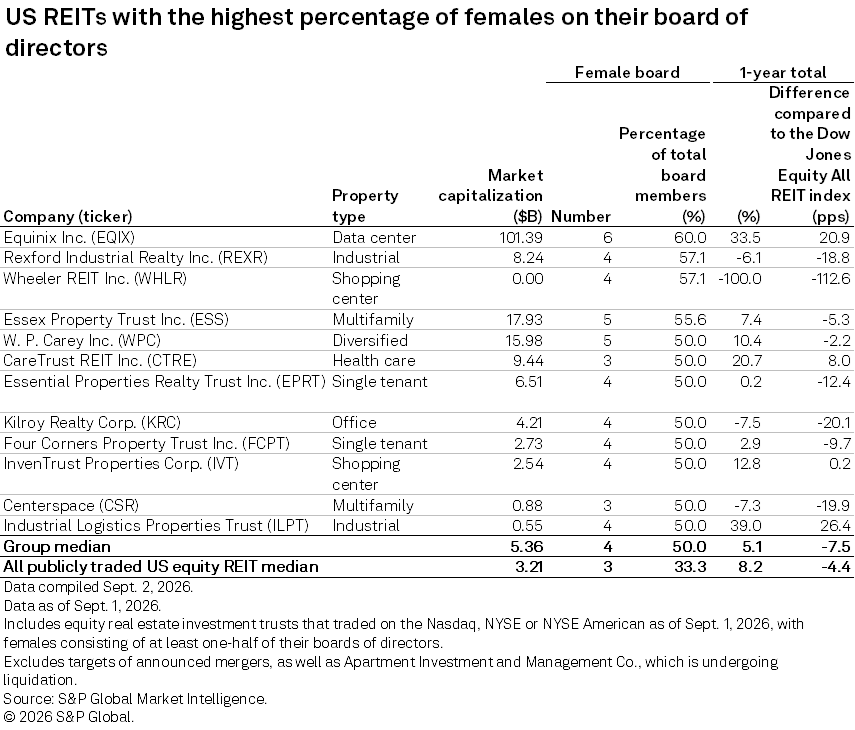
Twelve REITs in the analysis had at least half of their board seats occupied by women.
Data center REIT Equinix Inc. had the highest percentage of female representation on its board among all US REITs, with six of its 10 directors, or 60%.
Industrial REIT Rexford Industrial Realty Inc. and shopping center-focused Wheeler REIT Inc. each had four of seven seats on their boards of directors occupied by women, representing 57.1%.
Five of the nine board seats at multifamily REIT Essex Property Trust Inc. are occupied by women, or 55.6%.
Other REITs in which women held half of the board seats included W. P. Carey Inc., CareTrust REIT Inc., Essential Properties Realty Trust Inc., Kilroy Realty Corp., Four Corners Property Trust, InvenTrust Properties Corp., Centerspace and Industrial Logistics Properties Trust.
REITs with no women board members
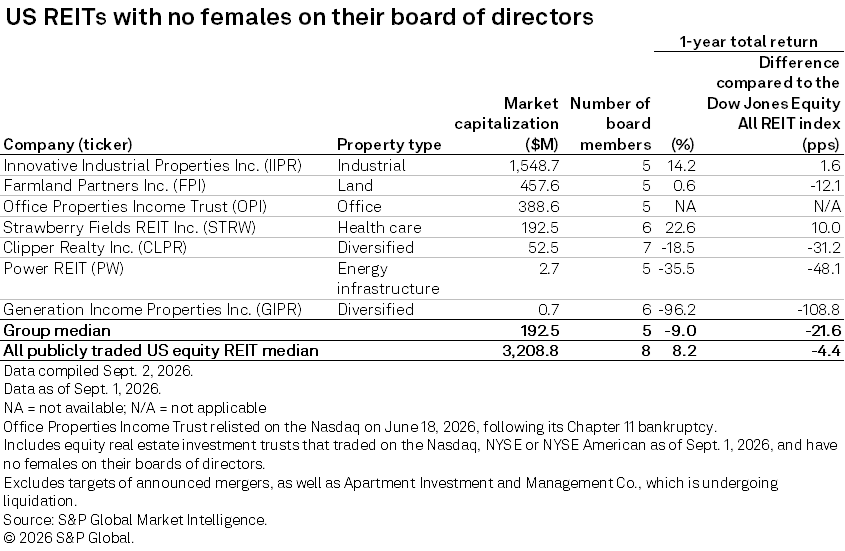
Seven REITs have no women on their boards: Innovative Industrial Properties Inc., Farmland Partners Inc., Office Properties Income Trust, Strawberry Fields REIT Inc., Clipper Realty Inc., Power REIT and Generation Income Properties.
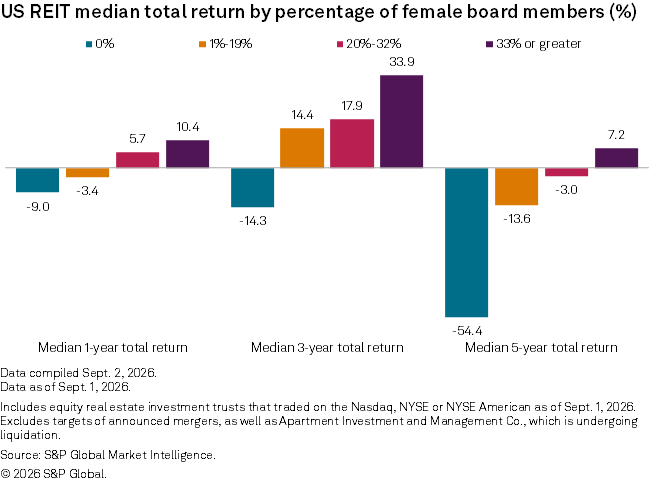
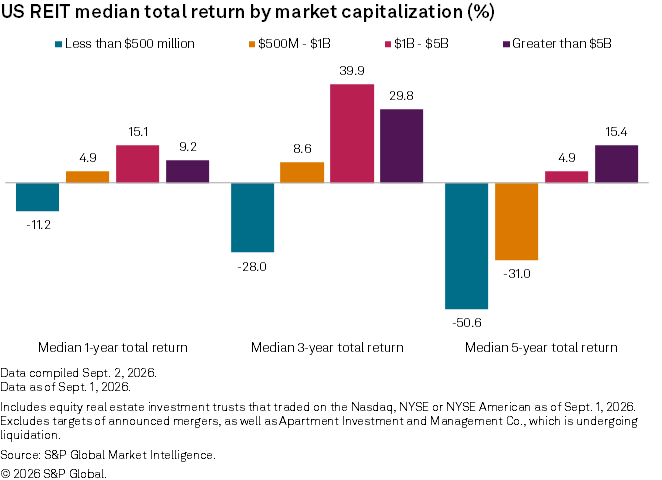
When looking at total returns over the recent one-, three- and five-year periods, REITs with a larger percentage of women on their boards generally posted higher returns than those with smaller percentages of women on their boards, according to Market Intelligence data. That being said, the data also showed that larger-cap REITs, which were more likely to have a higher percentage of women on their boards, outperformed their smaller-cap counterparts over those time periods.