22 Sep, 2026
Cross-selling, integrated platform to drive growth at DNB's i-bank arm Carnegie
By Adrian Jimenea and Marissa Ramos

|
Alexander Opstad, group executive vice president of DNB |
A combined platform and a push for product cross-selling are keys to maximizing returns from Norway-based DNB Bank ASA's acquisition of Swedish investment bank Carnegie nearly two years ago, according to the unit's chief.
"We are still in the process of realizing the full benefits of the combined DNB Carnegie, and we expect a positive trajectory in the coming years," Alexander Opstad, group executive vice president of DNB Carnegie, told S&P Global Market Intelligence.
Oslo-headquartered DNB Bank signed a deal for Carnegie in October 2024 for more than €1 billion. It combined the business with its existing DNB Markets investment banking arm and rebranded the merged unit as DNB Carnegie. The business has since been a key earnings driver for the group as the windfall from high interest rates dwindles.
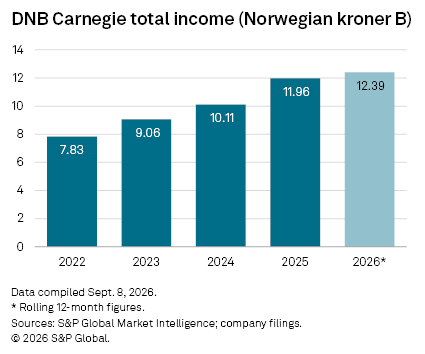
In 2025, the year after the acquisition, DNB Carnegie's revenue jumped 18.3% to 11.96 billion Norwegian kroner ($1.27 billion). For 2026, the rolling 12-month figure suggests an increase of nearly 4%, according to a company presentation.
The firm will leverage its "increasingly scalable and efficient platform" to drive growth by deepening client penetration, bolstering cross-business collaboration and continuing to expand in its major markets in the Nordics, Opstad said.
Conducive environment
Nordic lenders are placing a stronger emphasis on fees
Thanks to DNB Carnegie, DNB Bank now has better access to large international corporates in Sweden, Denmark and Finland, and can now build up cross-selling to those customers, Norne Securities equity analyst Žilvinas Jusaitis told Market Intelligence.
In the second quarter, DNB Bank said cross-selling income at its large corporate division increased, insulating the division's return on equity from lower average margins.
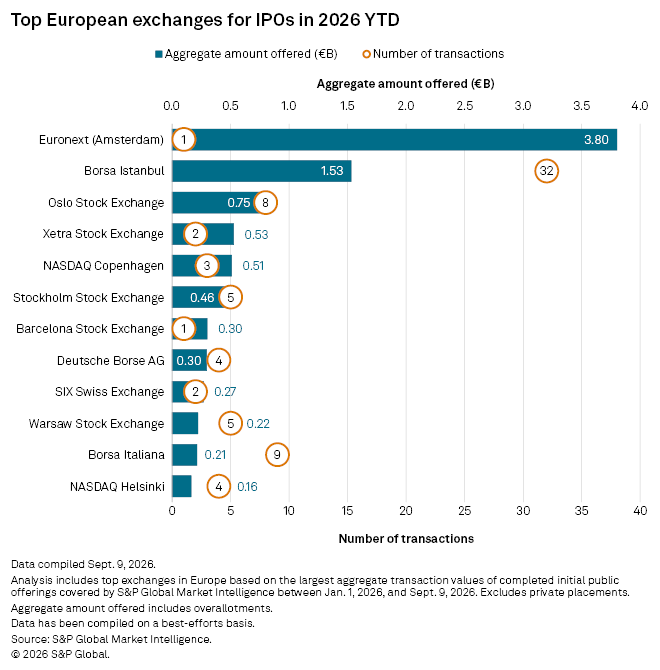
DNB Carnegie has also been the most active equity capital markets bank by transactions in Western Europe so far in 2026, according to a group earnings presentation.
Nordic listing venues are among the most active in Europe year to date, Market Intelligence data shows. The Oslo Stock Exchange, where DNB Bank's shares are primarily traded, has so far hosted eight IPOs. The Stockholm Stock Exchange, Nasdaq Helsinki and Nasdaq Copenhagen have hosted five, four and three listings, respectively.
"The Nordic region has historically had a healthy IPO culture, especially in Sweden, and an active M&A market … DNB Carnegie now has a genuinely strong market position, and activity levels are quite solid," Jusaitis said.
Large Nordic banks' first-half 2026 earnings also benefited from wealth and asset management. The lenders are continuing to expand in this space, with Denmark-based Danske Bank A/S and Jyske Bank A/S announcing acquisitions in wealth management in early September.
DNB Bank itself saw its AUM hit 1.782 trillion kroner as of June 30, up nearly 14% year over year and 11% quarter over quarter.
DNB Carnegie has combined banking, advisory, capital markets and wealth management in one platform, Opstad said, which "creates real opportunities to deepen relationships and grow business volumes in ways neither organization could do alone."
"[DNB Carnegie's] contribution is most visible in what we can now offer clients," Opstad said.
The fee engine
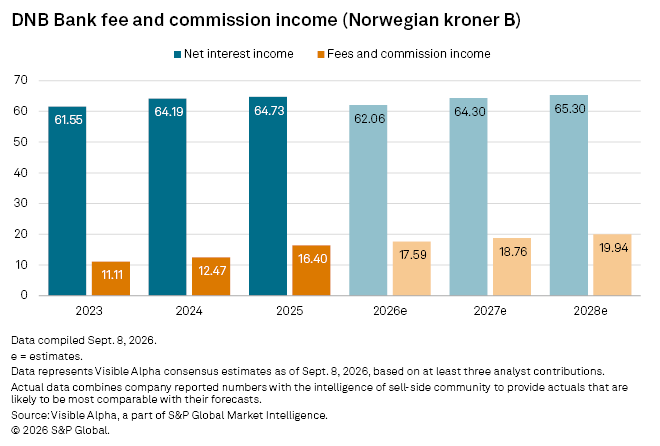
Elevated central bank policy rates starting in 2022 helped DNB Bank to grow net interest income (NII) — the difference between the interest earned on loans and the interest paid on deposits. As policy rates normalized, however, banks' NII also declined, prompting efforts to find means to insulate bottom lines. DNB Bank is also facing tough competition in its home market.
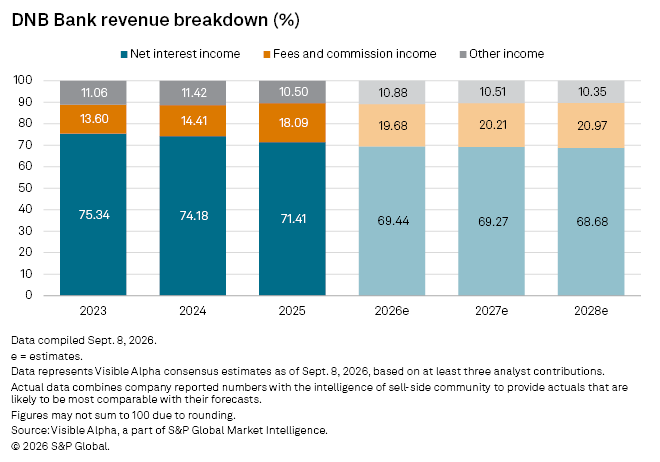
DNB Bank's NII grew each year from 2023 to 2025, but it is projected to decline 4% in 2026, according to the latest Visible Alpha consensus estimates. Fee and commission income, meanwhile, is projected to continue growing until at least 2028.
Bank of America analysts downgraded DNB Bank's shares to "underperform" on Sept. 10, noting that savings and challenger banks are exerting market-share pressure in both lending and deposits, eroding DNB's market-leading position in Norway.
Competitive pressures are particularly high in household lending and mortgages, CEO Kjerstin Braathen said during the company's latest earnings call, but DNB is differentiating its offering through advisory services, trade finance and commodity derivatives.
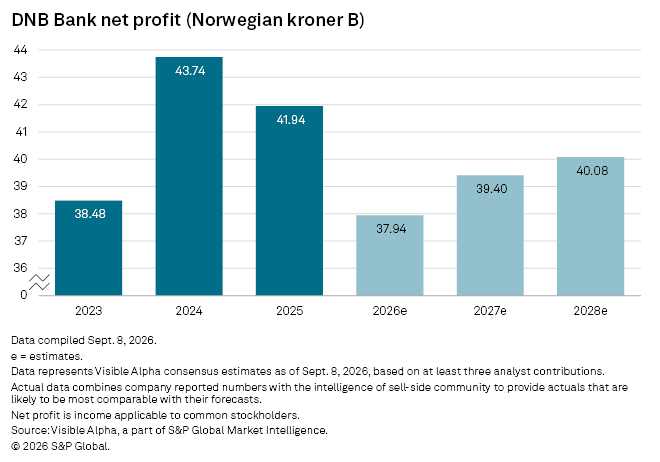
The bank's net profit hit 43.74 billion kroner in 2024 but declined to 41.94 billion in 2025. This is projected to further decline by nearly 10% to 37.94 billion kroner in 2026, Visible Alpha estimates indicate.
Acquiring Carnegie was a "smart move" to boost DNB Bank's investment banking and wealth management capabilities and diversify its revenue streams to increase the share of non-interest income, Jusaitis of Norne Securities said.
The contribution of NII to DNB Bank's total revenue has also fallen from 75.34% in 2023 to 71.41% in 2025. The decline is expected to continue over the next three years. At the same time, the share of fees and commissions has grown and is projected to be as much as a fifth of total revenue as early as 2027.
"We continue to see the fee engine delivering for DNB," Jefferies equity analyst Alexander Demetriou said in a note after the bank's second-quarter earnings presentation.
DNB Bank is scheduled to host a capital markets day in November. "You can expect us to address our future ambitions as well as [build] up to our strategic initiatives in order to deliver on those," Braathen said in July.
In the meantime, DNB Carnegie is "building capacity for the next phase of growth," Opstad said. "The strategy will reflect that."
|