06 Aug, 2026
US portfolio company bankruptcies, terminated PE transactions fall in H1 2026
Private equity-backed companies in the US filed for bankruptcy 24 times in the first half of the year, down from 36 filings in the same period in 2025, according to S&P Global Market Intelligence data.
The filings accounted for a smaller share of the broader US bankruptcy landscape, representing 6% of the 372 total filings in the first half of 2026, compared to 9.7% in the first half of 2025.
In June, private equity-backed companies filed for bankruptcy three times, compared to six filings in June 2025.
- Download a spreadsheet with data featured in this story.
- Read about trends in global private equity fundraising in the first half of 2026.
- Explore more private market headlines.

Massive maturity walls
Bankruptcy filings could soon increase due to "massive maturity walls" coming in 2028 and 2029, said Scott Greenberg, global chair of the global business restructuring and reorganization practice group at Gibson Dunn, a law firm.
"There's definitely been a downtick in the number of filings because the last couple of years, all of us have been kind of working gears ahead of maturity walls to try to push things out and see if there's a deleveraging transaction that works for both the sponsor and the lenders."
Recent liability management transactions helped avoid filings by extending 2024-2025 maturities into 2027-2028, deleveraging balance sheets and giving borrowers time, Greenberg said. However, those deals often failed to address the underlying operational problems that caused deterioration.
"If the balance sheet is better, but the company continues to deteriorate, then we just kind of delay the problem, but we didn't fix the problem," Greenberg said, adding that the occurrence of such situations is "unfortunately quite high."
Additionally, many prior restructurings locked down debt documents, leaving the borrower with less flexibility for another out-of-court exchange, Greenberg said.
Sector breakdown
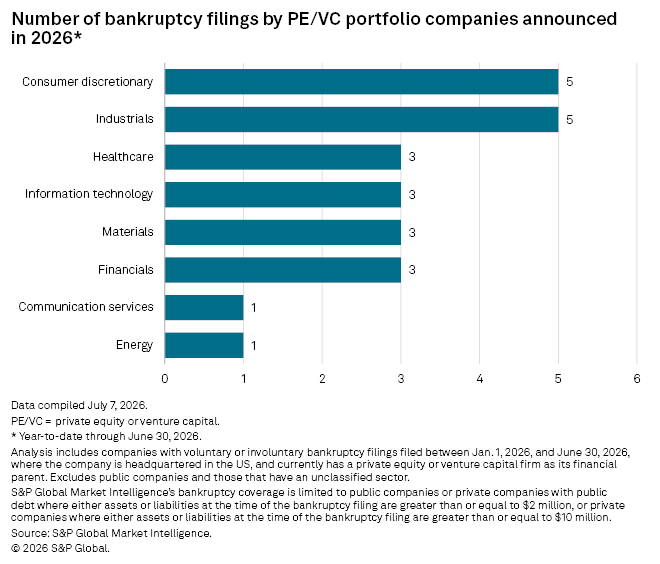
Among private equity portfolio companies, the highest number of filing announcements through June 30 came from the consumer discretionary and industrial sectors, with five filings each. The healthcare, IT, materials and financials sectors saw three filings each during the period.
The consumer discretionary sector is now under pressure as consumers face tighter budgets, pressured by higher gas and general household product costs, according to Steven Simms, global vice-chairman of corporate finance at FTI Consulting.
Simms noted that the filings are not concentrated in any particular industry, though he expects continued or potentially increased pressure in consumer-facing categories such as retail, restaurants, luxury goods and broader consumer products if high prices persist.
The industrial sector is not showing a large concentration of bankruptcies, but some companies face pressure from higher input costs, including chemical prices and tariff-related pressures, Simms added.
Sector-wise, software-as-a-service companies are the most vulnerable to distress now, according to Steve Hartt, managing principal, private equity at Meketa Investment Group Inc.
"AI disruption is impacting the ability of these firms to refinance their debts. There is concern that AI will impact revenue and margins down the line, which is leading to the refinancing weakness," Hartt wrote in an emailed commentary.
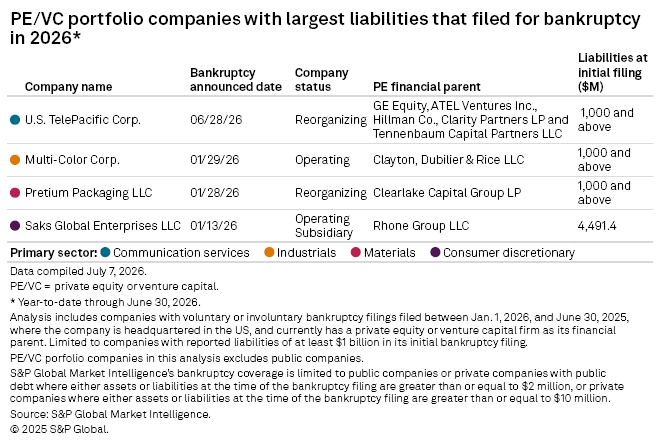
The companies that reported the largest liabilities were U.S. TelePacific Corp., a provider of managed IT services and technology solutions backed by GE Equity, ATEL Ventures Inc., The Hillman Co., Clarity Partners LP and Tennenbaum Capital Partners LLC; Multi-Color Corp., a packaging label manufacturer backed by Clayton Dubilier & Rice LLC; Pretium Packaging LLC, backed by Clearlake Capital Group LP; and Saks Global Enterprises LLC, a luxury retailer backed by Rhone Group LLC.
Saks Global announced its emergence from Chapter 11 under new ownership on June 26. Saks, which includes luxury retailers Neiman Marcus, Saks Fifth Avenue and Bergdorf Goodman, changed its name to Exemplar Luxury Group following the completion of its restructuring process.
Multi-Color Corp. has also emerged from its Chapter 11 process, with Clayton Dubilier & Rice remaining the company's majority owner.
Terminated transactions
The volume of terminated or withdrawn US private equity transactions fell year over year in the first half, alongside a significant decline in overall terminations, including non-private equity deals.
There were four terminated private equity deals in the first half of 2026, down 73% from 15 in the same period in 2025. Two transactions involved private equity firms as sellers, while the other two had private equity on both the seller and buyer sides. The deals targeted Seer Inc., Solana Co., Monument Peak Property and Rallybio Corp.
Overall, the first-half volume of terminated or withdrawn transactions also fell 73% year over year, to 19 from 71.