17 Aug, 2026
US health insurers raise outlooks despite Q2 cost rises, shifting membership
By Tyler Hammel and Unzilla Shaikh
Most leading US publicly traded managed care insurers raised their full-year earnings estimates following second-quarter results, despite increasing medical costs and membership attrition.
Many of the top publicly traded US managed care insurers' medical costs rose in the second quarter of 2026, following notable increases throughout 2025. While first-half cost figures improved compared to full year 2025, second-quarter results were more mixed, with most leading insurers reporting higher figures than in the prior-year quarter.
Medical loss ratios shift
Rising medical costs have been an ongoing issue for insurers, particularly among Medicaid insurers, since states resumed the post-COVID-19 redetermination process, removing some healthier, less costly individuals from the government-subsidized plans.
Four of the largest publicly traded US managed care insurers saw their medical loss ratios worsen during the second quarter, with only UnitedHealth Group Inc. and Centene Corp. posting improved figures. Of the six, only Humana Inc. and Molina Healthcare, Inc. logged loss ratios exceeding 90% in the second quarter of 2026, with Molina Healthcare, Inc. posting the largest ratio of 92.2%.
Ratios for the first half of 2026 remain at or below full-year 2025 figures, however.
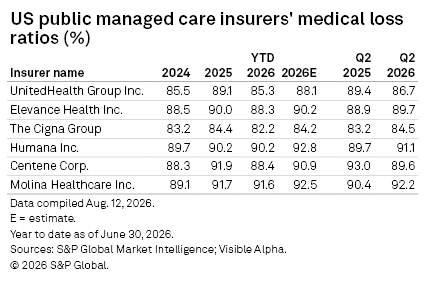
Much of Molina's cost ratio was exacerbated by Medicaid costs, CEO Joseph Zubretsky said during a July 23 earnings call, although he said the ratio remained in line with expectations.
"The imbalance between Medicaid rates and medical cost trend appears to have stabilized and is well positioned to be corrected with future rate increases," Zubretsky said. "This reinforces our belief that 2026 is the trough year for Medicaid pretax margins."
Medicare and Marketplace plans fared slightly better for Molina, with medical cost ratios of 90.7% and 88.9%, respectively, according to the CEO.
Regulatory scores
Kentucky-based Humana has faced a tumultuous couple of years, as its senior-focused Medicare plans were adversely affected by lower scores from the Centers for Medicare & Medicaid Services (CMS). The government body annually issues quality star ratings for Medicare Advantage plans, which affect the bonus payments insurers receive from the US government.
Humana CEO Jim Rechtin said the company is performing as expected in 2026 as it seeks to increase the percentage of members in Medicare Advantage plans that are rated four stars or higher. The insurer's membership growth is expected to fuel further earnings potential, Rechtin said during a July 29 earnings call, adding that Humana is making progress on improving its star margins ahead of upcoming bonus years, during which CMS calculates scores and bonus payments.
"As we look ahead to [2027], our No. 1 priority in [Medicare Advantage] bids was to make the necessary margin progression to remain on track to deliver our [2028] commitment of returning to a sustainable margin of at least 3%," Rechtin said. "We must drive sustainable earnings and appropriate returns to be able to provide excellent health outcomes and service for our members and our patients."
UnitedHealth saw its medical loss ratio improve during the second quarter. CEO Stephen Hemsley credited the improvement of its health insurance arm, UnitedHealthcare, to cost moderations in some lines. While the insurer's Medicare and Medicaid businesses are "in line with expectations," Hemsley said the commercial business remains pressured.
"Our commercial benefits business, consistent with the broader and more diverse commercial market it serves, continues to experience higher-than-expected cost trends," Hemsley said.
Through the first half of the year, UnitedHealthcare has seen a divergence within its portfolio, said UnitedHealthcare CEO Tim Noel. Medical cost trends in Medicare are still running well above historical levels but below the company's expectations so far in 2026, Noel said. In Medicaid, overall performance during the quarter, including cost trend, was broadly in line with expectations, he said.
Humana and Molina were the sole leading publicly traded managed care insurers not to raise earnings estimates following the release of second-quarter results.
Membership shifts
In an ongoing trend, many leading managed care insurers saw shifts in membership, notably in the senior-focused, government-subsidized Medicare Advantage plans. Most leading companies have seen membership levels decline since the start of the year.
Centene was among the insurers that experienced a decline in membership, which CEO Sarah London attributed to several factors during an earnings call.
"While some of this was driven by state-specific program changes, we also saw an uptick in activity around enrollment and eligibility in certain states," London said.
Traditional Medicaid membership fell to 12.11 million, down from 12.82 million in the prior-year period, while Marketplace membership fell to 3.49 million, down from 5.86 million, according to a Centene earnings release.
Despite these declines, rate increases in Marketplace and in the Medicaid businesses "remain a critical lever and continue to develop positively," London said.
Costs among the senior-aimed Medicare Advantage plans remain elevated when compared to historical averages, London said, but the year-to-date trend is running modestly favorable to expectations, and Centene plans to further simplify its Medicare Advantage footprint.
Elevance Health Inc., which has seen a notable drop in Medicare Advantage membership since the third quarter of 2025, raised its full-year earnings projections. The updated projections reflect "stronger-than-expected rate updates, membership and acuity that remain broadly aligned with our assumptions and targeted actions against known areas of elevated trends," CEO Gail Boudreaux said during an earnings call.
Medicare Advantage is not the only area where Elevance is seeing membership shifts, according to Boudreaux's comments. The company's Affordable Care Act (ACA) business performance is "developing broadly consistent with how we priced and planned the year," the CEO said during the call. Prior to earnings season, analysts pointed to a growing trend of ACA members either disenrolling or switching to lower-quality Bronze plans, a trend that Boudreaux acknowledged Elevance is also facing.
"As expected, the higher mix of Bronze plans creates more seasonality, and we are not extrapolating early year favorability as we prepare for 2027," Boudreaux said.
As managed care insurers head toward the end of the year, when open enrollment season begins, it remains to be seen whether membership declines and shifts among subsidized plans will continue.