21 Aug, 2026
Nordic lenders bank on fee income to prop up earnings
By Adrian Jimenea and Cheska Lozano
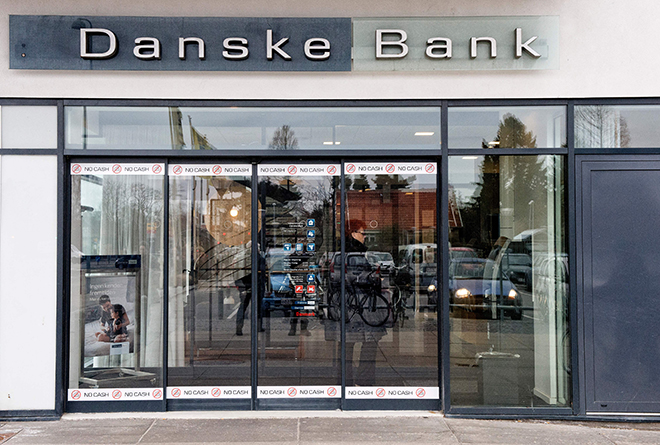
| Danske Bank reported the largest year-over-year rise in second-quarter fee income among |
Nordic banks are leaning on strong fee income to support their earnings amid a lower interest rate environment.
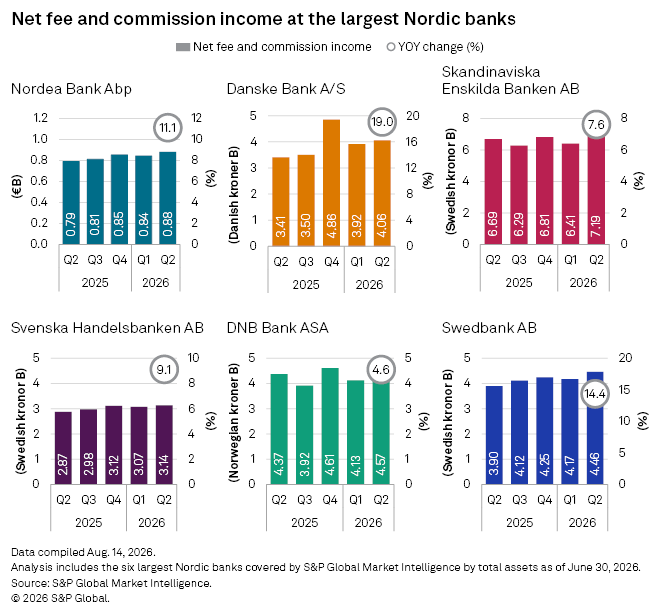
The region's six largest banks — Nordea Bank Abp, Danske Bank A/S, Skandinaviska Enskilda Banken AB (publ), Svenska Handelsbanken AB (publ), DNB Bank ASA and Swedbank AB (publ) — posted an average 10.9% year-over-year growth in their second-quarter net fee and commission income, according to S&P Global Market Intelligence data. This reflects a longer running trend of fee growth outstripping that of net interest income (NII).
Banks have sought to increase fee income to underpin their profitability as a normalizing interest-rate environment has hampered lending income. Fees and commissions have become a "quality growth line option," according to Prashant Gupta, manager at insights and analytics solutions company Evalueserve.
"We view revenue diversification as positive, as a broader mix of businesses generally helps smoothen revenue volatility over the cycle," Salla von Steinaecker, director and lead analyst for Nordic and Baltic financial services at S&P Global Ratings, said in emailed comments.
Buoyant capital markets in the region, along with a general appreciation of assets and net new investment flows, helped support fee income growth in the second quarter.
Stronger industrial activity, financed by significant defense and green investments, also translated into growth in corporate lending and, in turn, meant more payments, said Manish Vishwakarma, associate director at Evalueserve.
"If the business grows, a lot of tertiary activities also grow in line with that," Vishwakarma said in an interview with Market Intelligence.
Copenhagen-based Danske Bank reported the best fee income growth at 19%. The bank benefited from increased customer activity, particularly in capital markets, as well as growth in assets under management (AUM) and higher asset prices, according to CFO Cecile Hillary.
Asset growth
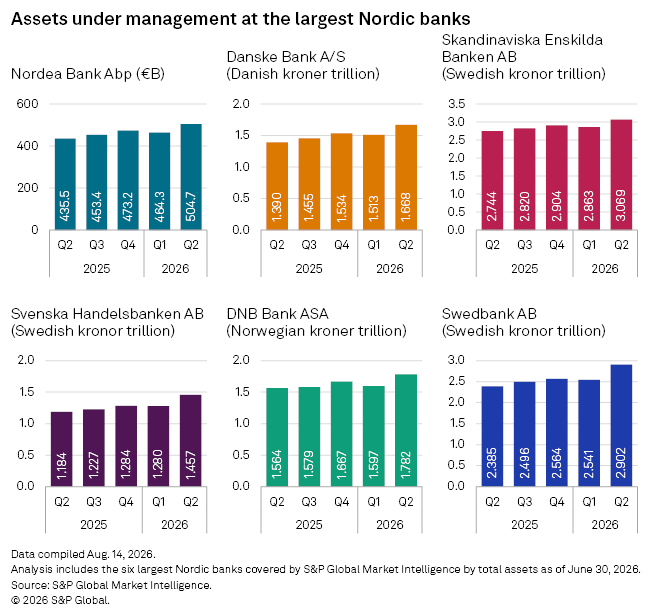
All six banks posted annual and quarterly increases in AUM as of June 30, most of which were in double-digits, according to Market Intelligence data.
Finland-based Nordea Bank said AUM rose 15.9% year over year to a record €504.70 billion at the end of June, helping fee income jump 11.1% in the quarter. The bank said it facilitated several high-profile equity capital markets issuances.
Swedbank's AUM rose 14.2% in the second quarter, the largest quarterly increase in the sample. The bank said asset management commissions grew due to strong stock market performance, positive foreign-currency effects and high net inflows, CEO Jon Lidefelt said.
AUM at Nordic banks are expected to grow 6% to 8% annually over the long term, providing banks with plenty of fee-income opportunities, according to Morten Sørensen, partner and head of financial services in the Nordics at advisory firm Simon-Kucher. Banks are also actively linking products across divisions to maximize revenue.
"When we look under the hood of the banks and their clients, we see a lot of potential also within their existing portfolios to drive further growth from cross-selling, upselling and enhancing the value proposition," Sørensen said in an interview.
Norway-based DNB Bank said cross-selling income at its large corporate division rose in the second quarter, insulating the division's return on equity from lower average margins. Nordea also said an increase in lending volumes enabled cross-selling opportunities.
Nordic capital markets also provide further opportunities for banks, with the bourses in Oslo, Copenhagen and Stockholm being among the most active IPO venues in Europe in the first half of 2026.
The overall sentiment in the equity capital markets (ECM) has improved, Nordea Bank CEO Frank Vang-Jensen said during an earnings call. The bank had a "decent second quarter" in ECM and measures to improve the investment banking business are "helping to deliver improvements," CFO Ian Smith said on the same call.
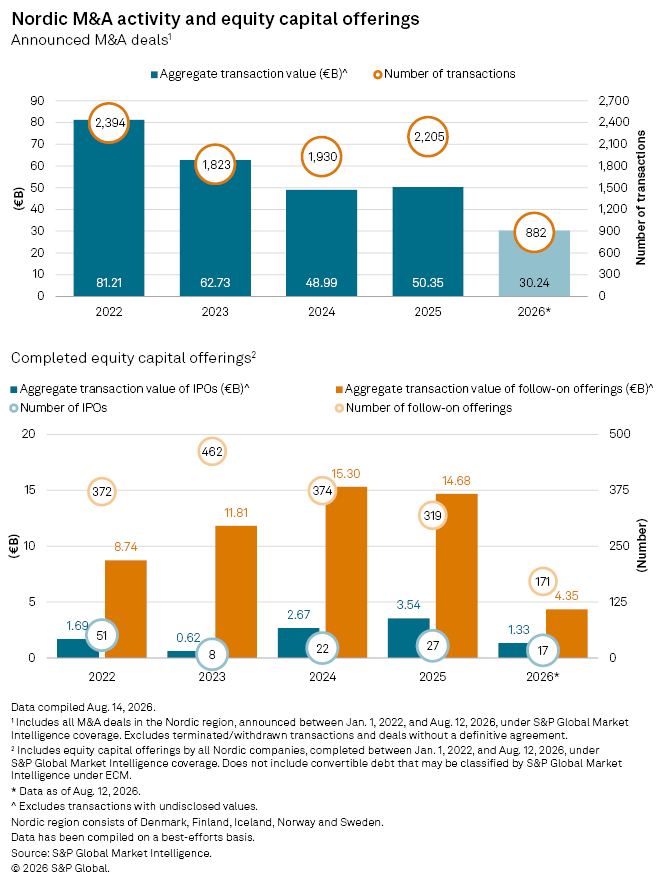
Still, experts cautioned that the fee performance might be too transaction-driven, suggesting that banks may need to increase structural and recurring fees.
"What we also see and work a lot with is shifting more transactional revenue into more recurring revenue. That's also a key theme because it's not only the level of fee income, it's also the robustness of that fee income," Simon-Kucher's Sørensen said.
Corporate activity in the second quarter was "largely episodic," Citi Research analysts said in a note, although some of the banks reported genuine market share gains, like Danske Bank.
Bank executives have also expressed interest in bolt-on acquisitions, which could further support fee income. Nordea already has its sights on targets, but those are not for sale at the moment, CEO Vang-Jensen said. Danske Bank CEO Carsten Egeriis has said Sweden was an "interesting market" for inorganic opportunities.
DNB Bank acquired Sweden-based Carnegie in 2024 and the business has contributed positively to the group's fee income from both asset management and investment banking businesses, Ratings' von Steinaecker said.
– Access Visible Alpha estimates for Danske Bank. (May require additional subscription.)
– Learn about Visible Alpha.
– Sign up for Earnings IQ alerts to get results as soon as they're released.