24 Aug, 2026
NAIC summer 2026: Colorado commissioner urges action toward an AI model law

By Hailey Ross
|
Colorado Insurance Commissioner Michael Conway Source: Colorado Division of Insurance |
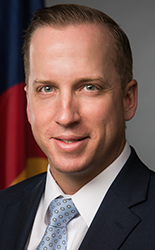
Pursuing an AI model law within the National Association of Insurance Commissioners is an important step to ensure the power of the state-based regulatory system is preserved, according to Colorado Insurance Commissioner Michael Conway.
"I fundamentally think that when other regulatory bodies, whether at the state or federal level, try to regulate the business of insurance, they don't do a good job," Conway said in an interview with S&P Global Market Intelligence on the sidelines of the NAIC's recent summer meeting in Columbus, Ohio. "That's why I think it's so important for us to make sure that we are continuing to move that conversation forward."
An NAIC model law is a regulation adopted by the organization intended to provide uniformity to how an issue is approached across the country. States' adoption of insurance model laws and regulations is largely what creates a harmonized legal framework for insurance regulation in the US.
Conway's beliefs on the issue stem from an experience he had in Colorado. When the state passed a comprehensive piece of legislation this year, giving the attorney general broad authority over AI use in Colorado, the insurance sector was carved out since the industry's use of AI was already being regulated by the insurance commissioner, as established in a 2021 bill passed by the state senate.
Conway said that the industry had initially pushed back against the bill passed in 2021, but was later "exceptionally happy" that the law was in place when the state attorney general pursued broad authority to regulate AI.
"It meant they got to stay with the regulatory body that they understood and knew, and they weren't going to have some other secondary one that was coming after them," Conway said.
Therefore, if state regulators do not step in with model regulation, "somebody else will fill that void," Conway said.
Conway is one of the more vocal regulators on the need for model AI regulation, but he said other regulators feel the same way.
"There is a broad understanding that we need to move in the space," Conway said. "Half of the states [have] now adopted the AI bulletin; I think if there wasn't a broad understanding and agreement ... that we need to be in this space, that wouldn't be the case."
While the NAIC has not enacted an AI model law, the organization has acted in other ways. The NAIC passed a Model Bulletin on the Use of Artificial Intelligence Systems by Insurers in fall 2023, which has since been adopted by at least half of the US states.
The NAIC is also piloting its AI Risk Evaluation Supplement, which was formerly known as the AI Systems Evaluation Tool. The supplement is being used by 12 states in a pilot program in support of things such as market conduct exams, financial exams and financial analyses, in addition to general regulatory inquiry. The pilot program is scheduled to run through September.