13 Aug, 2026
Lloyds seen well positioned to beat new medium-term return, revenue targets

|
Lloyds set new medium-term targets with the release of its second-quarter results on July 30. |

Analysts view Lloyds Banking Group PLC as well placed to exceed the return on tangible equity and revenue growth targets set under its new medium-term strategy.
The UK's third-largest bank unveiled the strategy in its July 30 second-quarter results, saying it targets a mid-single-digit compound annual growth rate (CAGR) in revenue over the next four years, raising its return on tangible equity (ROTE) to about 20% by 2030.
These targets "may prove conservative" given that consensus estimates for ROTE are already above Lloyds' goal, Matt Britzman, senior equity analyst at Hargreaves Lansdown, wrote in a July 30 note. Lloyds' higher non-interest income and cautious interest income assumptions also "offer clear routes to upside" in revenue, according to the analyst.
"That fits its track record of setting conservative targets before raising expectations as delivery improves," Britzman wrote.
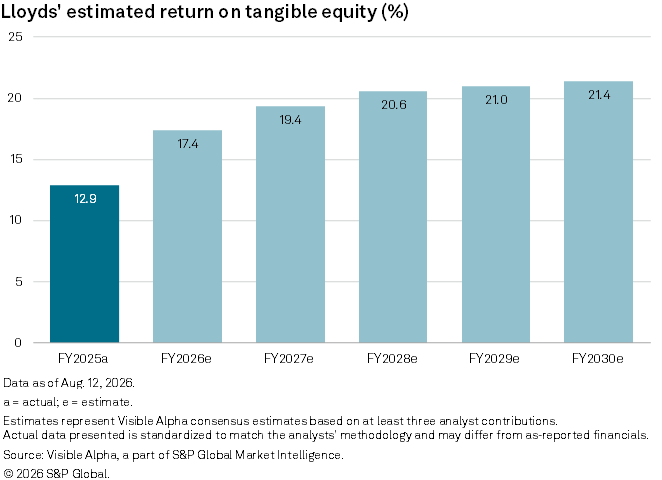
Lloyds expects its ROTE to stand at over 16% in 2026, rise to above 18% in 2028 and finally reach about 20% in 2030. Current consensus estimates are already above all three targets, implying ROTE of over 17% for 2026, more than 19% for 2028 and exceeding 21% for 2030, Visible Alpha data shows.
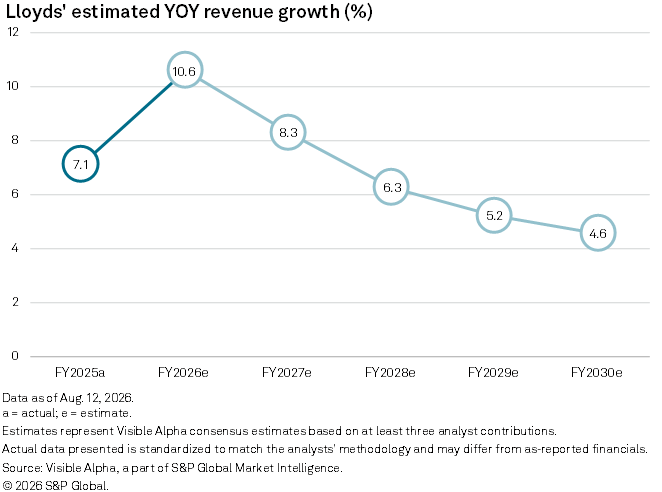
Consensus is also ahead of the bank's target for a mid-single-digit percent, or 4%-6%, revenue CAGR for the period 2027 to 2030, as the annual growth rates forecast by analysts for the four years imply a CAGR of slightly above 6%, the data shows.
While Lloyds' ROTE targets are below current consensus, the revenue guidance "appears particularly conservative" given a potential boost to net interest income (NII) coming from Lloyds' structural hedge income, John Cronin, founder of financial sector research firm SeaPoint Insights, wrote in an Aug. 10 note.
Revenue dynamics
Lloyds has made more prudent assumptions on NII when setting the mid-term revenue growth target, including modeling a lower refinancing rate on the structural hedge than the market, CFO William Chalmers said during the group's second-quarter earnings call. Lloyds considered mainly factors outside of its control, including the shape of the yield curve and market competition, CEO Charlie Nunn said during the call.
The curve, reflecting market expectations for the future path of interest rates, and competitive pressure could impact asset and deposit pricing and influence NII, according to the executives.
Lloyds aims to navigate any curve shifts and competitive pressure effectively over the next four years, Nunn said. The group has not provided specific NII guidance for the period 2027 to 2030, but there is room for "very healthy NII growth," Chalmers noted. Lloyds targets high-single-digit growth in non-interest income over the next four years, the CFO said.
Hargreaves Lansdown analysts are "increasingly positive on" non-interest income with Lloyds' insurance, wealth, workplace car schemes and property-related businesses expected to "grow faster than the wider group", Britzman wrote.
"Much of this relies on existing momentum and selling more products to current customers, not unproven ventures. That makes the ambition credible and reduces reliance on lending income," Britzman wrote.
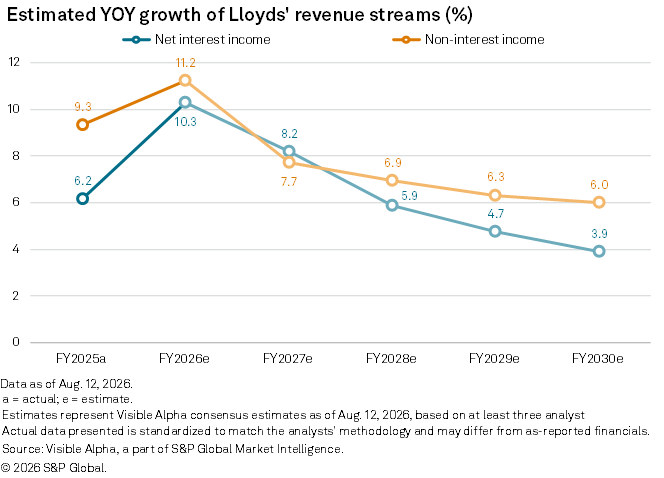
Current consensus estimates put Lloyds' NII growth rates at roughly 8% in 2027 and 6% in 2028, slowing to about 5% in 2029 and roughly 4% in 2030. Non-interest income is set to grow at roughly 7% on average in the next four years, Visible Alpha data shows.
Cost management
As part of the new strategy, Lloyds also targets further efficiency gains, aiming to achieve £2 billion in gross cost savings over the period 2027 to 2030. The group wants to reduce its cost-to-income ratio to below 45% in 2030 from a targeted ratio of below 50% in 2026.
Lloyds' gross cost savings largely continue the group's existing efforts to simplify and automate processes, partly through AI, Berenberg analysts wrote in a July 31 note. The savings are aimed to "largely neutralize the impact of investments and the natural inflation of the cost base," they said. The analysts expect these efforts to lead to a gradual improvement of the cost-to-income ratio toward Lloyds' targets.
There appears to be an ambition to "potentially significantly" outperform the targeted cost savings, too, Cronin said in his note.
Any outperformance in cost targets would most likely be driven by technology-led optimizations, CFO Chalmers said during Lloyds' earnings call.
"We have been demanding in terms of our cost ambitions. But let's see whether we are able to do better than," Chalmers said.
According to analyst consensus estimates compiled by Lloyds before its second-quarter earnings release, the group's cost-to-income ratio is forecast to stand at 50% in 2026 and about 44% in 2030.
Low execution risk
Lloyds' medium-term targets are "ambitious but credible" as "most of the key levers supporting the group's financial and operational objectives are closely aligned with existing capabilities, scale and market positions," Scope Ratings credit analyst Álvaro Domínguez Alcalde said in an Aug. 7 report. This is "a prudent approach that should help contain execution risk", he said.
Lloyds has a good track record of meeting strategic commitments, "which also supports confidence in management ability to execute," Domínguez said.
The group's new strategy builds on the business growth and financial performance achieved over the last five years and would not alter Lloyds' risk profile materially, S&P Global Ratings analysts said in a July 31 bulletin.
The continued focus on non-interest income expansion should improve Lloyds' earnings resilience over time by reducing reliance on NII, the Ratings analysts said. Increased technology investments, which are a key pillar of Lloyds' strategy, are consistent with similar initiatives underway across the sector and "should help the group maintain its competitive position in an increasingly digital European banking market," the Ratings analysts said.
Visible Alpha is a part of S&P Global Market Intelligence. This report may contain references to a bulletin by S&P Global Ratings. Descriptions in this report were not prepared by S&P Global Ratings.