13 Aug, 2026
Greek banks target fee income, regional growth with wave of M&A deals
Greek banks have stepped up M&A activity to focus on geographic and revenue diversification, with the aim of making their business models more robust and less reliant on traditional lending.
The structural improvements in the Greek banking system over the past several years, including clean balance sheets, strong capital buffers and restored profitability, have materially expanded banks' capacity to pursue M&A, both domestically and abroad, translating to increased M&A activity, according to the country's central bank.
"Recent cross-border transactions illustrate a clear shift toward a more outward-looking, regionally integrated business model," the Bank of Greece told S&P Global Market Intelligence.
The continued expansion of Greek banking groups' international presence contributes to "greater geographical diversification of revenue and exposures, reducing concentration in the domestic market and supporting resilience over the medium term," the central bank said.
Greek banks have increasingly targeted Cyprus for M&A activity in recent years. Recent examples include Eurobank SA's acquisition of Cyprus-based Hellenic Bank in 2025 and Alpha Bank SA's purchase of Cyprus-based AstroBank PCL. Outside Cyprus, CrediaBank SA agreed to acquire HSBC Bank Malta PLC in September 2025.
"Taken together, these deals are evidence that Greek banks are actively diversifying revenue sources and geographic presence beyond traditional domestic lending," the central bank said.
Focus on fees
The M&A-driven diversification trend also expanded into adjacent sectors, including insurance, asset management and investment banking. Alpha Bank recently acquired Alpha Trust Holdings SA, Altius Insurance Ltd. and Axia Ventures Group Ltd., while Eurobank is finalizing the acquisition of Eurolife FFH Insurance Group Holdings SA's life insurance operations. Piraeus Bank SA also joined this trend by purchasing The Ethniki Hellenic General Insurance Co. SA.
The transactions demonstrate growing cross-sector convergence between banking and insurance, as the banks look to build integrated financial service groups, the Greek central bank noted.
Converting excess capital into capital-light, non-rate-sensitive fee income provides banks with a direct hedge against rate normalization while also improving earnings quality and valuation multiples, Agapi Mavrogianni, equity analyst at Beta Securities, an Athens-based brokerage, research and asset management firm, told Market Intelligence.
Alpha Bank's "proactive M&A strategy" was already supporting fee growth, with headline fees up 34% year over year or 24% on an underlying basis, CEO Vassilios Psaltis told analysts July 31.
In May, National Bank of Greece SA (NBG) said it intends to acquire a 30% stake in Allianz Greece and enter a bancassurance partnership with Allianz SE to boost insurance-related fee income. The following month, NBG signed a preliminary agreement with Dromeus Capital Group for a long-term strategic partnership in commercial real estate, including the roughly €400 million acquisition of a commercial real estate portfolio.
The Allianz deal is part of NBG's broader effort to scale up fee-based income, while the Dromeus agreement broadens recurring income opportunities, further enhancing the resilience and diversification of NBG's earnings profile, according to CFO Christos Christodoulou. "Both transactions create substantial value, delivering a significant uplift to both our earnings per share and return on tangible equity and exemplify the type of strategic transactions we seek to pursue," Christodoulou said July 30.
While net interest income remains the primary revenue driver, net fee and commission income is making up an increasingly larger share of total revenue at Greece's four systemic banks. Piraeus Bank will have the highest fee contributions to total income among the group over the next few years, according to Visible Alpha consensus estimates.
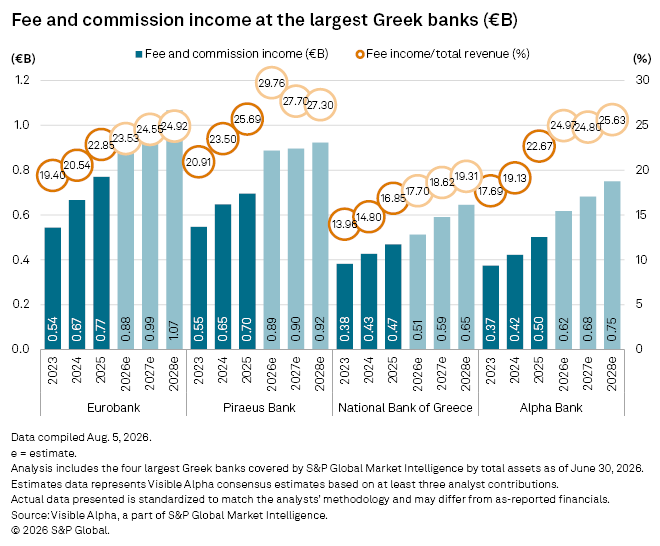
Given the already high concentration of the domestic banking market, future M&A will remain focused on revenue diversification, fee-generating businesses and selective international expansion, Andrea Costanzo, vice president for financial institutions at credit rating agency Morningstar DBRS, told Market Intelligence.
The M&A trend should continue mainly through smaller, bolt-on deals that do not risk the distribution capacity, while the era of large, transformative transactions is likely over for now, Beta Securities' Mavrogianni said.
Integrating insurance, unlocking capital
Revenue diversification through recent acquisitions is a positive development for Greek banks, provided integration and execution are well managed and associated capital deployment does not erode buffers, S&P Global Ratings said in a recent commentary.
After the recent deals, the next few years through 2028 will be pivotal for Greek banks' insurance integration strategies as regulators provide greater clarity on the Financial Conglomerate status and implement CRR3 rules, Mavrogianni said. This refers to the third revision of the EU Capital Requirements Regulation, which updates how banks must calculate and hold regulatory capital.
The Danish Compromise could unlock meaningful capital efficiency, helping Greek banks align more closely with European peers in profitability and valuation, and potentially reducing common equity Tier 1 requirements by about 50 basis points on the insurance deals of Piraeus and Eurobank, Mavrogianni said.
The Financial Conglomerate status is a formal EU classification that determines how banking groups with insurance operations are supervised and how their capital requirements are set. The Danish Compromise, now codified in CRR3, allows banks to apply a risk weight to their insurance holdings instead of a full capital deduction, making insurance integration more capital-efficient.
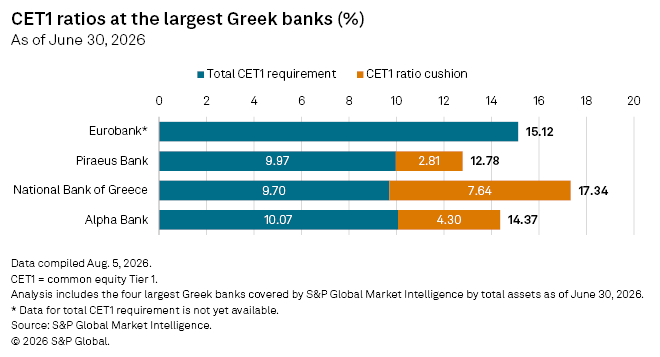
As of June-end, Piraeus Bank had the lowest CET1 capital ratio among Greece's systemic banks, at 12.78%.
Piraeus CFO Theodoros Gnardellis said July 29 that surplus capital held above the target solvency ratio at the recently-acquired Ethniki Insurance could be upstreamed to the parent bank, potentially boosting the group's CET1 ratio by 10 basis points.
Foreign interest
Among the smaller European banking markets, Greece remains the only one without an international bank operating through a local subsidiary, a legacy of the Greek sovereign crisis, Alessandro Boratti, associate director and lead analyst for Greek banks at Scope Ratings, told Market Intelligence.
UniCredit SpA's recent investment in Alpha Bank suggests renewed foreign interest in the sector and could pave the way for further transactions, according to Boratti.
With UniCredit focused on Commerzbank AG and potential opportunities in Italy, Deutsche Bank analysts do not expect a quick move on Alpha Bank, although they do see the takeover as inevitable. "We believe this deal is not a matter of 'if' but 'when,' which could be a matter of quarters or a few years, in our view," the analysts said in a June 5 note.
Deutsche Bank analysts also view Piraeus Bank and Eurobank as appealing acquisition targets. Piraeus stands out as a straightforward, Greece-focused option with a lower market capitalization, making potential integration easier. Eurobank, on the other hand, offers access to markets beyond Greece, such as Bulgaria and Cyprus, which could attract buyers seeking regional diversification, according to the analysts.
NBG is the least likely M&A target, given its size, higher valuation and 8.4% state ownership, according to Deutsche Bank analysts. Although selling the state's stake could open the door to foreign buyers, the analysts believe that this appears unlikely for now, as the Greek government is in no rush to proceed.
Visible Alpha is a part of S&P Global Market Intelligence.